

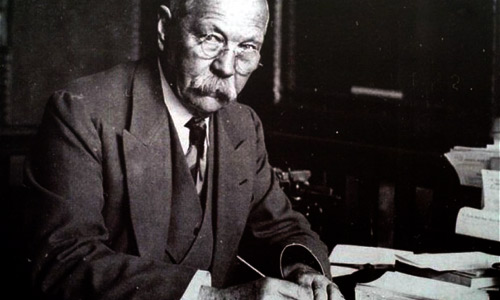
When in 1882 the young Arthur Conan Doyle took up residence above his new practice at No.1 Bush Villas, Elm Grove, Southsea, it is said he was astonished to find piled in his basement stacks of human jaws grinning at him – the jawbones of numerous people who had visited that building in the preceding years.
It is a detail from his life worthy of an episode of his great detective, Sherlock Holmes, whom he was to create during his extraordinarily fruitful stay in Southsea between 1882 and 1890.
From the very beginning, elements of the Gothic filled Conan Doyle’s stories, revealing an imagination and a thought process fascinated by the unknown and apparently inexplicable.
Long before he strode on to the world’s stage to evangelise Spiritualism his tales already included moments of spiritual contact. In the spine-tingling conclusion to his 1890 short story The Captain of the Polestar, the narrator observed near the body of the eponymous Captain an inexplicable vision in the vast Arctic wastes.
He was lying face downwards upon a frozen bank. Many little crystals of ice and feathers of snow had drifted on to him as he lay, and sparkled upon his dark seaman’s jacket.
As we came up, some wandering puff of wind caught these tiny flakes in its vortex, and they whirled up into the air, partially descended again, and then, caught once more in the current, sped rapidly away in the direction of the sea.
To my eyes it seemed but a snow-drift, but many of my companions averred that it started up in the shape of a woman, stooped over the corpse and kissed it, and then hurried away across the floe. I have learned never to ridicule any man’s opinion, however strange it may seem.
It is a moment straight from the Romantic tradition. The Arctic setting echoes the denouement of Mary Shelley’s Frankenstein – another writer who skilfully combined elements of science and spirit to ask philosophical questions and create a supernatural thrill.
Conan Doyle and supernatural fiction
Other early works also show his love of the unexplained and the occult. His horror novel The Mystery of Cloomber employs reincarnation, karma and astral projection in a tale of vengeance involving a cursed army general.
Conan Doyle’s love of the apparently inexplicable also suffused the stories starring his greatest creation, Sherlock Holmes.
From the apparently supernatural menace of The Hound of the Baskervilles to the macabre murder in The Sign of Four and the violence of Abbey Grange, there is often a gory and otherworldly aspect over which Holmes eventually casts the cold light of reason.
Sherlock Holmes and the supernatural
Reading the Holmes stories in isolation, one might not guess the driving force in Doyle’s nature – an imagination that revelled in mystery of any kind, whether its origin was material or spiritual.
Just so with the short story Lot No 249, published in 1892, the same year The Adventures of Sherlock Holmes began to appear in The Strand. It tells the ghoulish tale of Edward Bellingham, an Oxford student with an unhealthy interest in necromancy, who shares a Gothic turret with two other students and an ancient Egyptian mummy which Bellingham bought at auction.
After reanimating the long-dead mummy, Bellingham uses it to remove one of his room-mates as a rival in love. Finally, he is forced at gunpoint by his other room-mate to destroy it. Doyle describes the moment with wonderful ghastly detail:
“In frantic haste he caught up the knife and hacked at the figure of the mummy, ever glancing round to see the eye and the weapon of his terrible visitor bent upon him. The creature crackled and snapped under every stab of the keen blade.
A thick yellow dust rose up from it. Spices and dried essences rained down upon the floor.
Suddenly, with a rending crack, its backbone snapped asunder, and it fell, in a brown heap of sprawling limbs, upon the floor.”
Doyle was a master of horror as well as the detective fiction he is renowned for. Both genres reflected two of the main currents in Victorian culture: the huge advances being made in science and the tumult in which religion found itself post-Darwin.
It is this rich mixture that was to have such a profound influence on Doyle’s thinking and his writing – and which contributed so dramatically to his personal belief in spirits.
It is this belief that I explore further in Conan Doyle and the Mysterious World of Light.
