

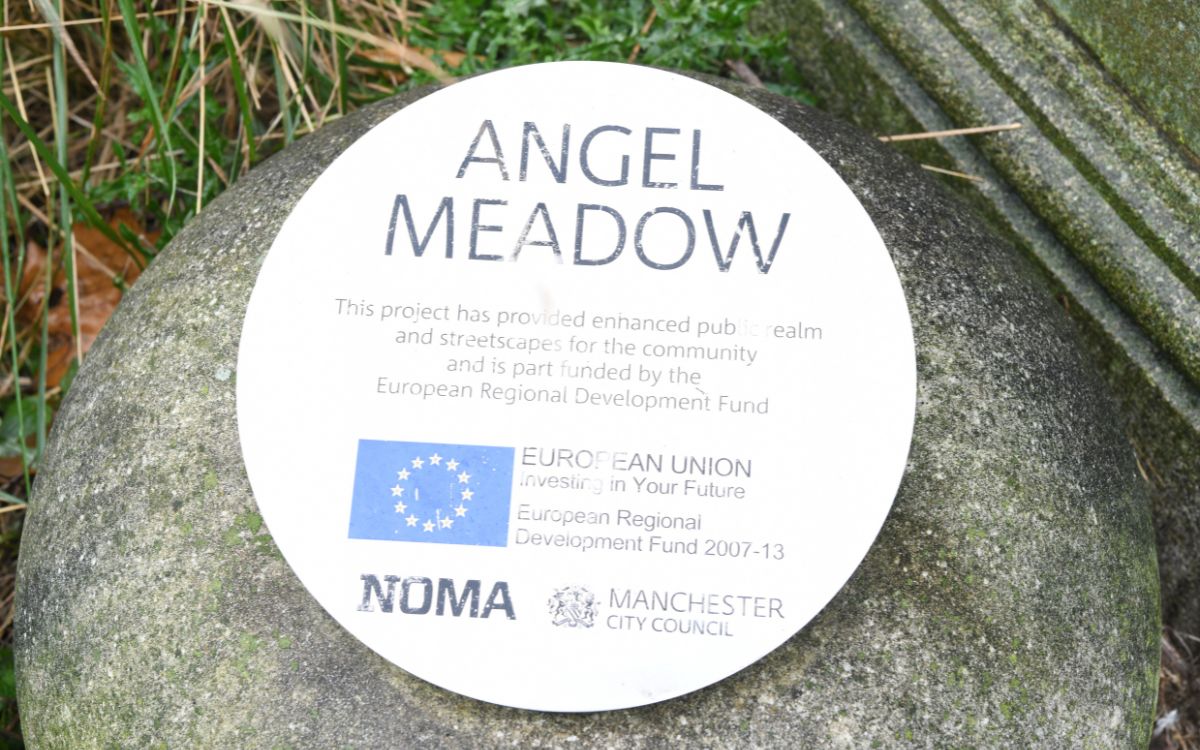
Angel Meadow, now part of Manchester’s gentrified Green Quarter, was once one of the city’s most feared and infamous slums — a place where poverty, disease, and death lingered in the air.
From its misleadingly peaceful name to its chilling present-day discoveries, Angel Meadow’s history is a haunting tale of decay, deprivation and resilience.
A Rural Beginning and Rapid Decline
In the 1700s, Angel Meadow was a pleasant, pastoral area on the outskirts of Manchester. Dotted with fields and hedges, it became a desirable location for the city’s wealthy elite.
Luxury homes were built, and the land was initially used for grazing.
However, the Industrial Revolution changed everything.
Factories and cotton mills quickly dominated the landscape. Overcrowded slums replaced elegant homes, and industrial smoke choked the air. Substandard housing filled the area as Manchester’s population exploded.
By the early 1800s, Angel Meadow was no longer a rural retreat but a cauldron of poverty and pollution.
Life in Angel Meadow: Disease and Despair
By the mid-19th century, the slum was home to as many as 30,000 residents, crammed into filthy courts, cellars, and alleys. Many lived in single-room lodgings, with up to 30 people sharing one dwelling.
Sanitation was almost non-existent. Human and animal waste littered the streets. Cellars served as homes, and foul-smelling gas seeped up through grids in the roads, contributing to respiratory illnesses.
In 1832, cholera arrived in Manchester. It had already swept through Glasgow, London, and Belfast, brought to England by sailors docking in Sunderland. The disease quickly found fertile ground in Angel Meadow’s cesspools and overcrowded tenements.
Friedrich Engels, the German philosopher and industrialist’s son, was appalled by what he saw when he arrived in Manchester in the 1840s. He famously described the city as one that “changed water into stinking slops” and dubbed Angel Meadow “Hell upon Earth”.
Diseases such as cholera, typhus, tuberculosis, scrofula and bronchitis ravaged the population. One fever outbreak alone saw over 900 recorded cases in a single year.
A particularly grim area was the Old Burying Ground next to Saint Michael’s Church, which had been closed to new burials in 1816. Despite this, the site was used to dispose of ashes, offal and even animal corpses.
Children reportedly played football with human skulls that surfaced from the shallow graves. Headstones were repurposed as building materials. Bodies lay just inches beneath the soil.

The Role of the Irish in Angel Meadow’s History
Following the Irish Potato Famine, many immigrants arrived in Manchester seeking work and shelter. By the mid-1800s, over 52,000 Irish people had settled in the city, many of them in Angel Meadow.
Living conditions were dire, and disease took its toll.
Although the Irish were initially blamed for outbreaks of typhus and fever, it was later recognised that the true culprit was the unsanitary environment, overcrowding, and poor housing. High food prices and harsh winters only added to the suffering.
Engels and Reform
Engels documented what he witnessed in his 1845 book, The Condition of the Working Class in England. His descriptions of Angel Meadow were among the most graphic and damning.
He wrote of pigs in tiny pens, ancient crumbling viaducts, and pathways slick with filth and urine.
Manchester’s authorities eventually took notice. In 1848, sanitation workers removed 3,500 tons of human waste and over 1,800 tons of refuse within twelve days. Despite these efforts, cholera returned the following year, killing 700 city residents, including 108 from Angel Meadow alone.
How Angel Meadow Got Its Name
The origin of the name “Angel Meadow” is still debated.
Some believe it was named after its scenic beauty, while an 1827 Manchester Courier report linked it to the Angel public house in Angel Court. However, historical records haven’t confirmed this theory.
Other local pubs named the Angel existed in the area, including one on Angel Street and the Wheatsheaf, which later took the name.
Interestingly, similar names existed elsewhere in Manchester, such as in Cheetham and on the road to Bolton, suggesting it wasn’t a unique moniker.
Author Dean Kirby, who extensively researched the area, states the earliest reference to Angel Meadow appeared in a 1788 Manchester Mercury article, around the time Saint Michael’s Church was built.
An information board in today’s Angel Meadow Park also offers a more mystical interpretation. It claims locals believed they saw angels guarding the graves of children who died in the area — a spiritual explanation tied to the area’s tragic past.
Saint Michael’s Flags: Manchester’s Largest Pauper Graveyard
One of the most sobering sites in Angel Meadow is the area known as Saint Michael’s Flags.
Located on the former grounds of Saint Michael’s Church, the area once served as Manchester’s largest pauper burial ground.
From 1788 to 1816, an estimated 40,000 impoverished residents were buried here. Once the graveyard filled, it was paved over with flagstones and later repurposed as a children’s play area.
In 1935, the church was demolished due to a lack of funding, though some gravestones remained.
Today, beneath the tranquil park, thousands of skeletons lie in silence. The only reminders are a few plaques and an information board, detailing the grim truth beneath visitors’ feet.
The Angel of the Meadow: A Modern-Day Mystery
In January 2010, a gruesome discovery unearthed yet another layer to Angel Meadow’s dark past.
Construction workers near Angel Street found a skull wrapped in blue carpet. Soon, the full skeleton of a young woman was uncovered in what had once been a car park.
Post-mortem examination revealed injuries to her jaw, collarbone, and neck — signs of a violent assault. She had no clothing from the waist down, suggesting a possible sexual motive. Detectives estimated her death occurred in the 1970s or 1980s.
Artefacts found nearby included a green pinafore dress, a 1960s measuring chart, a single stiletto, and an empty handbag.
Despite efforts to identify her using facial reconstruction, international appeals, and DNA matching, her identity remains unknown. She became known simply as the “Angel of the Meadow”.
In 2015, she was laid to rest in Chorlton’s Southern Cemetery. Only two police officers attended her funeral. A gravestone now marks her resting place with the words: “In memory of Angel of the Meadow. Found 25th January, 2010”.
Her killer has never been identified.
Angel Meadow Today: Gentrification and Ghosts
Today, Angel Meadow is almost unrecognisable.
The tobacco factory on Ludgate Hill has been converted into stylish apartments. The old Ragged School is now home to a creative agency, and the former Pot of Beer pub houses a mental health charity.
Modern buildings dominate the area. Foundation Coffee occupies part of a new residential block, casting a shadow over an old mill that once typified the area’s industrial past.
Angel Meadow Park now provides a peaceful green space. Information boards and scattered plaques are the only acknowledgements of the horror that once gripped the district.
People lounge on benches, walk dogs, and enjoy picnics — seemingly unaware that beneath the soil lie the bones of tens of thousands of forgotten souls.
A Place Where Shadows Linger
Though the slum has been swept away by time and development, Angel Meadow’s past still clings to the area like mist.
Friedrich Engels’ “Hell upon Earth” may now be leafy and quiet, but it will forever be remembered for its tragic role in Manchester’s history.
Perhaps the spirits of those who suffered here still walk the shaded paths — silent reminders of the price paid for progress.
ANDREW HUDSON says: “I live in Manchester and have always been fascinated by the paranormal and supernatural. I’m a keen writer, photographer and an avid reader and huge film fan, particularly of the horror genre. I graduated with a Bachelor’s degree in film in 2016 and gained a Scriptwriting MA the following year. I’m currently working on a number of short horror stories, novels and screenplays.”