

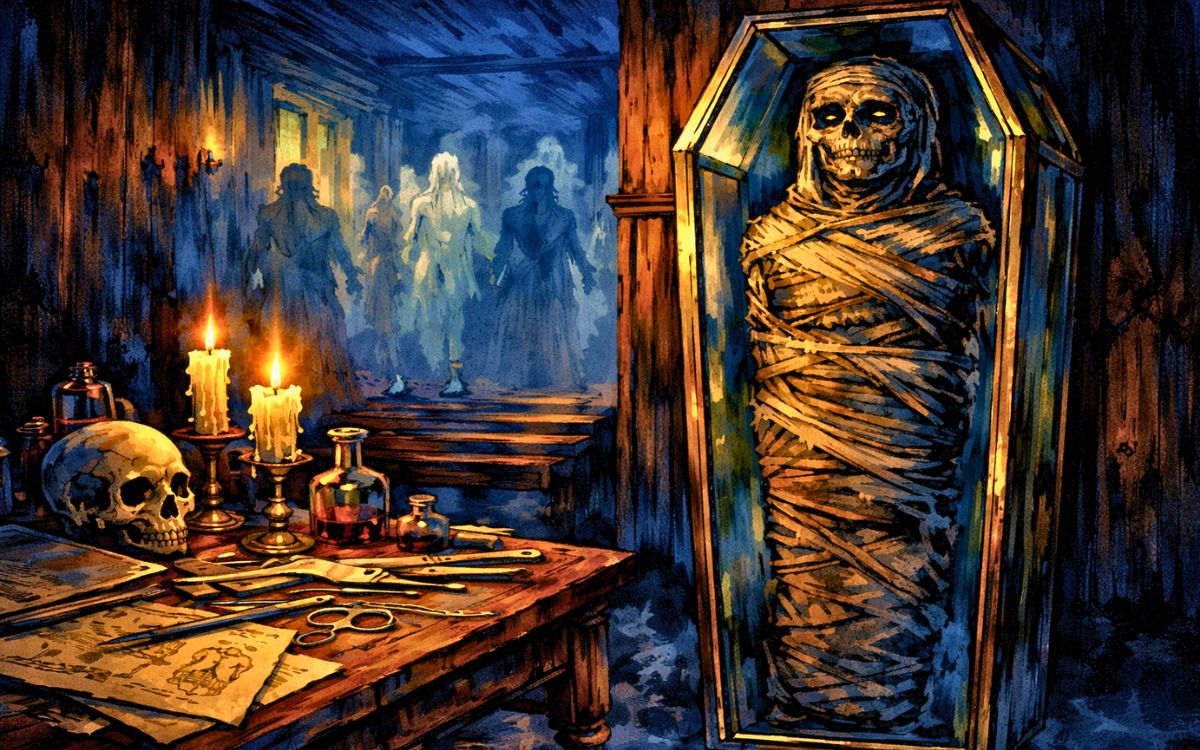
Few have heard of the Manchester Mummy, but some claim her restless spirit still roams the corridors of her old home, writes GEMMA JOHNSON
Hannah Beswick was born in 1688. She came from a wealthy family and led a life of comfort and abundance.
After her father, John, passed away in 1706, Hannah inherited a great fortune but chose to shun the trappings of wealth she had grown up with.
She moved away from the family home, Cheetham Old Hall in Manchester, to a more modest abode in Hollinworth, just on the outskirts of Oldham.
Here, Hannah led a quiet, simple life. She relished peace and solitude.
That was until the death of her brother, John. The loss left Hannah bereft, but it also shattered her faith in the medical profession, leading her to develop an unhealthy obsession and phobia of death.
The funeral proceedings for John were all going to plan. His coffin had been left open so family members and friends could pay their respects.
John looked peaceful and serene, the small pillow gently cradling his head, his body at ease on the silk lining.
However, this was far from a typical funeral. Just as the lid was being placed on John’s coffin, a member of the gathering noticed that his eyes had flickered.
Alarmed, the family doctor conducted an in-depth assessment and found that John was not dead at all. He was in a deep slumber – what we would now recognise as a coma.
He was removed from the coffin and taken into medical care, where he later recovered.
Hannah was so disturbed by the events surrounding her brother’s near-burial that she developed a phobia of being buried alive. In her deepest fears, there would be no rescue, unlike her brother.
Throughout her life, Hannah was haunted by troubling visions and dreams of premature burial. As a result, she opted to alter her will.
Just a few years before her death, Hannah declared in her will that her body was not to be buried. Instead, it was to remain above ground and be checked regularly for signs of life until there was guaranteed certainty that she was dead.
Hannah specified that only one doctor was permitted to examine her body. She entrusted her care to Dr Charles White.
When Hannah passed away in February 1758, Dr White took possession of her body. However, it seems that he was more interested in building his own reputation than fulfilling her last wishes.
Hannah was not buried, as she had requested, but nor was her body left intact. No regular examinations were carried out.
Instead, Dr White opted to mummify her. Her organs were removed, all fluid drained, and the body washed with strong alcohol.
She was then stuffed and sewn up before finally being covered in tar.
Hannah’s body was moved several times across Manchester. On one occasion, she was even displayed within the case of a grandfather clock in a house in Sale.
Dr White gained notoriety for his macabre creation and seemed to revel in his newfound celebrity status.
Word spread about the Manchester Mummy, and people flocked to see Hannah in person.
Dr White included Hannah in his will, declaring that upon his death she was to be given to his colleague, Dr Ollier.
When Dr White died in 1813, Dr Ollier took custody of Hannah’s body and faced an ethical dilemma: had Dr White honoured Hannah’s wishes, or had she simply become a morbid tourist attraction?
For several years, Dr Ollier cared for Hannah. His final wishes were that she should be entrusted to the Museum of the Manchester Natural History Society.
Hannah was eventually placed in the museum, where she was displayed in a glass coffin.
However, public interest had waned. Many commented that it was a sad display, lacking in dignity and respect for the deceased.
The museum decided that, as it was clear Hannah was indeed dead, she should finally be buried in accordance with her wishes.
Due to her notoriety, she was buried in an unmarked grave in 1868, a decision made to protect her body from graverobbers.
Yet there was one final indignity. Since Hannah’s death in 1758, a new law had been introduced requiring a death certificate before burial.
Given how long she had been dead, it was no longer possible to produce one.
The museum had to write frantic appeals to the government to resolve the situation so that Hannah could finally be laid to rest.
The process took more than a year to complete.
With such a traumatic series of events surrounding Hannah Beswick, could she ever truly be at peace in the afterlife?
It seems not.
Several tenants of Hannah’s old home – which had since been converted into small flats – reported seeing Hannah roaming the hallways and corridors, as if searching for something.