

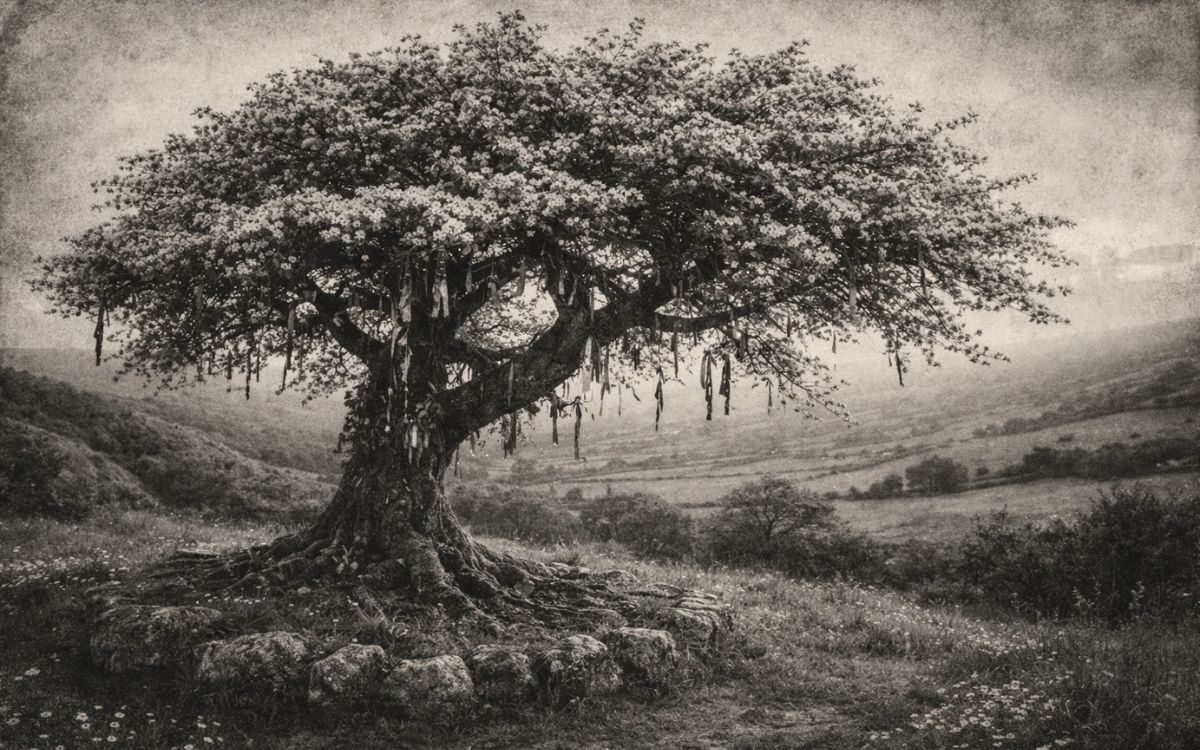
Ireland’s fairy trees remain powerful symbols of folklore and living tradition, marking places where myth and landscape intertwine.
Ireland’s rolling green fields and ancient landscapes are threaded with folklore that continues to captivate locals and visitors alike.
Central to this living mythology are the legendary fairy trees. These are sacred trees believed to mark portals between the human world and the Otherworld of the fairies, or Sídhe.
But how do you spot these mystical landmarks in Ireland? Here is a detailed guide rooted in Irish myth, landscape clues and centuries-old tradition.
What exactly is a Fairy Tree?
In Irish folklore, a fairy tree usually refers to a lone tree, most commonly a hawthorn (Crataegus monogyna) — that stands alone in a field, at a crossroads or beside a stream.
These trees have long been revered as sacred sites connected to the Sídhe, the supernatural ‘wee folk’ said to inhabit the world just beyond human sight.
The importance of these trees was not merely poetic.
Folklorists have documented the deep cultural belief that cutting down or disturbing a fairy tree would bring severe misfortune — even death — upon the offender.
Farmers traditionally worked their fields around these trees rather than risk interference.
Look for lone trees in fields
The easiest way to spot a fairy tree in Ireland is visual: scan open fields and rural roadsides for a single tree standing apart from others.
Unlike woods or hedgerows, these lone trees are conspicuous because of their solitary position.
According to tradition, these trees were never planted by human hands.
They grew naturally, which in ancient Celtic belief signified a gateway into the Otherworld.
Hawthorn is the most common species because it thrives in poor soil and open fields, producing thorny branches, white or pink flowers in May, and red haws in autumn.

Identify the species: Hawthorn and allies
Hawthorn is the quintessential Irish fairy tree, but other species such as blackthorn, rowan and occasionally gnarled oak can also carry supernatural associations.
Hawthorn (Sceach Geal) — often called the whitethorn — was sacred in Brehon law and folklore.
When it appeared alone, it marked a meeting place of fairies and a portal between realms.
Blackthorn and rowan are less common but still significant, particularly where they grow apart from woodland edges.
Notice surrounding stones and shrines
Fairy trees are often found encircled by stones, offering evidence of ancient reverence or ritual.
These stones may mark a primeval shrine or sacred perimeter — places where offerings were once placed for blessings or rites.
In some cases, ribbons, religious tokens or pieces of cloth are tied nearby, a practice that blends Christian devotion with older Celtic belief.
Check for local lore and place names
Many Irish towns and rural districts still have place names associated with fairy lore — field names, roads or forests tied to stories of the wee folk.
Asking locals can reveal hidden fairy trees known only to residents and local historians.
Some sacred sites are documented, such as trees near holy wells, fairy forts (ancient ringforts) and high places like the Hill of Tara, where fairy trees have been preserved through centuries of tradition.
Respect the Folklore
While modern visitors are unlikely to encounter fairies themselves, many Irish people still adhere to traditional customs of respect.
- Do not cut or damage these trees.
- Avoid bringing hawthorn branches indoors.
- Be aware that some places are still considered sacred.
Even in the late 20th century, construction projects in Ireland were delayed or rerouted to protect well-known fairy trees, highlighting that belief in these sacred sites persists.
To find a fairy tree in Ireland is to glimpse the landscape not just as farmland, but as a tapestry woven with myth and memory.
These solitary trees — especially hawthorns — act as living markers of Celtic tradition, spiritual belief and a worldview that sees the land as a meeting place between the human and the fantastical.
Whether you seek them for folklore, photography or a brush with the mystical, spotting a fairy tree brings you closer to the ancient heartbeat of Ireland’s soul.