

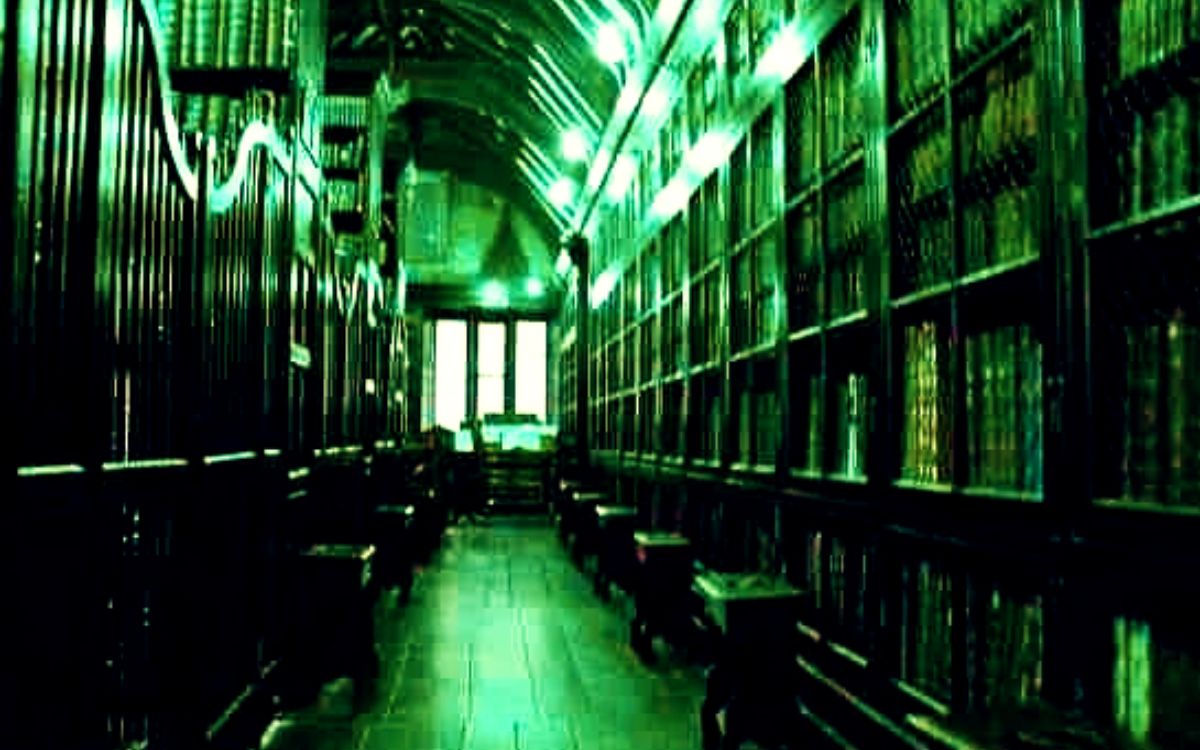
The centuries-old story of the Grey Lady continues to cast a haunting shadow over Chetham’s Library in Manchester, writes ANDREW HUDSON
Is Chetham’s Library haunted?
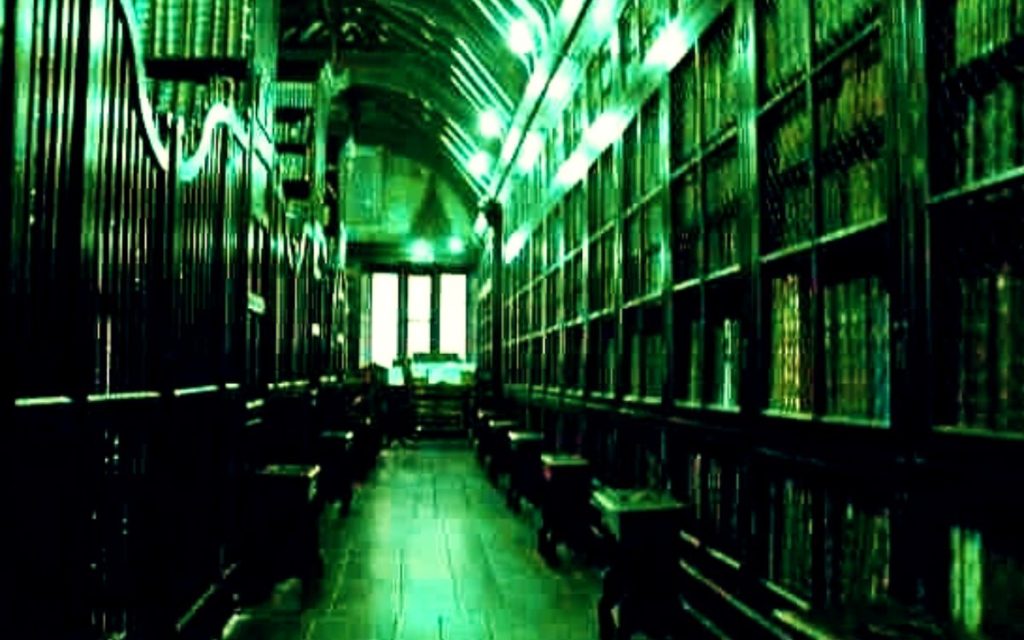
That is a question that has lingered for generations, fuelled by long-standing rumours of a mysterious “grey lady” said to haunt the ancient corridors of one of Manchester’s oldest buildings.
Witnesses claim she appears in the passageway linking the library’s reading room to the hidden stairwell leading up to the Minstrel’s Gallery, often when the ancient bell on the heavy oak door is sounded.
Who she is, and why she appears, remains unknown.
Located in central Manchester, behind the Football Museum near the Printworks, sits Chetham’s School of Music and Library.
Despite its charming medieval façade, the building has a plentiful, and at times unsettling, past contained within its walls.
A Brief History of Chetham’s Library
Although Chetham’s School and Library were founded in the 1600s, the history of the building itself stretches back much further. The site was originally Manchester’s manor house, owned by Lord Thomas de la Warre, who also served as rector of the parish church.
In 1421, after acquiring a licence from Henry V, de la Warre relinquished his home and grounds to establish a collegiate institution for priests connected to the adjacent Manchester Cathedral. The college employed a warden, eight fellows, four clerks and six lay choristers, embedding the building firmly within the city’s religious life.
The Stanley Takeover
By the late 1400s, control of the college passed to the Stanleys, Lancashire’s most powerful family. Thomas Stanley, made first Earl of Derby by Henry VII, appointed his son James Stanley as the fifth warden in 1485. Assisted by his stepmother, Lady Margaret Beaufort, James oversaw substantial redevelopment of the church.
James Stanley remained warden until 1509 and died in 1515. The Ely Chapel, constructed to house his grey marble tomb, was endowed in 1513 and founded alongside his son John, who was knighted following his role at the Battle of Flodden Field.
The religious turbulence of the 16th century soon followed. In 1547, shortly before Henry VIII’s death, legislation was passed to dissolve chantry chapels, and commissioners arrived to inventory the college’s assets. The property was swiftly acquired by Edward Stanley, the Third Earl of Derby.
Under Queen Mary, the Catholic college was briefly re-established, allowing the fellows to return. When Elizabeth I took the throne in 1558, the college was dissolved once more before being re-established as Christ’s College in 1578.
Doctor Dee and the Devil
Elizabeth I appointed Doctor John Dee as warden, a figure whose reputation alone has ensured Chetham’s place in occult folklore. Dee was an astrologer, alchemist, scientist, theologian, courtier and spy — a man of formidable intellect and enduring controversy.
Born in 1527, Dee earned a reputation for sorcery while studying at Cambridge after creating elaborate mechanical effects for a production of Aristophanes’ Peace. His construction of a giant mechanical beetle convinced audiences he had enlisted the help of Lucifer himself.
Dee was imprisoned for heresy in 1555 and later served as royal astrologer, advising on navigation and even predicting Elizabeth’s coronation. When he arrived in Manchester in 1596, rumours followed him. It was during his tenure that he was said to have summoned the Devil, who allegedly left a scorched hoof print on a wooden table in Chetham’s Audit Room. The mark is still not publicly displayed.
Dee remained warden until 1605 and died in poverty in 1608. His reputation endured. In 1996, a local paranormal group reportedly attempted to levitate Manchester’s Corn Exchange, believing Dee had once inhabited the site.
The Founding of the Library
Chetham’s Library itself was established under the will of Humphrey Chetham in 1651. The medieval College House was purchased by his executors for £500 in 1653, following years of use as a prison and arsenal during the Civil War.
Chetham, a Mancunian textile merchant and banker, also founded a school for forty poor boys and planned a network of chained libraries across local churches. The College House was renovated by local craftsmen, including joiner Richard Martinscroft, who was responsible for the library’s fittings.
The library opened in 1655 and remains Britain’s oldest surviving free public library.
The Grey Lady
Despite centuries of documented history, it is the Grey Lady who continues to dominate Chetham’s folklore. Reports describe a silent figure in grey, glimpsed in the corridor between the reading room and the Minstrel’s Gallery. Her appearances are often associated with the ringing of the ancient bell beside the staircase door.
Accounts persist to this day. One visitor wrote of her phone malfunctioning while attempting to photograph a portrait of Humphrey Chetham, describing the experience as deeply unsettling.
In 1927, photographer R. Walker Berry claimed to have captured the apparition on film at the entrance to the Minstrel’s Gallery. He submitted the image to Our Journal, noting that the camera’s supposed resistance to illusion had produced an unexpected result. The photograph remains one of the most discussed pieces of evidence connected to the haunting.
An Uncertain Future
Chetham’s Library has survived dissolution, civil war and centuries of change. While it continues to expand its collections, the future of the associated music school has faced uncertainty due to proposed funding cuts announced in 2024.
Today, access to the library is limited to guided tours and events. The Grey Lady, however, is said to remain. Whether she is a fragment of folklore or something more, her presence continues to shape how Chetham’s is remembered — as a place where history does not always rest quietly.