

In the 1880s, an Oxford professor spent a summer holiday with his wife and a friend in a remote cottage by a small mountain lake in Merionethshire, Wales.
One afternoon, while fly fishing near the shore, the professor struck his toe against something hard. Stooping down, he unearthed a skull. At first glance it seemed canine, but its great breadth of head was unlike that of any ordinary dog. Fascinated, he kept the relic and set it upon the kitchen shelf as a curiosity.
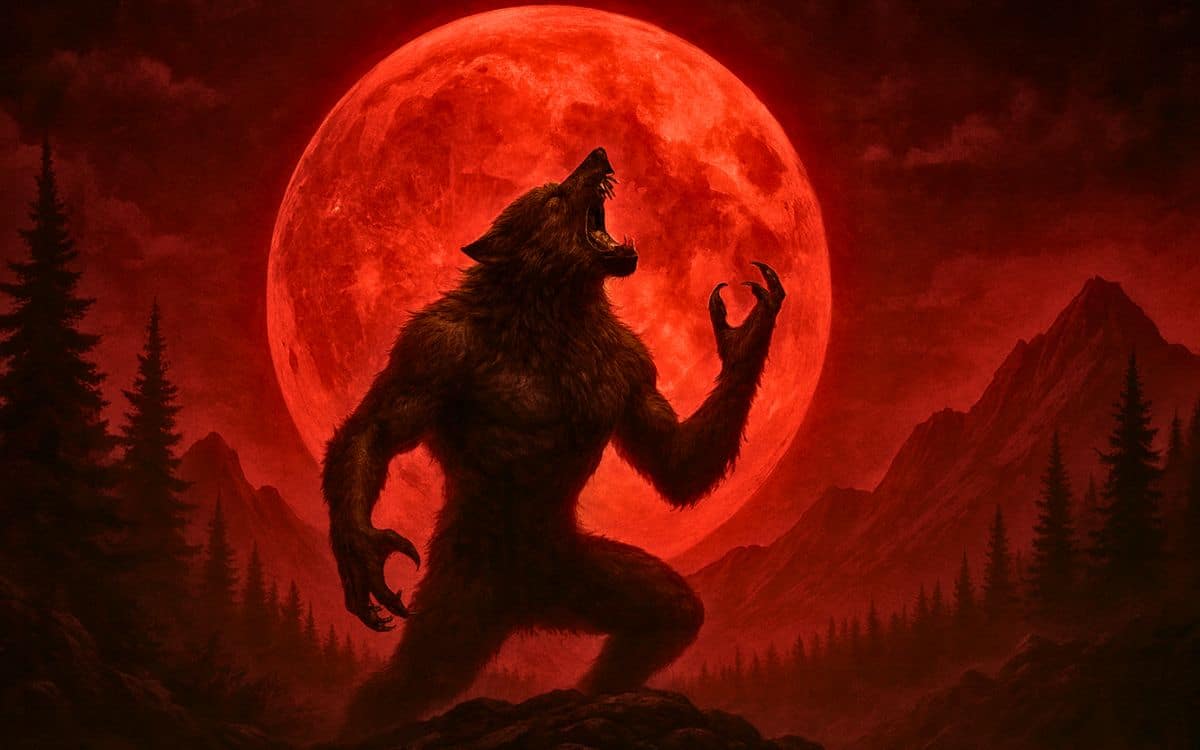
That evening, the professor and his companion took a walk, leaving his wife alone. Not long after, she heard strange noises at the kitchen door. Thinking it a farm dog, she went to investigate, only to be confronted by a horror. Two immense paws rose at the window. In the lamplight, behind the diamond panes, loomed a grotesque face: a monstrous jaw, glowing red eyes, and features neither wholly wolf nor wholly human.
The beast vanished from the window, but she heard it prowling around the cottage. With a start, she realised the front door was unlatched. She raced to it and slammed the bolt home just as the creature threw its weight against the wood.
Scratching, panting, and snarling followed. The thing circled and circled, seeking a way inside. For what seemed endless minutes, she cowered in terror—haunted by the thought that her husband and their guest would soon return, defenseless.
At last she heard voices. The men were back. She flung open the door and col lapsed at her husband’s feet, almost fainting as she poured out her tale.
The professor soothed her and urged her to bed. He and his friend remained awake, armed with a shotgun, to see if the creature would return.
In the dead of night, it came again. They heard its heavy tread, saw it circle the walls, and then, with a thud, it leapt at the kitchen window. There, inches away, was its face—luminous, wolfish, and unearthly. It glared at them before springing away. The men rushed out, weapon in hand, and chased the shadowy shape through the garden. It fled towards the lake, scuttled over the shingle, and disappeared be neath the water without so much as a ripple.
At dawn, the professor took the skull from the shelf and hurled it back into the lake. The “wolf-man” was never seen again.
What had haunted that cottage? Was the skull bound to the apparition—or was it all coincidence, a terrifying encounter with a monstrous dog? Local folklore hints otherwise. Stories from the early 19th century tell of a “man-wolf” stalking the hills and terrifying the shepherds.
Years later, a woman named Miss St Denis lodged at a Merionethshire farm near a village, a railway station, and abandoned slate quarries. An amateur painter, she of ten worked on the station platform. One evening she lingered later than usual. Glancing up, she noticed a man seated on a railway truck, staring at her with an un wavering gaze. The station was almost deserted, the station master long gone.
The longer he stared, the more uneasy she became. She coughed, then again, but he gave no sign of hearing. “Can you tell me the time, please?” she called. Still no response.
Gathering her belongings, she hurried away — only to see, when she looked back, that the man was following. She quickened her pace, whistling to feign calm, but twilight had drawn her onto a lonely path between cliffs and quarries. If she cried for help, no one would hear. Mustering her courage, she spun round and shouted, “What do you want? How dare you!”
Now she saw him clearly. He was no man at all. Though human in form, his body was swathed in grey hair, and his head was that of a wolf. With feral intensity he sprang forward. In desperation, she drew a torch from her pocket and flashed it in his face. The beast recoiled, shielding its eyes with clawed hands. Then, before her horrified gaze, it faded into nothingness.
The next day, Miss St. Denis inquired about the spot. Locals told her that bones— half human, half animal—had been discovered in a quarry nearby, a place whis pered to be cursed and avoided after dusk. Her story later reached the writer Elliott O’Donnell, who published it in his 1912 book Werewolves.
Even today, wander the lonely hills of Merionethshire and you may still hear tales of ghostly, wolfish figures seen at twilight. Many dismiss such stories as rustic gos sip or playful invention. But ask yourself—would you dare walk those desolate hills at sunset, knowing what might be waiting in the shadows?
Have you experienced anything strange in the hills of Wales? Tell us in the comments section!
JOHN WEST is a Suffolk-based film producer, actor, broadcaster, and author with a passion for history, ghosts, and folklore. His work spans radio, TV, film, and publishing, including books like Britain’s Haunted Heritage and Britain’s Haunted Land. Discover more about his projects at johnwestmedia.com