
In Irish tradition, the humble pig was anything but ordinary. It fed kings, outwitted warriors, crossed into the realm of the dead, and even gave its name to the land itself.
Sacred and supernatural, pigs loomed large in the Irish imagination — as creatures of magic, mystery, and power.
From feasting halls to ghostly crossroads, pigs appear in the folklore of every province.
Sometimes they nourished; sometimes they destroyed. Always, they stood at the threshold between the human and the otherworldly.
Pork: The food of heroes and gods
In ancient Ireland, pork was the royal meat — rich, plentiful, and prestigious.
While cattle were valued as walking wealth, pigs were raised to be eaten. And when they were, it was usually in style.
Roast pork featured heavily in mythological feasts, especially those held by the gods or the legendary warrior band, the Fianna.
Pork was so tied to status that joints of it were often buried with chieftains, intended to sustain them in the afterlife.
To eat pork was to take part in something larger — a celebration of kingship, of hospitality, of divine favour.
The animal, raised in the mud, became a symbol of feasting and abundance at the highest levels of society.
The self-reviving pigs of the otherworld
Some pigs went further still — becoming immortal.
In the Irish otherworld, where hunger and decay are banished, magical pigs appear that can be eaten night after night and return to life each morning.
These stories occur in several early texts, where enchanted swine serve as eternal providers.
One such tale features a magical cauldron and a pig that is slaughtered daily to feed an endless feast.
This cyclical pig — dying and reviving — echoes ancient beliefs in renewal and rebirth.
It is also a powerful symbol of how the otherworld flips the rules of reality: no hunger, no loss, just eternal plenty.
Mesgegra’s giant pig: The prize of kings
King Mesgegra of Leinster possessed a pig of such size and richness it became legend.
Fed on the milk of 60 cows, the pig was both a marvel and a status symbol.
Tales of this pig describe it as the spark of rivalry between provinces.
Much like cattle raids in Irish epic tales, this pig became the centre of territorial disputes and feasting contests.
In a society where honour and power were measured in livestock, this one pig stood for much more: it was prosperity, prestige, and pride on four legs.
The Black Pig’s Dyke: A scar across the land
Stretching across parts of Ulster are a series of Iron Age earthworks known as the Black Pig’s Dyke.
Archaeologists debate their original purpose — perhaps they were defensive barriers or boundaries between kingdoms.
But in folklore, their origin lies in magic.
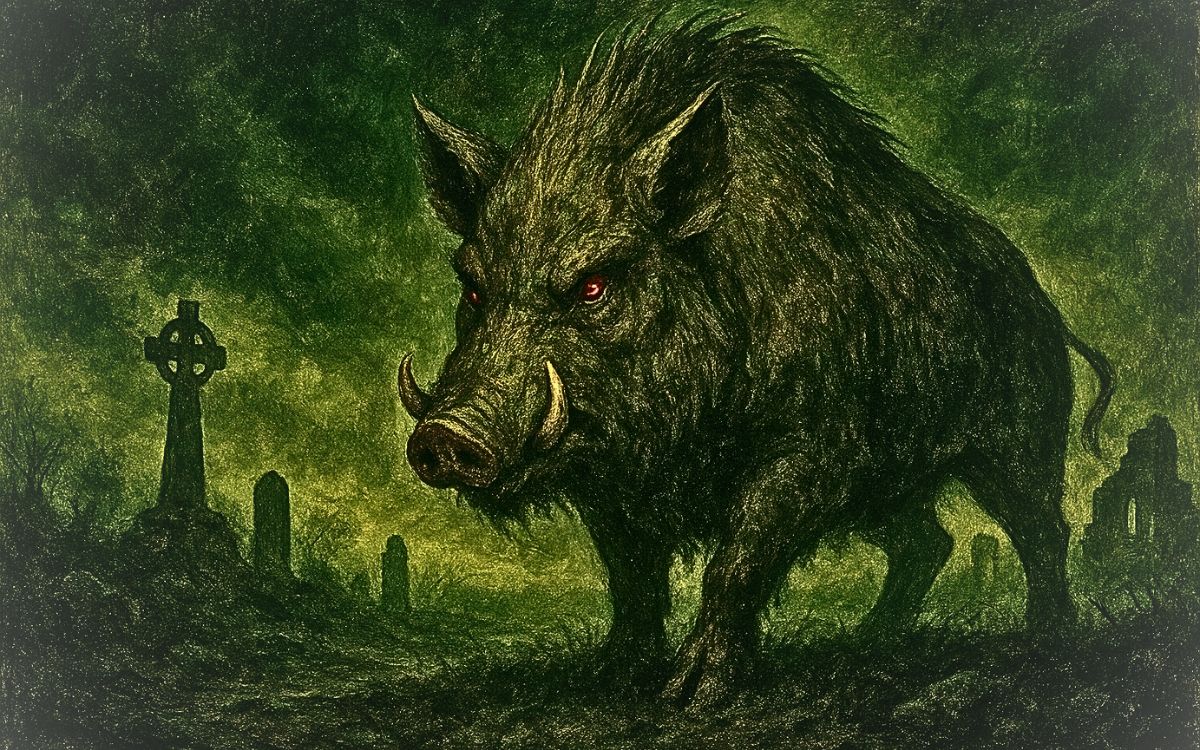
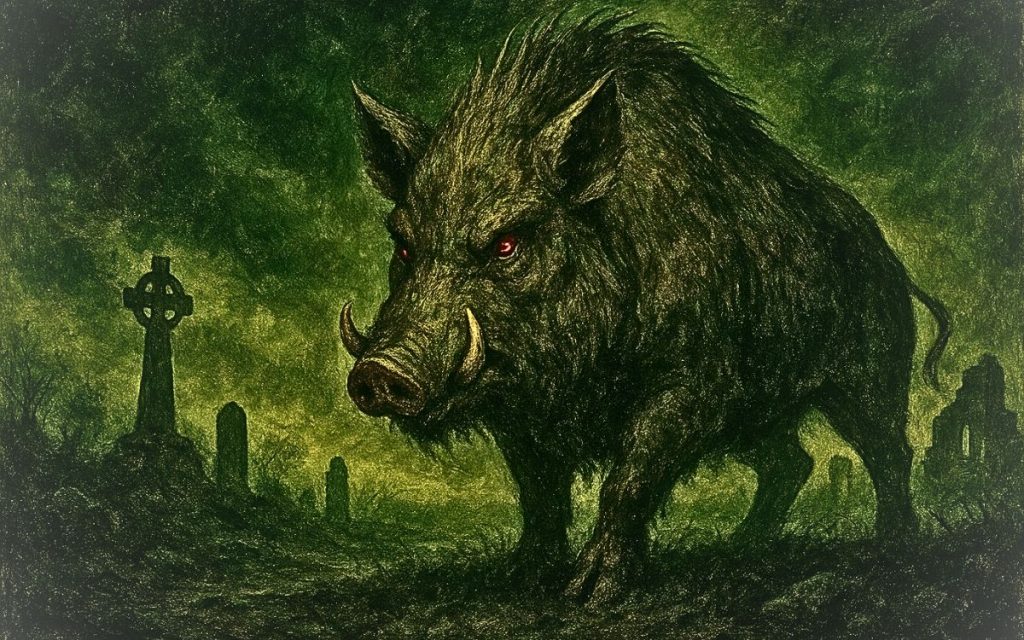
Legend says a giant black pig, cursed or enchanted, charged through the countryside, tearing trenches with its tusks.
In some versions, the beast was a shape-shifting schoolmaster or sorcerer, punished for forbidden knowledge.
The dykes became symbolic borderlands — physical places where the everyday world brushed against the supernatural.
The pig, here, is a force of change, carving out boundaries in myth and soil alike.
Black pigs as omens of death
Not all pigs in Irish folklore are nourishing or noble. Some, particularly black pigs, are feared as death omens.
Meeting a black pig on a dark road was a sign of terrible luck — even imminent death.
These spectral animals were often silent, their presence alone enough to send people fleeing.
One belief held that crossing running water was the only protection, as spirits of pigs could not follow.
In this way, black pigs joined the ranks of Ireland’s supernatural warnings — alongside the banshee and the death-watch beetle — serving as eerie reminders of life’s fragility.
Shape-shifting pigs and enchanted beings
Transformation is a recurring theme in Irish storytelling — and pigs are no exception.
In one tale, a long-haired schoolteacher delves into forbidden magic and, to escape, takes the form of a huge pig.
Tearing across the land, he leaves destruction in his wake, echoing the chaos of the Black Pig’s Dyke.
Another legend tells of the Fianna hunting a boar, only for the beast, once slain, to transform into a beautiful woman playing a harp.
She enchants the warriors, then vanishes at dawn — a fleeting vision of the otherworld.
Even Ireland itself, in one ancient tale, is said to have disguised its shape as a pig to protect itself from foreign invaders.
These stories show pigs as liminal creatures — walking (or trotting) the line between human, animal, and spirit.
Inis na Múice: Ireland as “Pig Island”
The name Inis na Múice, meaning “Island of the Pig,” appears in early sources as a poetic name for Ireland.
The image of the island disguised as a massive pig floating in the sea may seem odd to modern ears — but it fits into a broader Celtic worldview.
In this tradition, pigs were not only domestic animals, but guardians, tricksters, and embodiments of the land itself.
The magical pig-island was hidden from invaders, shielded by enchantment, fierce and protective.
In this telling, the pig becomes more than a creature. It is Ireland itself — fertile, wild, and ready to resist.
Diarmuid and the fatal boar
In one of Ireland’s most famous tales, the warrior Diarmuid Ua Duibhne meets his death on Beann Gulbain, slain by a wild boar.
The boar is no ordinary beast. In some versions, it is a cursed foster brother, transformed by jealousy.
In others, it is fate itself, sent to punish Diarmuid for breaking a sacred bond.
As with other myths across Europe — including Adonis and the boar in Greek legend — the pig here becomes the bringer of destiny.
No amount of courage can stop what is foretold. Even a hero must fall.
Ghostly pigs on Samhain night
On Samhain — the ancient festival marking the end of the harvest and the start of winter — the boundaries between worlds were at their weakest.
Spirits walked abroad, and pigs were among them.
Phantom pigs were said to haunt crossroads, lanes, and boggy paths, especially after dark.
Their sudden appearance was a warning: someone nearby would soon die.
Just as the banshee cries or the headless horseman rides, the ghost pig trotted into Irish lore as a figure of fear.
Only sacred ground or running water offered protection.
Lessons from the pig
Together, these stories reveal a creature far richer in meaning than its muddy reputation suggests.
As food, the pig symbolised plenty, honour, and sacred hospitality.
As myth, it took on magical roles — a provider, a protector, a trickster.
As omen, it reminded people of death, danger, and the power of fate.
To ancient Irish minds, the pig was not just meat on the table.
It was a symbol of life’s abundance and life’s fragility. A creature rooted in the earth, yet roaming the edge of the otherworld.
Have you heard any tales of pigs in Irish folklore? Share your favourite legends in the comments!