

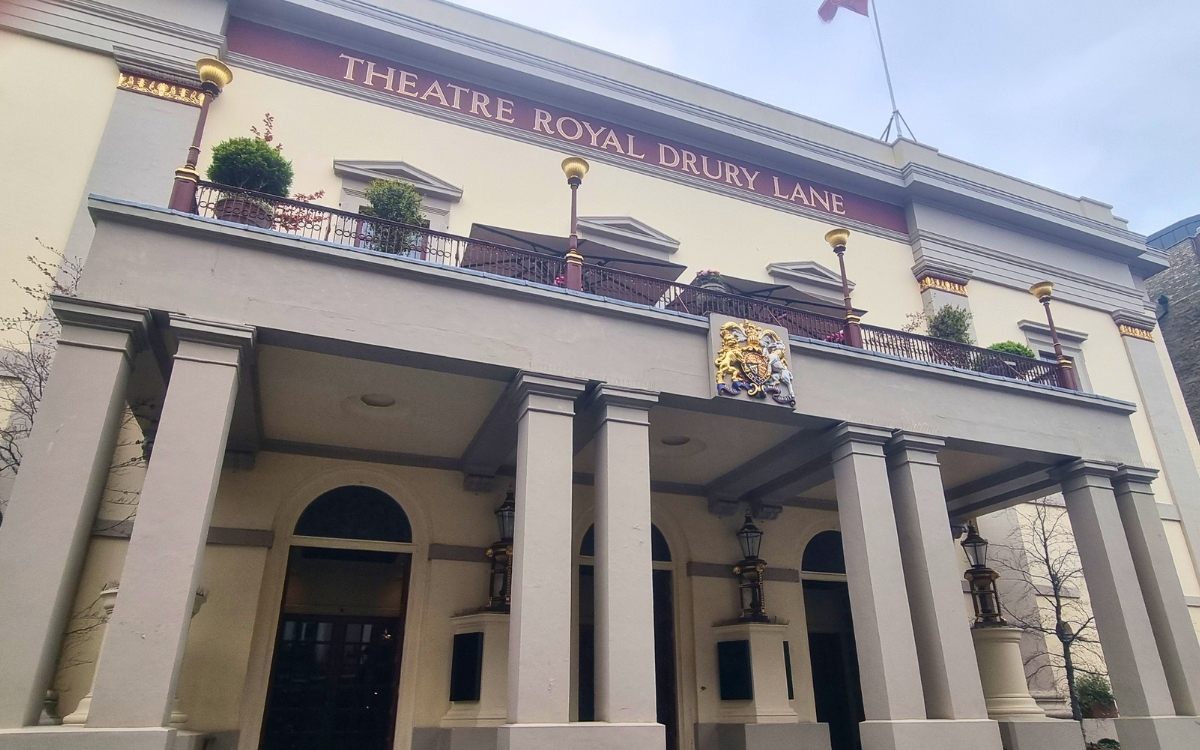

The current Theatre Royal in London’s Drury Lane, which underwent a £60 million restoration in 2021, dates back more than 200 years to 1812. However, the site has a much longer theatrical history.
The first theatre, built in 1663, was destroyed by fire in 1672. Its replacement opened in 1674 but was demolished in 1791 to make way for a new, larger and allegedly “fireproof” theatre, which opened in 1794. The fireproofing proved less than successful when the building burned to the ground again in 1809.
Gothic horror on the Georgian stage
During the Georgian and Regency eras, the Theatre Royal became home to some of the finest examples of early theatrical horror.
Top of the list was The Castle Spectre by Matthew Lewis, author of the Gothic classic The Monk. The play pioneered some of the earliest theatrical special effects, using specialised lighting, a hidden chorus and the ghostly Evelina, who materialised before the audience, draped in white, emerging from an oratory. Premiering in December 1797, it ran for 47 sold-out nights, saving the theatre from impending bankruptcy.
Another Gothic castle appeared in Bertram; or, The Castle of St Aldobrand, which opened on 9 May 1816 in the newly built 1812 theatre. Alongside the castle itself, the drama featured an abandoned monastery and a violent thunderstorm. It caused such a sensation that Lord Byron hailed it as “the best thing since Shakespeare”. Its success also rescued its author, Charles Robert Maturin, from personal bankruptcy.
In 1824, adaptations of The Seventh Bullet—also known as The Demon in the Wolf’s Glen—based on German playwright Carl Maria von Weber’s opera Der Freischütz, were all the rage. Plagiarised versions appeared at the Theatre Royal Covent Garden, the English Opera House (now the Lyceum), and Drury Lane.
The story follows a woodcutter named Max who makes a bargain with the forest demon Samiel, the Black Huntsman. Samiel casts seven bullets for him. Six will strike whatever target Max chooses, but the seventh belongs to the Devil himself. Once again, theatrical effects played a starring role, with bats flapping over the audience, lightning flashing across the stage and smoke filling the auditorium.
Christmas 1838 saw a production of George Colman’s opera Bluebeard. In it, the heroine Fatima defies her soon-to-be husband, the blue-bearded Abomelique, by opening the forbidden door to his secret chamber. Inside she discovers the skeletons of his murdered wives, watched over by a demonic corpse holding blood-dripping scrolls. Puppetry brought the skeletons to life before the audience’s eyes.
Joseph Grimaldi’s vegetable monster
Among these Gothic entertainments appeared Joseph Grimaldi’s legendary vegetable monster.
The white-faced clown was a regular star of the theatre’s pantomimes and harlequinades. In the famous sketch, Grimaldi’s clown assembled a man from vegetables scattered across the stage, with celery for limbs and a turnip for a head. Through clever stage lighting, the lifeless vegetable figure was secretly replaced by an actor in costume, creating the illusion that it had miraculously sprung to life.
The creature promptly turned on its creator, chasing Grimaldi around the stage and engaging him in comic fisticuffs.
The sketch first appeared before Mary Shelley’s Frankenstein was published in 1818, but afterwards it earned Grimaldi the nickname “Joe Frankenstein”.
The helpful ghost of Grimaldi
Grimaldi’s ghost is said to haunt the theatre in both helpful and mischievous ways.
Stagehands have reported being gently pushed aside when standing too close to dangerous scenery or equipment. Others claim to have received an unexpected kick up the backside from an invisible prankster while bending over.
Dan Leno and the scent of lavender
Grimaldi’s ghost is said to share the theatre with music hall legend Dan Leno.
Leno appeared in the Theatre Royal’s annual pantomime from 1888 until his death in 1904 and helped define the role of the pantomime dame.
His ghost reportedly favours his old dressing room, where performers have claimed he assists with applying make-up and occasionally gives wigs a playful tug. His appearances are said to be accompanied by the strong scent of the lavender perfume he wore while performing his dame characters.
Leno was also an accomplished clog dancer, and late-night sounds of someone rehearsing intricate dance routines have frequently been reported.
Charles Macklin’s murderous cane
A darker story surrounds Charles Macklin, regarded as one of the greatest Shakespearean actors of his generation.
On 10 May 1735, while preparing to appear in The Comic Rival, Macklin became involved in an argument backstage with fellow actor Thomas Hallam over a wig. In a fit of rage, Macklin thrust his walking cane at Hallam, piercing his left eye and driving it into his brain.
Hallam later died from his injuries.
At his trial, Macklin successfully argued that the killing had been accidental. The charge was reduced to manslaughter, and instead of being hanged, he was branded on the hand with a hot iron before being released.
Although Macklin lived into his nineties, his ghost is said to have returned to the scene of the killing. Actors have reported cold spots and an oppressive atmosphere in the area where the fatal argument took place, often accompanied by the ghostly tapping of his cane.
The hidden room and its forgotten skeleton
More than a century later, during alterations in the 1840s, workmen demolishing part of the auditorium noticed that a wall near the Upper Circle sounded hollow.
Breaking through the brickwork, they uncovered a small forgotten room.
Inside lay a human skeleton dressed in rags and covered with cobwebs. A steel dagger still protruded from its ribcage.
The murder has never been solved, and the victim has never been identified.
Since then, numerous sightings have been reported of a man wearing a grey riding cloak and a three-cornered tricorn hat, carrying a sheathed sword. Curiously, he appears only during daylight hours, between 10am and 6pm, walking along the Upper Circle before disappearing into the very wall where the hidden chamber was discovered.
A return to Gothic horror
The Theatre Royal returned to its Gothic roots in 2025 with the musical The Sea Witch, a prequel to Hans Christian Andersen’s The Little Mermaid exploring the descent into darkness of a powerful magical practitioner.
