
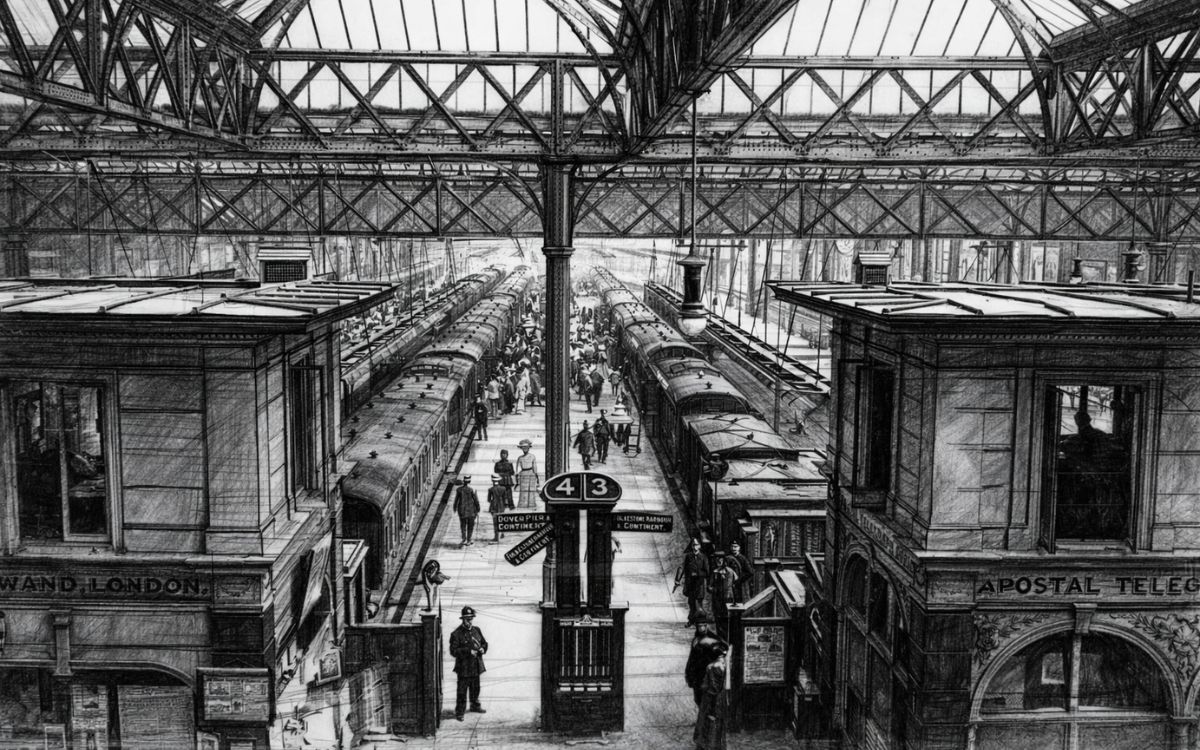
A routine day at Charing Cross Station turned into one of London’s most disturbing true crime cases when a mysterious trunk revealed the remains of a dismembered woman.
On the morning of 10 May 1927, staff at Charing Cross Station’s left-luggage office were battling an unmistakable stench.
Somewhere among the piles of suitcases and trunks was a package that reeked of rot and decay.
It didn’t take long to find the culprit: a stout black trunk, strapped with a heavy buckle and suspiciously weighty for its size.
When police forced it open, they uncovered one of the most shocking crimes in interwar London.
Inside were a series of carefully wrapped brown-paper parcels, each tied neatly with string.
It was almost domestic in its precision – the sort of packaging one might expect from a grocer.
But inside were not goods for sale, but the dismembered remains of a woman.
Alongside the grisly parcels were a pair of smart black shoes, a handbag, and some clothing.
A Suspicious Trunk at Charing Cross Station
The trunk had been deposited on 6 May 1927 by a man arriving in a taxi.
He quietly signed it into the left-luggage office and vanished.
Four days later, the dreadful smell forced its opening.
What lay inside would soon be known nationwide as the Charing Cross Trunk Murder.
The Clue in the Laundry Tag
Among the grisly bundles, detectives found a pair of women’s knickers marked with a laundry tag: “P Holt”.
That detail led investigators to a Chelsea household, where Mrs Holt confirmed the item was hers.
She was alive—but had once employed a servant who had vanished days earlier.
The servant’s name was Minnie Alice Bonati, who also used the alias Mrs Rolls.
Bonati had worked as a domestic but had also resorted to prostitution to survive.
It was enough for detectives to begin piecing together her final days.
Minnie Bonati’s Final Hours
Bonati was last seen at Victoria Station, where she met a man named John Robinson, a 35-year-old estate agent.
Robinson took her to his office at 86 Rochester Row, Westminster.
She never left.
Two days later, the black trunk appeared at Charing Cross.
The careful packaging and Robinson’s hasty attempts to erase bloodstains in his office told police they had their suspect.
John Robinson: From Estate Agent to Murderer
Robinson did not deny knowing Bonati, nor that she had died in his office.
But he claimed it was an accident.
According to his story, she had demanded money and threatened him.
In panic, he pushed her; she fell, struck her head, and died.
Terrified, he cut up her body and packed it in the trunk.
It was a desperate lie.
Sir Bernard Spilsbury Exposes the Truth
Forensic pathologist Sir Bernard Spilsbury examined the remains.
His testimony was damning: Bonati’s injuries were not consistent with a fall.
Instead, she had been asphyxiated while unconscious – the hallmark of deliberate murder.
Spilsbury’s evidence shredded Robinson’s account.
Combined with the physical trail of the trunk, the matchstick with dried blood found in his office, and eyewitnesses who had seen him with Bonati, the case was overwhelming.
Trial, Conviction and Execution
The trial at the Old Bailey gripped the press.
The details – the paper parcels, the laundry tag, the trunk’s eerie contents – fascinated readers.
Robinson’s defence collapsed under Spilsbury’s expert testimony.
On 12 August 1927, Robinson was hanged at Pentonville Prison, joining the infamous roll call of criminals executed there, from Dr Crippen to Roger Casement.
The Trunk’s Grim Afterlife
The black trunk itself became a relic of horror.
It was displayed in Scotland Yard’s secretive Black Museum, a collection of murder artefacts used for police training.
In the 1950s, the case was retold in The Black Museum radio series, narrated by Orson Welles.
Most recently, the trunk resurfaced in the Crime Museum Uncovered exhibition at the Museum of London.
The case shocked London not just for its brutality, but for its calculated neatness.
A woman had been reduced to parcels, tied up with string, and left to rot in the heart of the capital.
It was a crime of horror and orderliness. A grotesque puzzle in brown paper.
Nearly a century later, the Charing Cross Trunk Murder remains one of London’s darkest true crime tales.
A story where everyday objects – a laundry tag, a trunk, a handbag – became pieces in a macabre jigsaw that ended on the gallows.