

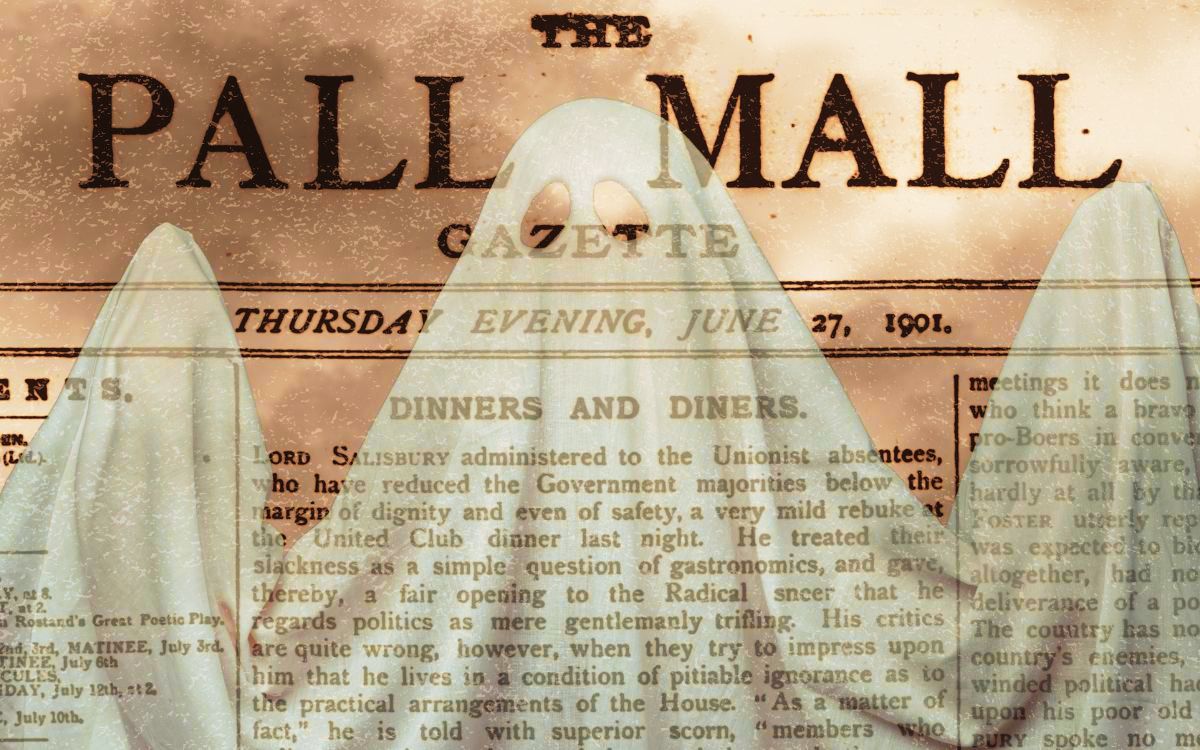
What happens to a city’s ghosts when the city itself disappears?
That was the question posed by the Pall Mall Gazette on 27 June 1901.
Founded in 1865, the Pall Mall Gazette was one of Britain’s most influential evening newspapers. Read by politicians, writers and London’s growing middle class, it covered everything from Parliament and foreign affairs to social issues and the curiosities of everyday life. Alongside hard news, it published thoughtful features on history, folklore and the stranger side of life.
Just five months after Queen Victoria’s death, the newspaper turned its attention to a rather unusual subject.
London, it suggested, was in danger of losing its ghosts.
Progress versus the paranormal
At the dawn of the Edwardian era, London was changing at a remarkable pace. Ancient buildings were disappearing. Medieval streets were being swept away. Warehouses, offices and red-brick mansion blocks were transforming neighbourhoods that had stood for centuries.
The Pall Mall Gazette wondered what would happen to the spirits said to haunt these old places.
“For London has its ghosts,” the article confidently declared.
It described a city where ghosts could still be “visible to those that have the gift of clairvoyance” or heard by those blessed with “clairaudience”. Others, it said, simply experienced the strange unease that clung to certain old houses.
The writer wasn’t convinced redevelopment would solve the problem.
Instead, they imagined ghosts becoming thoroughly annoyed at having their homes demolished, joking there was “something fitting in the idea of an indignant ghost chasing the affrighted builder of buildings as unsubstantial as itself!”
It’s a delightful image. Rather than being driven away by progress, London’s ghosts simply refuse to cooperate.
A newspaper couldn’t have known
Looking back 125 years later, it’s impossible not to smile at the timing.
The Pall Mall Gazette feared that modern London would leave little room for old ghost stories.
History had other ideas.
Within a few years, Britain would enter one of the greatest periods of fascination with the supernatural it had ever known. Spiritualism gathered momentum during the Edwardian years. Séances became fashionable drawing rooms. Newspapers reported haunted houses with surprising seriousness. The Society for Psychical Research continued its investigations, while Sir Arthur Conan Doyle became one of Spiritualism’s most famous champions.
Then came the First World War.
The deaths of millions of young men left grieving families searching desperately for comfort. Across Britain, bereaved parents, wives and children turned to mediums, hoping for one final conversation with those they had lost. Ghosts and spirits became more than folklore; for many people, they represented hope that death was not the end.
Far from disappearing, Britain’s fascination with the supernatural would shape much of the twentieth century.
Meet Brother John
To make its point, the newspaper introduced readers to one of London’s more curious hauntings.
An old riverside house, it claimed, was haunted by a ghostly monk known simply as Brother John.
Clad in a misty gown and cowl, Brother John wandered endlessly through the building. Witnesses claimed they had seen him during daylight as well as at night, while others reported hearing slow, shuffling footsteps echoing through the rooms long after everyone had gone to bed.
The house was believed to have once belonged to a monastery. According to local tradition, underground passages beneath the Thames connected it with other religious buildings and had been used to shelter friends in dangerous times.
Or perhaps, the newspaper suggested with a wink, they had another purpose.
The tunnels may also have been useful for “smuggling choice wines to replenish the Abbot’s cellar.”
Apparently, not every medieval monk lived on bread and water.
A mystery without an answer
No one could explain why Brother John still walked the house.
The Pall Mall Gazette admitted that “nothing can be learned” about the reason for his nightly patrols. Perhaps he had once rung the monastery bell to wake the brethren for prayer. Whatever his original task, he seemed determined to carry on performing it.
Residents claimed they saw the hooded figure climbing the stairs, heard footsteps pacing the corridors and, on one occasion, rushed to investigate when the house bell began ringing by itself.
They found nobody.
Only the bell, still “slowly swinging to and fro.”
The article never identified the building with certainty. Was the story based on genuine eyewitness accounts? Had details been changed to protect the occupants? Or was it simply a piece of Edwardian storytelling designed to entertain readers over their evening paper?
We’ll probably never know.
Did the ghosts survive?
That article appeared on 27 June 1901.
Exactly 125 years later, London is almost unrecognisable.
The city has survived two world wars, the Blitz, post-war reconstruction, the decline of the docks, the rise of Canary Wharf, the Millennium, the Shard and wave after wave of redevelopment. Thousands of historic buildings have disappeared, while countless others have been altered beyond recognition.
So what became of Brother John?
Did his riverside home survive? Does the hooded monk still patrol its corridors? Or did he finally disappear beneath bricks, concrete and glass, exactly as the Pall Mall Gazette feared?
Perhaps the newspaper got it wrong.
Perhaps London’s ghosts are harder to find today not because they’ve vanished, but because we no longer stop to listen for footsteps on an empty staircase or notice a bell gently swinging when nobody is there to ring it.
Or perhaps, somewhere beside the Thames, Brother John is still patiently making his rounds, waiting for someone to look up from their phone and notice him.
Exactly 125 years ago today, the Pall Mall Gazette wondered whether London was losing its ghosts.
A century and a quarter later, after everything the city has endured, perhaps the ghosts have had the last laugh.
The Pall Mall Gazette itself disappeared, merging with The Globe before being absorbed into the Evening Standard in 1923. Yet while the newspaper vanished, its tale of London’s disappearing ghosts has endured for 125 years.