

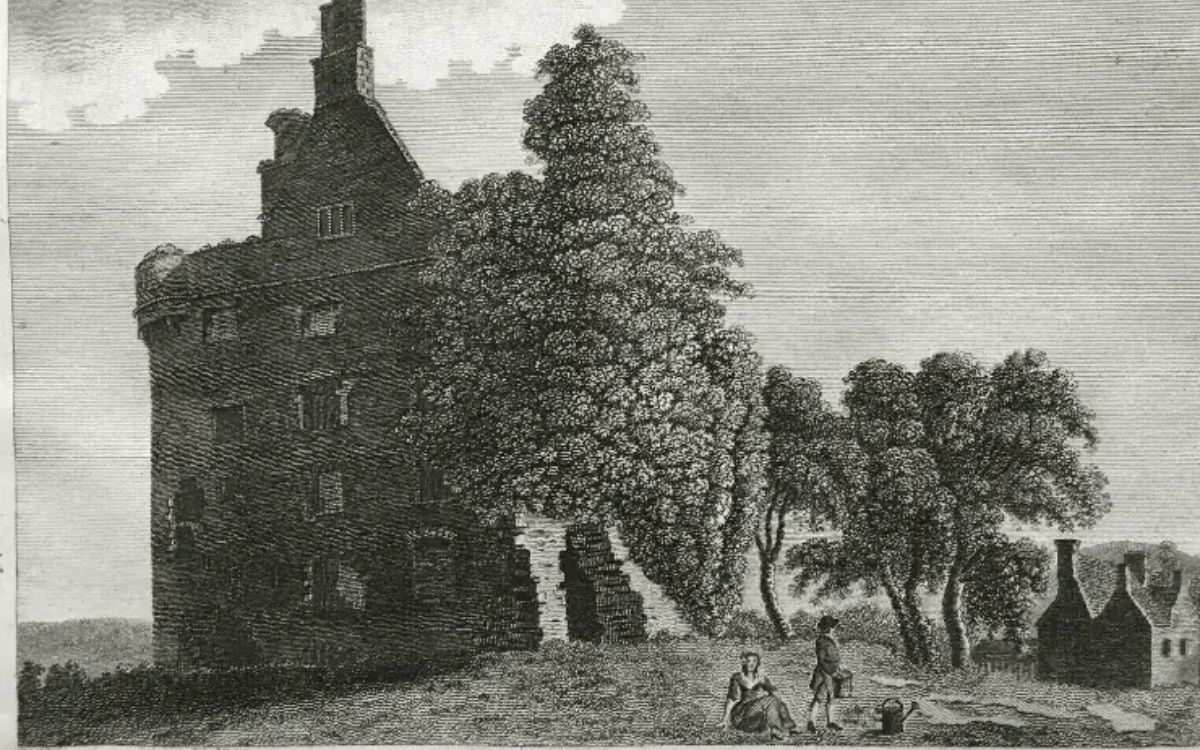
In the quiet heart of County Laois, where the winds sweep across The Heath and the land remembers more than it reveals, the skeletal remains of Morett Castle rise from the fields like the bones of a fallen giant.
Once a proud stronghold of the Fitzgeralds of Kildare, its chimneys still claw at the sky, defiant against the Irish dusk.
Built around 1580 on the old O’Dempsey lands of Magh Rechet, Morett was no simple tower. It was a statement of power — four soaring storeys, circular turrets, and a dramatic chimney cluster that marked it as a fortress of ambition in a land of unrest.
But Ireland in the seventeenth century knew no peace.
The 1641 Rebellion, Cromwell’s campaign, and the chaos of the Williamite Wars battered the castle again and again.
In 1690, Stephen Fitzgerald, heir to the estate, took a quiet walk through his garden. He never returned.
Seized by the rival O’Cahills, he was forced to surrender the castle without a fight. The walls that had withstood cannon fire fell to silence and betrayal.
By the eighteenth century, Morett was collapsing into ruin.
Historians sketched its silhouette, poets sighed at its beauty, but beneath the ivy and stone, the land remembered blood.
Morett Castle Folklore and Fire
The castle’s story did not end with its fall.
Local lore speaks of sieges, betrayals, and revenge.
One tale tells of the Dwyers, who laid siege to the castle. The defenders fought back not with swords, but with boiling water and stones, hurled from the ramparts.
The attackers fled, scalded and broken.
Another story tells of the O’Moores, who set the castle ablaze after the treacherous killing of O’Kelly.
Flames lit the night sky, and the castle became an inferno of vengeance.
Beneath the ruins lies St Brigid’s Well, beside an ancient graveyard.
Locals say the ground there is “thin,” a place where the veil between the living and the dead wears away—especially when the wind is right.
Whispers on the Wind
Today, Morett Castle stands on private land, its chimneys like crooked fingers pointing skyward.
But those who walk its perimeter after dark speak of a presence that lingers.
Some have heard footsteps pacing the overgrown courtyard, slow and deliberate.
Others report the sobbing of a woman near the well, though no one is ever found.
A recurring tale tells of the “Garden Walk.” On still nights, a man in seventeenth-century dress appears near the ruins, walking calmly toward the invisible garden path where Stephen Fitzgerald was taken.
He vanishes before reaching the graveyard.
Witnesses describe not fear, but a strange heaviness, as if watching a man relive his final mistake.
Paranormal investigators report equipment failures, temperature inconsistencies, and shadow figures.
Morett doesn’t scream; it whispers, like an old soldier quietly recounting wounds that never healed.
Echoes on the Heath
Morett Castle is easy to miss, hidden among hedgerows and quiet roads.
The Fitzgeralds are long gone. The soldiers are dust. But the echoes of a turbulent past remain.
Would you walk in the footsteps of Stephen Fitzgerald along the garden path, not knowing if you would return?
Have you experienced strange happenings near Morett Castle? Tell us in the comments section!