
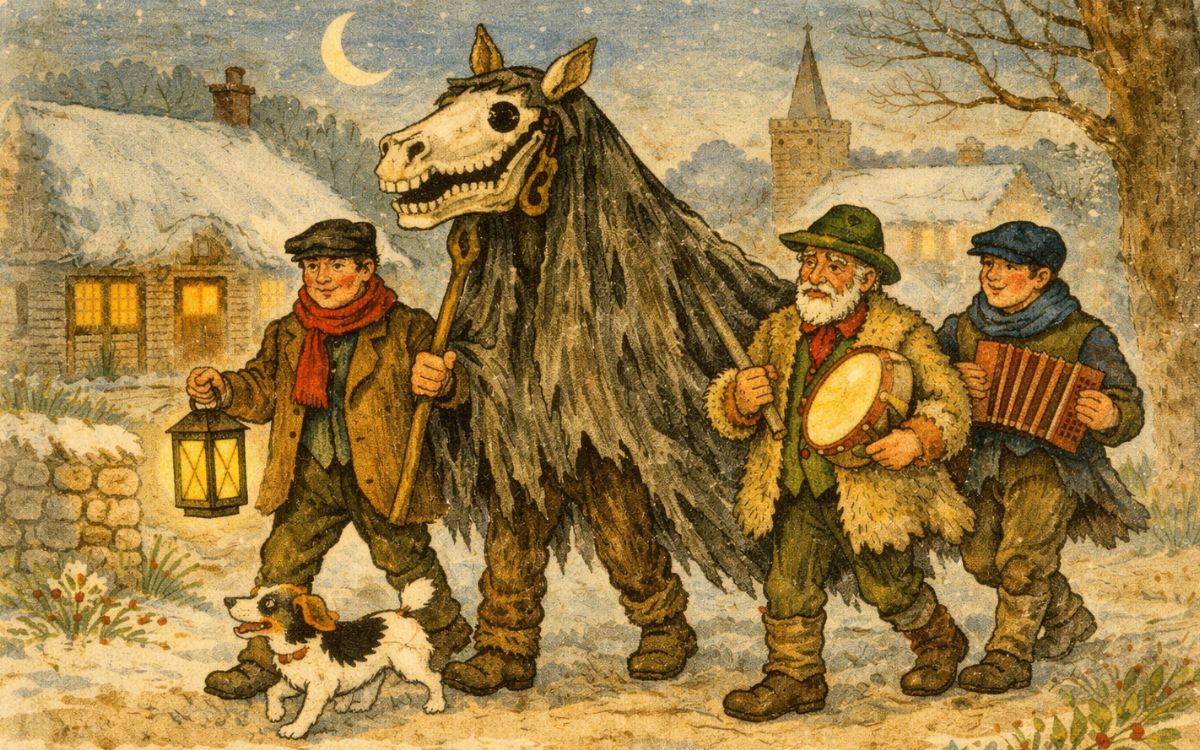
On dark winter nights in East Kent, something strange once came clattering out of the lanes. A horse’s head, carved from wood. Glassy eyes staring. Jaws snapping open and shut with a sharp crack. Bells ringing. A whip cutting the air.
For some, it was funny. For others, it was terrifying. This was the Hooden Horse, and it did not knock politely.
The Hooden Horse is a folk tradition found only in East Kent, especially around the Isle of Thanet and nearby villages.
While other parts of Britain have winter customs, nothing quite matches this one.
It appeared mainly at Christmas, when groups known as Hoodeners went from house to house, bringing noise, confusion and a strange kind of seasonal unease.
The Hooden Horse at the Door
At the centre of the custom was the Hooden Horse itself.
This was usually a wooden horse’s head fixed to a pole.
Some had glass bottle bottoms for eyes. Others had nails driven into the jaws for teeth.
Many had a hinged lower jaw, worked by a string, so it could snap suddenly and loudly.
The person carrying it was hidden under a cloth or sack, bent forward to suggest a body beneath the head.
In the half-light of a winter evening, it could look alarmingly real.
The Hoodeners were often farm workers, waggoners or stable hands. Horses were part of their daily lives, which may explain why the Horse took such a central role.
One member of the group usually dressed as a woman, known as Mollie, carrying a broom.
When a door opened, Mollie would sweep at people’s feet while the Hooden Horse snapped its jaws.
Others rang handbells, played fiddles or cracked a whip to heighten the chaos.
Once the shock passed, the group would sing carols or short verses.
In return, the household was expected to give food, drink or money. Ale, cider and cakes were common.
It was loud, messy and deliberately unsettling, especially for anyone not expecting a visit.
Fear, Origins and Survival in Kent
Many old accounts describe people being genuinely frightened by the Hooden Horse.
Some jumped from chairs. Others fled rooms.
In Broadstairs, the custom was reportedly stopped after a woman was said to have been badly frightened by a Hoodening party.
Despite this, the tradition continued in other parts of East Kent, from Deal to Canterbury and inland villages.
The origins of the Hooden Horse are uncertain.
Older writers linked it to ancient pagan beliefs and the god Woden, pointing to Kent’s early Jutish settlers and the county’s white horse emblem.
Modern historians are more cautious.
There is no clear proof of direct pagan worship.
What is certain is that the custom grew out of rural Kent, shaped by farming life, horses and the dark winter season.
Written references to Hoodening appear from the 18th century, with the tradition strongest in the 19th century.
By the early 20th century, it was fading.
Working horses were disappearing. Farms were changing. Old customs were seen as embarrassing or dangerous.
Many Hooden Horse heads were taken down from walls and burned.
Yet the Hooden Horse survived.
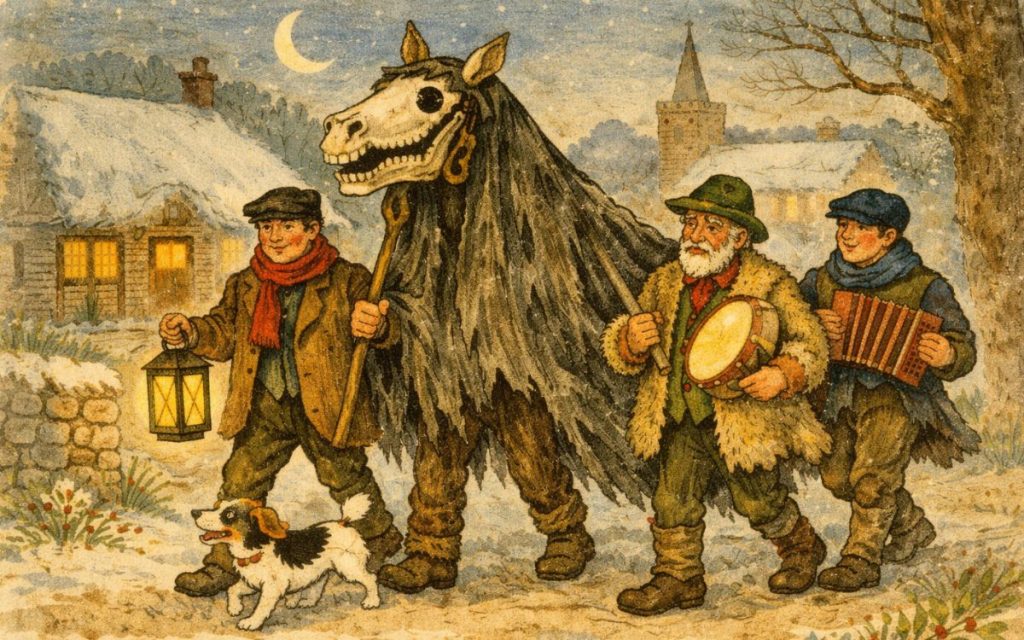
From the 1950s onwards, folk groups and Morris sides brought it back.
New wooden heads were carved, based on old examples from Deal and elsewhere.
Today, the Hooden Horse still appears in East Kent at Christmas events and folk festivals, often alongside Morris dancing, mumming plays and wassailing.
Even now, the image remains unsettling.
A wooden horse’s head, snapping in the dark, carried by a hidden figure, still feels ancient and strange.
In modern Kent, it offers a glimpse of an older world, when winter was dangerous, nights were long, and unexpected visitors at the door were not always welcome.