
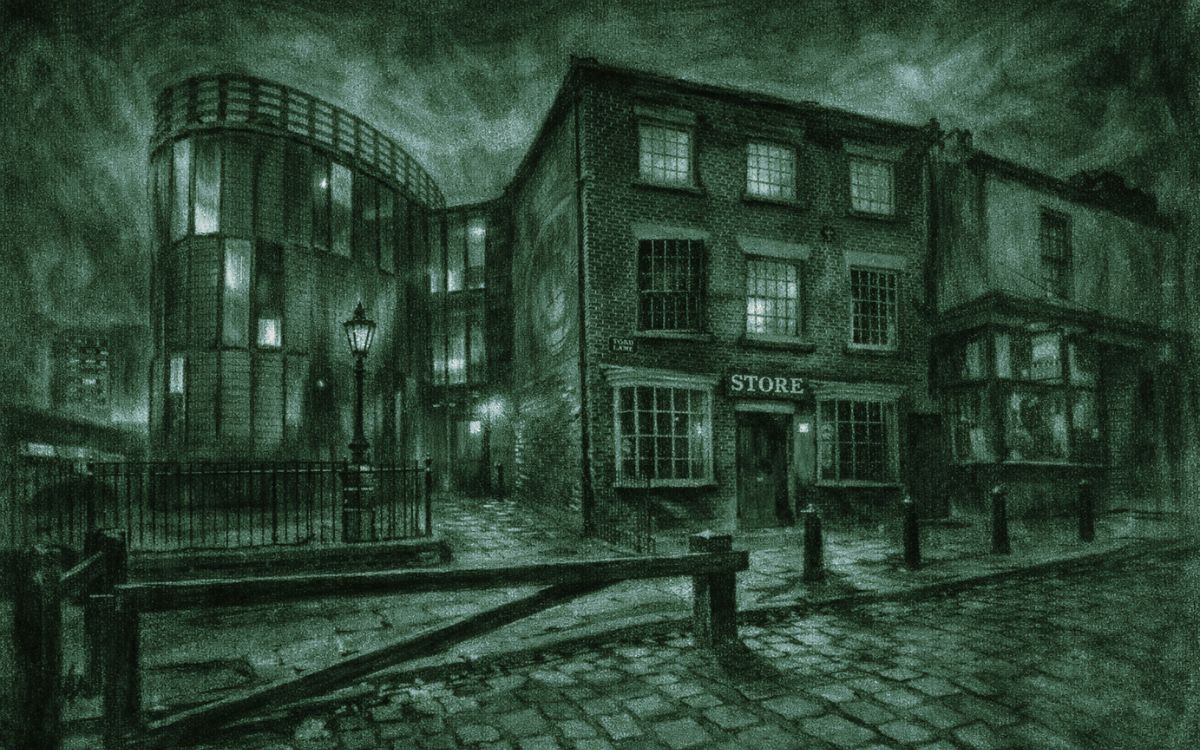
Across from the bustling St Mary’s Gate, a primary road surrounding Rochdale town centre, lies a humble building steeped in history and folklore.
Within the walls of this very building, the Co-operative movement was created. The small shops that we all pop to when we have run out of milk are the legacy of that very movement, and it all began right here in my hometown.
Right here, on the old cobbled road of Toad Lane, which holds secrets, mysteries and stories aplenty.
What is The Pioneers Museum?
The Pioneers Museum is the original building where the 28 members of the Co-operative movement met and founded the Rochdale Principles of fair trade, honest weights and profit share.
Each one of the 28 founding members had been living in poverty, unable to provide enough food for their families; they combined resources and created a community of support.
The actual building was constructed in the early 1800s. It has the appearance of a house spread over three floors, with a simple brick structure and slate roof.
It was initially used as a fleece warehouse before it was adapted to work as a shop in 1844 by the Pioneers.
The Co-operative movement was a social crusade heavily influenced by Robert Owen, a social reformer who had multiple followers known as Owenites.
Connections to Spiritualism
Robert himself had connections to spiritualism and later became a practising spiritualist. His son, Robert Dale Owen, was a prominent spiritualist, and he influenced his father greatly.
Robert began to participate in seances with his son, where he believed he was receiving messages from Benjamin Franklin and Thomas Jefferson.
Robert claimed that these messages were confirmation that his ideas on social reform were correct and his life’s work had been of value.
An interesting concept – the Co-operative movement gaining approval from the afterlife.
The story of the Pioneers and the start of the Co-operative movement are, of course, super important; however, there is another well-known resident, one of the furry variety.
It was a full moon. A gentleman was walking through the churchyard of St Mary’s in the Baum, adjacent to the Pioneers Museum, when he stopped in his tracks.
Terror filled his veins because, from out of the Baum bushes, appeared a giant rabbit creature. Its fur glistened bright white underneath the shimmering moon.
The rabbit had glowing red eyes and locked its gaze with the gentleman. For what felt like an eternity, the two stared at each other in silence, the gentleman frozen in fear, the rabbit creature intrigued.
Ever so slowly, the creature began to rise on its hind legs, increasing its stature and bringing it almost to direct eye level with the gentleman.
He gasped. Why did he take the shortcut through the churchyard?
The rabbit creature slowly began to move towards the gentleman, picking up speed.
Not knowing what to do, he closed his eyes and prepared for the worst. When nothing happened, he peeked through his clammy hands – there was nothing there; the rabbit creature had disappeared.
This encounter established the Baum Rabbit in local folklore, and tales grew of its appearance on the cobbles of Toad Lane and beyond.
It is a tale that is engrained within the Pioneers Museum, one that enthrals audiences young and old, from far and wide.
More spooky tales from Toad Lane
More recently, it has become apparent that the spooky tales of Toad Lane extend into the Pioneers Museum, which seems to have its own otherworldly residents.
Loud knocking on the front door, which, when opened, reveals that there is nobody there – perhaps it is one of the founders arriving late for a meeting.
An account of a male voice whispering in ears, speaking in a thick Lancashire accent not easily understood, but enough to make the hairs stand up on the back of your neck.
Marching and stamping can be heard from the front room downstairs, coming from the floor above, rhythmic and consistent, but there is nobody there.
Could this be the residual energy of the workers when the building was a fleece warehouse?
Strange, unaccountable clanging and banging of metal caught on EVP recorders, and a sense of being watched, have also been encountered.
The preservation of the Pioneers Museum is not only essential in terms of saving the history for generations to come but also of sharing the folklore and ghost stories connected to it.
For it is those stories that also provide a glimpse into our past.