

Regardless of what actually occurred there, the supposed UFO crash just outside Roswell, New Mexico, in 1947 remains the most important and highest-profile UFO-related event in history. Whether you believe it was the site of a genuine UFO crash with bodies or merely a downed weather balloon, if you’ve heard about UFOs at all, it’s probably the case you’ll know.
One reason it became so famous is that the US military initially stated that what had crashed was indeed a flying saucer – an actual UFO, at least at first. This report made it into newspapers not only across America but also in the UK. However, that claim was quickly superseded by a revised explanation that it was merely a downed weather balloon. To support this version, the US military produced intelligence officer Major Jesse Marcel, who was photographed holding pieces of the supposed wreckage while more was scattered around him.
Despite the initial excitement, the story faded away and was largely forgotten until nuclear physicist turned UFO researcher Stanton Friedman unearthed it. Friedman argued that it had been a genuine UFO crash. Partly because of Friedman’s high profile and his appearance before the United States House of Representatives in 1968, the US military revised its explanation once again, this time claiming the wreckage came from a special weather balloon carrying top-secret equipment designed to detect Soviet nuclear testing, known as Project Mogul.
Of course, this revised story raised even more questions. If the authorities had lied in 1947, what else were they lying about? Meanwhile, rumours continued to circulate, including claims that bodies had been recovered or even that a living alien had survived the crash.
The case for a cover-up grew further when Friedman interviewed Jesse Marcel in 1978. Marcel claimed that the material shown in the famous photographs was not what had actually been recovered from the crash site and that he had been ordered to support the weather balloon explanation. Marcel now described the original material as unlike anything he had ever encountered before. Although he never directly claimed it came from a UFO, according to his son, Marcel privately told him it was from another world.
With the publication of the first book on the Roswell incident in 1980, the case became a permanent fixture in ufology – a story that simply would not die.
Now, you may be wondering why this is appearing on Spooky Isles, which is supposed to focus on UK-based strangeness. The reason is that, despite the alleged crash taking place in New Mexico, the next major twist in the Roswell story occurred here in Britain. More specifically, at the Museum of London.
In 1995, a small UK-based publishing company announced that it had acquired genuine footage of one of the occupants of the crashed UFO being autopsied. The company’s two main figures, Ray Santilli and Gary Shoefield, claimed they had obtained the footage while buying film and stills of early Elvis Presley performances during a trip to the United States in 1993.
After acquiring one particularly early Elvis film from a man they referred to only as “the Cameraman”, this mysterious figure supposedly offered them something else he had filmed while serving in the military during the 1940s. At the time, Santilli and Shoefield were in Cleveland, while the Cameraman lived in Florida, more than 1,000 miles away. Shoefield was not interested in making the trip, so Santilli travelled alone.
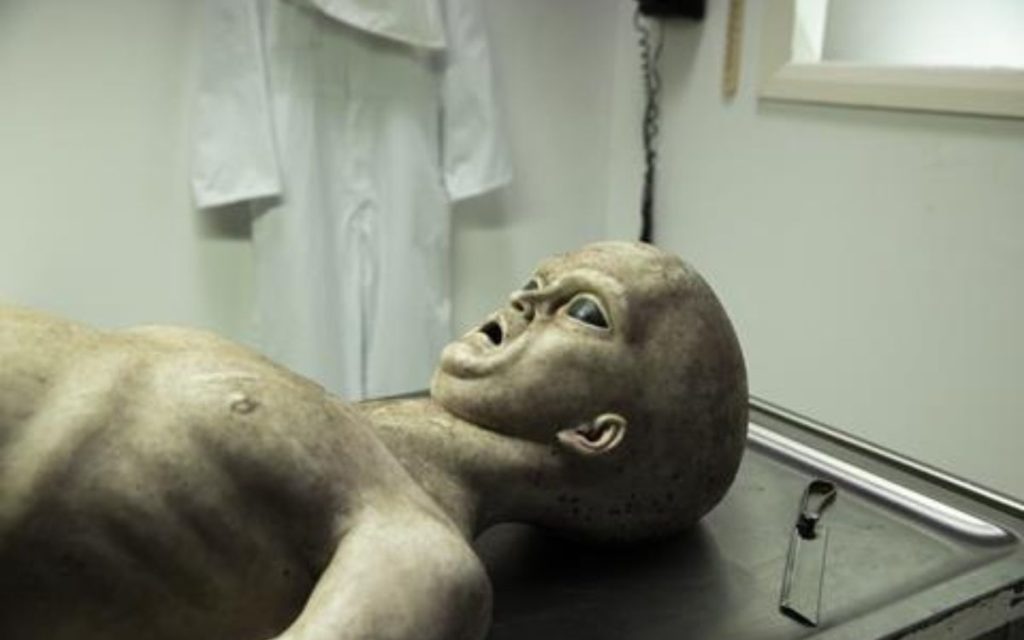
Santilli later described being shown sealed film canisters which the Cameraman claimed had not been opened since the footage was developed. According to Santilli, the reels contained footage of an alien autopsy, along with scenes showing wreckage from the crashed UFO.
Amazed by what he was seeing, Santilli wanted to buy the footage immediately. Unfortunately, the Cameraman’s asking price was $100,000 – far beyond what Santilli could afford. To cut a long story short, it took him two years to raise the money.
Despite not yet owning the footage, Santilli had already been speaking to members of the British UFO community, including author and researcher Philip Mantle. Word of the film’s existence began leaking out, almost certainly by design. By the time Santilli finally acquired it, anticipation had reached fever pitch.
To capitalise on the growing interest, Santilli and Shoefield hired the Museum of London and invited not only UFO enthusiasts but members of the press and even religious figures to attend a special screening.
According to those present, the audience watched in stunned silence. Was this real? Had the US military really autopsied an alien body? What had happened to the body? Who had filmed the footage?
These were questions Santilli and Shoefield either claimed they could not answer or simply avoided.
The Museum of London screening formed part of a larger marketing strategy. The footage would eventually be broadcast around the world in a simulcast carried by major television networks. Of those shown the material in May 1995, Fox Television in the United States showed the greatest interest.
Part of Santilli and Shoefield’s plan involved releasing the footage on a specific date – 28 August 1995 – leaving Fox only three months to prepare. The result was Alien Autopsy: Fact or Fiction, hosted by Jonathan Frakes of Star Trek fame.
The viewing figures were enormous. The programme proved so successful that Fox repeated it the following evening.
However, the broadcast raised more questions than it answered.
The biggest was obvious: who exactly was the mysterious Cameraman?
Santilli and Shoefield refused point-blank to reveal his identity. Instead, they filmed a supposed interview with him, heavily disguised and sitting in a darkened room. He claimed he had been present at Roswell and had personally filmed the autopsy.
Unfortunately for them, their attempt at concealment was flawed. Rather than properly obscuring his features, they had merely reduced the video’s contrast. By increasing the contrast, viewers could see much more clearly that the man appeared to be wearing a rather crude mask.
Combined with his wooden delivery, suspicion continued to grow.
Even so, Santilli and Shoefield managed to keep the truth hidden for almost a decade.
Then, around 2005, Philip Mantle was contacted by someone claiming to know the artist who had created the alien body seen in the footage. This appeared to confirm Mantle’s long-held suspicions that all was not as it seemed. The contact even offered to put Mantle directly in touch with the sculptor.
Before that could happen, however, everything suddenly went quiet.
In April 2006, the feature film Alien Autopsy, starring Ant and Dec, was released. The film told the story of how Santilli and Shoefield had faked the entire thing – or, as Santilli preferred to put it, “reconstructed” the footage.
Suddenly, the truth was out.
Santilli now claimed that, between seeing the original footage in 1993 and purchasing it in 1995, it had deteriorated so badly that it became unusable, leaving behind little more than dust and blank film.
However, the truth had already begun leaking out.
Just days before the film’s release, Sky Television broadcast an investigative documentary hosted by Eamonn Holmes. In it, Santilli admitted that the footage they had spent a decade selling on home video was not the original autopsy film.
By then, however, Santilli and Shoefield had already made a considerable amount of money.
The revelation was effectively forced upon them because people involved in the deception were beginning to come forward. This included not only the sculptor who created the alien body but also the cameraman who actually filmed the footage.
Ironically, the sculptor turned out to be the same individual who had originally been offered to Mantle as a whistleblower. He had gone quiet because he had been hired to recreate the alien body for the Alien Autopsy feature film and had signed a non-disclosure agreement.
Mantle had already worked out who he was. Their mutual contact had revealed that the artist had also created the model used for Max Headroom, the television personality designed to resemble a computer-generated character.
The sculptor appeared in the Holmes documentary and was identified as John Humphreys. In fact, Humphreys can also be seen in the footage itself as one of the people carrying out the autopsy.
Interestingly, the documentary did not identify the cameraman. While the Holmes programme left the matter unresolved, he is named in the newer Sky documentary The Alien Autopsy Scandal.
Since then, the cameraman has reportedly attempted to sue the programme makers, so perhaps it’s best not to name him here. A quick online search will reveal his identity anyway.
Rather cleverly, the makers of The Alien Autopsy Scandal used audio interviews but had actors lip-sync the words on screen. It is a neat technique that was also used in the Enfield Poltergeist documentary previously reviewed on Spooky Isles.
So, was any of it real?
According to Santilli, some of it was. He claims that a handful of frames from the original footage were inserted into their reconstruction. Both Santilli and Shoefield maintain that they possessed a few genuine frames showing the autopsy room and that these were used to recreate the set.
However, when asked to produce those frames for independent examination, they refused.
They also seem uncertain about which scenes are supposed to be original. Certain sequences identified as genuine in the Holmes documentary are not identified as such in the newer Sky production.
At the end of the day, it appears that the entire affair was one enormous con from start to finish.
While the above provides the broad outline, the new Sky documentary explores the story in much greater detail. It examines the original Roswell incident, those involved in both the alleged crash and subsequent investigations, and how the footage took on a life of its own far beyond anything Santilli, Shoefield or almost anyone else could have imagined.
It also reveals that the footage most people have seen was actually their third attempt to fake – sorry, “reconstruct” – the original film Santilli claimed to have viewed in the home of a retired military cameraman in Clearwater, Florida, in 1993.
If you’d like to hear me discussing the case and the documentary The Alien Autopsy Scandal with Philip Mantle, check out my new podcast, The Cryptic Files Podcast, available on Spreaker.