

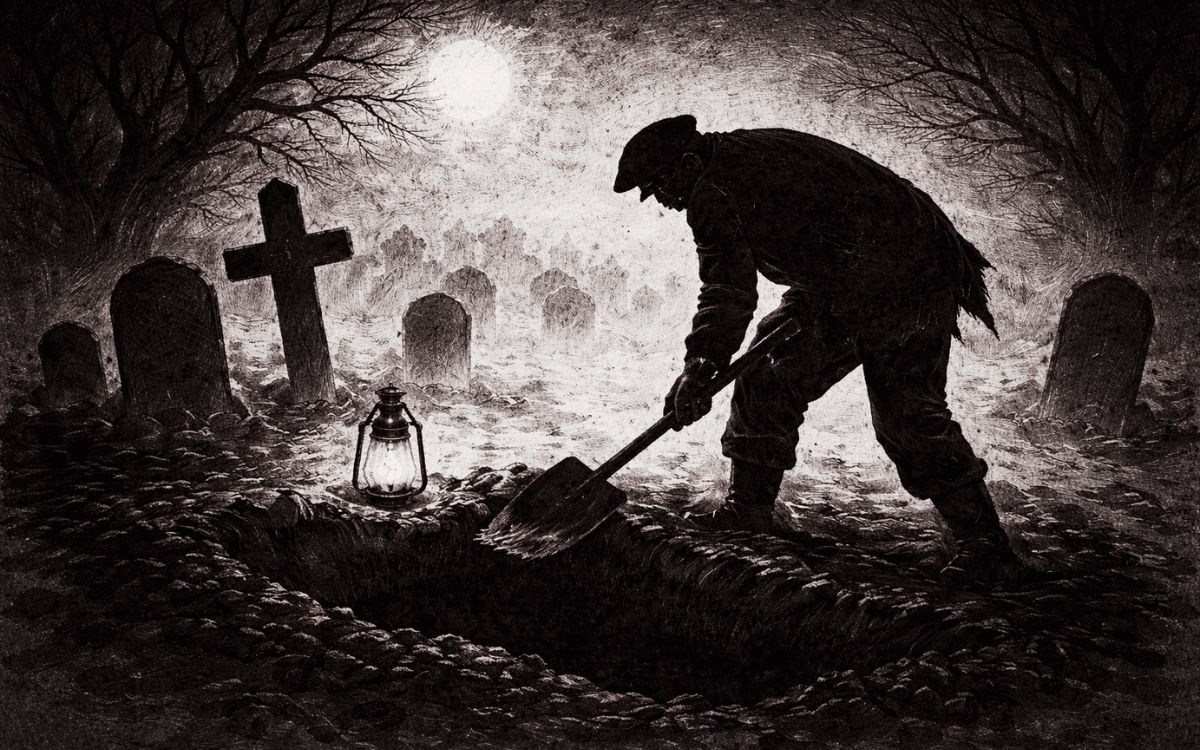
In the early 19th century, London was no stranger to grim trades.
Among the most notorious were the resurrectionists – men who robbed graves and sold the bodies to medical schools desperate for cadavers.
With no legal system in place to provide a steady supply for anatomy lessons, doctors and students often turned a blind eye to where the bodies came from.
Entire businesses sprang up offering “secure” coffins, while taverns near Smithfield Market became known as gathering spots for body-snatchers.
But in 1831, a gang from Bethnal Green took this sordid trade to a darker level.
From the Graveyard to Murder
The gang consisted of John Bishop, Thomas Williams, James May and Michael Shields.
For years, they had done what many resurrectionists did – dig up corpses and sell them to surgeons.
But by autumn 1831, they decided that digging was too much effort. The dead were no longer enough.
On 5 November 1831, they lured a young Italian street boy away from Covent Garden.
The child, later known as the Italian Boy, was drugged with laudanum and drowned in a well at their squalid lodgings in Nova Scotia Gardens, Bethnal Green.
The next day, Bishop and Williams carried the body across the city to King’s College School of Anatomy, where they asked for 12 guineas – a tidy sum for a single corpse.
A Surgeon’s Suspicion
At first glance, it looked like another ordinary transaction. But surgeon Richard Partridge noticed something unusual.
The body was too fresh – no smell of the earth, no signs of decay. The boy’s forehead bore a wound inconsistent with a burial.
Sensing foul play, Partridge delayed payment and alerted his colleagues. By the time the authorities arrived, the gang’s grim trade was exposed.
The Trial of the London Burkers
The arrests caused a sensation. Newspapers dubbed the men the London Burkers, linking them directly to the infamous Burke and Hare murders in Edinburgh.
At the Old Bailey trial in December 1831, Bishop and Williams were found guilty of murder and hanged outside Newgate Prison before a crowd of thousands.
May, though implicated, escaped the noose and was transported to Australia, where he died a few years later.
After conviction, Bishop confessed to supplying hundreds of bodies to surgeons over more than a decade. Chillingly, he admitted to killing other victims, including a woman named Frances Pigburn and a boy called Cunningham.
Aftermath and Reform
The case shocked London and added weight to the growing calls for reform.
Public anger was not just directed at the killers but also at the medical profession that had fuelled the trade.
In 1832, Parliament passed the Anatomy Act, which for the first time allowed unclaimed bodies from workhouses and hospitals to be legally used for dissection.
This measure cut off the market for stolen – or freshly murdered – corpses.
In a grim twist of fate, the bodies of Bishop and Williams were themselves dissected after their execution, giving students one last anatomy lesson courtesy of London’s most infamous resurrectionists.