

In English we reach for one word. Giant. It covers a chalk figure on a Dorset hillside, a wrestler hurled from a Cornish cliff in a twelfth-century chronicle, and the sea-born adversaries of the Tuatha Dé Danann.
The word is useful. It is also lossy. British and Irish tradition keeps several kinds of being under that single label, and they do not all mean the same thing.
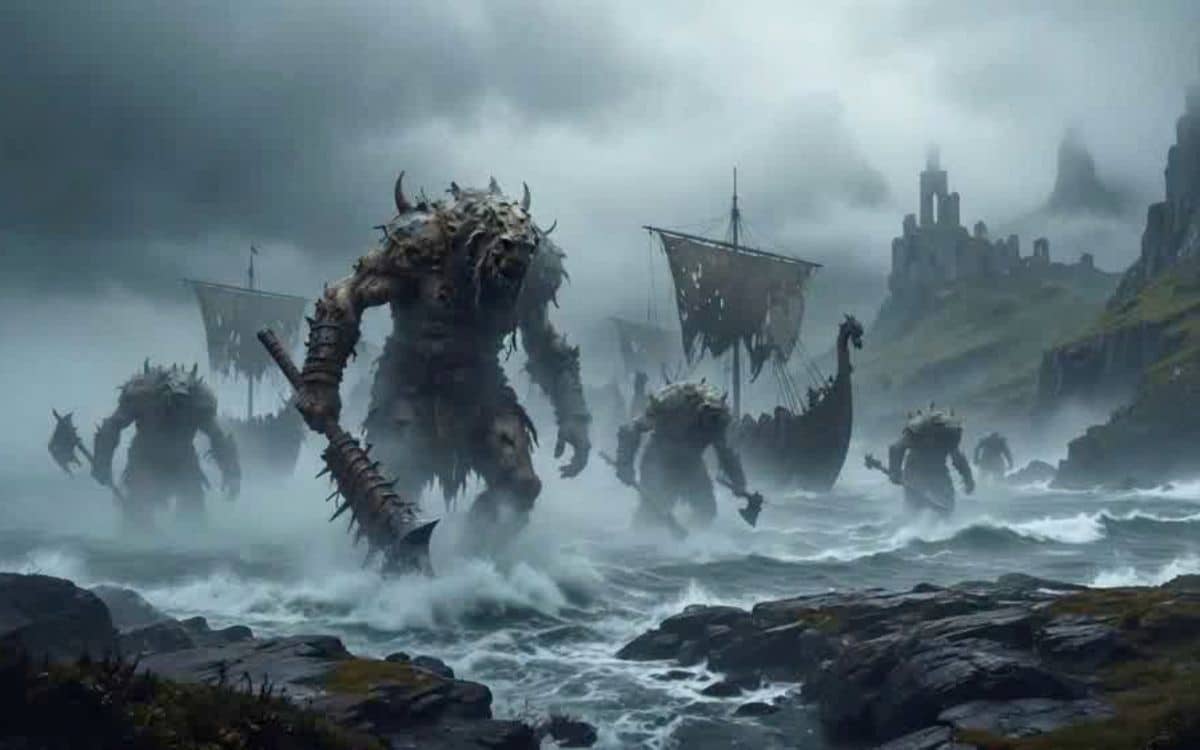
Start in Ireland. The Fomorians (Old Irish Fomóire, modern Fomhóraigh) are the adversary race of early Irish narrative.
In the oldest layer they dwell under the sea or under the worlds of men. Later tellings cast them as sea raiders. Later still, popular folklore and classical comparison push them toward outright gigantism.
What medieval sources often remember first about their rule is not height. It is tribute, fear, and a ban on teaching poetry and law.
Their overthrow is a family matter: Balor falls to Lugh, his own grandson, in Cath Maige Tuired (The Second Battle of Mag Tuired), a Middle Irish narrative edited by Whitley Stokes (1891) and later by Elizabeth A. Gray for the Irish Texts Society (1982).
Lebor Gabála Érenn (The Book of the Taking of Ireland), compiled from the eleventh century onward and edited by R. A. S. Macalister, folds the same race into a Christianised origin scheme for Ireland.
That scheme is valuable and it is not a neutral pagan transcript. When the texts disagree about who the Fomorians were, the seam is showing.
Call them “giants” alone and you lose the underworld origin, the sea-raider phase, and the politics of tribute.
Still in Ireland, landscape lore uses giants to explain the land itself. The Giant’s Causeway on the Antrim coast is a clear case.
Popular tradition credits the hexagonal basalt to Fionn mac Cumhaill (Finn MacCool), who builds a road toward Scotland to meet the giant Benandonner. In the Fenian Cycle, Fionn is a hero with extraordinary gifts, not a landscape-scale giant.
W. B. Yeats noted the pattern in Fairy and Folk Tales of the Irish Peasantry (1888): pagan gods shrink into fairies in popular imagination, while pagan heroes grow into giants.
The Irish placename tradition for the Causeway also remembers Clochán na bhFomhóraigh, “stepping stones of the Fomorians”, a reminder that the same stones have carried more than one giant label.
Geology gives one answer. Folklore keeps two.
Cross the Irish Sea and the job of the word shifts again. Wales and Cornwall add foundation stories rather than basalt bridges.
Geoffrey of Monmouth’s Historia Regum Britanniae (c. 1136) has Gogmagog, last of Albion’s giants, wrestled by Corineus and thrown from a cliff.
Effigies of Gog and Magog later stand in London’s Guildhall and still walk in civic pageantry. Whether Geoffrey drew on local tradition or invented the bout is debated.
The point for readers is simpler: here “giant” names a primordial race that must be cleared so a new people can claim the island.
That is a different job from Fomorian tribute, and a different job from explaining Antrim columns.
Even the Cerne Abbas Giant, the famous chalk outline above Cerne Abbas in Dorset, sits awkwardly under the word.
It is a real figure cut into the hillside and long treated as ancient pagan lore. Recent archaeological work associated with the National Trust has argued for a much later date than Victorian romanticism preferred.
Landscape “giants” can be chalk, story, geology, or civic theatre. The English word does not tell you which.
Why does the label matter for UK and Irish folklore writing? Because collapsing these figures into one type flattens the archive Spooky Isles readers care about.
A Fomorian who forbids the bards is not the same being as a Cornish cliff-wrestler, or as Fionn enlarged by later storytelling to fit a causeway.
Sources stay clearer when we keep the seams: Middle Irish narrative and Lebor Gabála for Ireland; Geoffrey and local place-lore for Albion; geology beside tradition for the Causeway.
Other European “giants” can wait. British and Irish material already gives more than enough variety inside one English word.
SILVIO METER runs Giants Codex (www.giantscodex.com), a sourced catalogue of giant traditions. Free door for Fomorians: www.giantscodex.com/giants/fomorians