

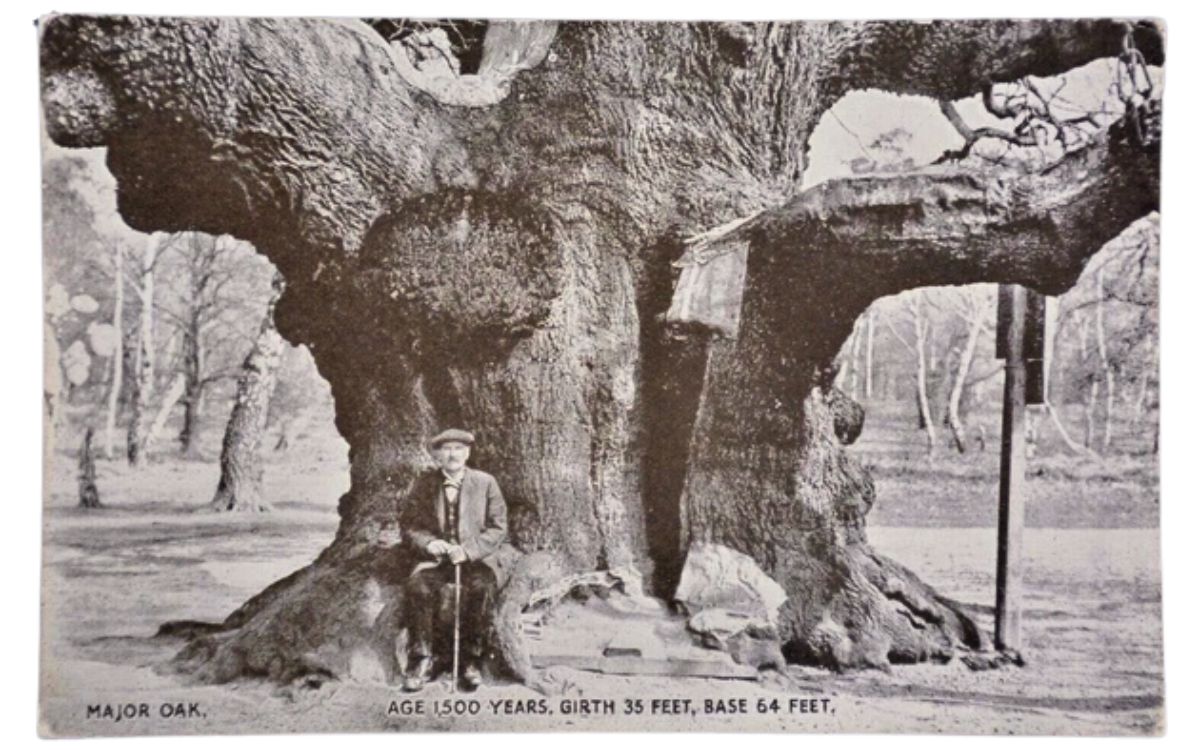
When reports emerged that the Major Oak in Sherwood Forest had finally died, many people felt they had lost an old friend.
That may sound strange. After all, Britain has millions of trees. Many are older than buildings we treasure and protect.
Yet the Major Oak was never just a tree. For centuries it has been linked to Robin Hood, England’s greatest folk hero. Visitors from around the world have travelled to Sherwood Forest to stand beneath its vast branches and imagine the legendary outlaw hiding among the trees.
Whether Robin Hood ever saw the Major Oak is doubtful. Whether he existed at all is another question entirely.
Yet that uncertainty is part of what makes the tree so fascinating.
What Is the Major Oak?
The Major Oak stands in the heart of Sherwood Forest in Nottinghamshire. It is one of Britain’s oldest and most celebrated trees.
Experts believe it is between 800 and 1,100 years old. If those estimates are correct, the tree may already have been growing when William the Conqueror invaded England in 1066.
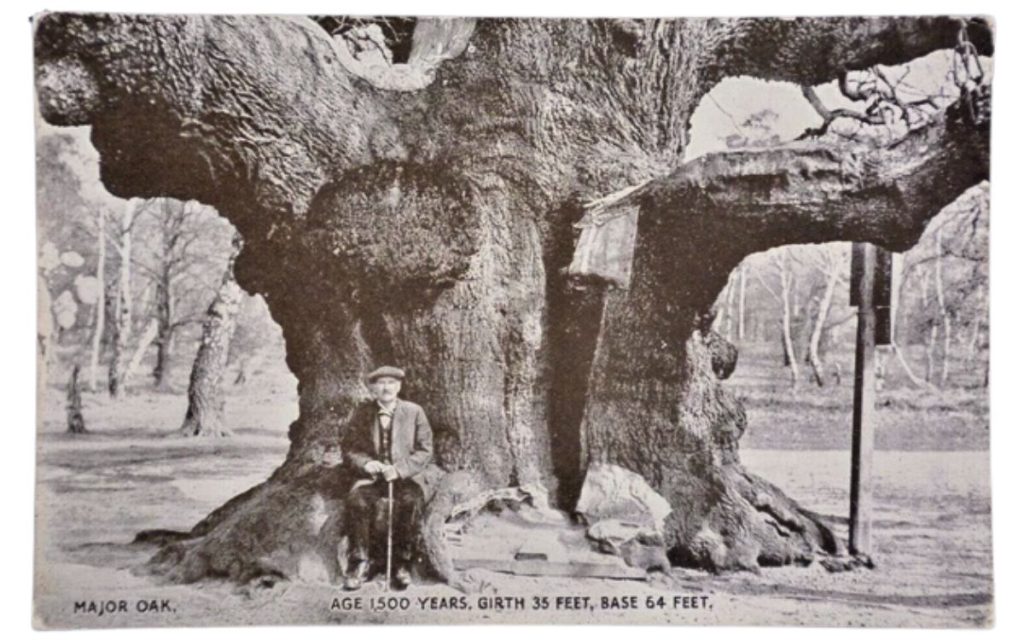
Its enormous trunk measures around ten metres in circumference. Its sprawling branches are so heavy that many have long been supported by props.
The tree takes its name from Major Hayman Rooke, an 18th-century antiquarian who studied Sherwood Forest and recorded many of its ancient features.
Before then, local people knew it as the Cockpen Tree.
Today, however, it is known throughout the world as Robin Hood’s tree.
Why Is the Major Oak Linked to Robin Hood?
The connection between Robin Hood and the Major Oak is not as ancient as many people assume.
The earliest Robin Hood ballads do not mention the tree. Nor do they identify a specific hideout in Sherwood Forest.
The link appears to have developed over time.
By the 18th and 19th centuries, visitors were arriving in Sherwood Forest hoping to see places connected with England’s most famous outlaw. The Major Oak was already one of the largest and most impressive trees in the forest. It quickly became the obvious candidate.
Local guides and writers began presenting it as Robin Hood’s headquarters. Some claimed he sheltered beneath its branches. Others suggested the hollow trunk could have hidden Robin Hood and his Merry Men from the Sheriff’s men.
There is no evidence that any of this happened. Indeed, there is no firm evidence that Robin Hood himself ever existed.
Historians have searched for a real Robin Hood for centuries. Several candidates have been proposed. None has been universally accepted. Most scholars now believe Robin Hood was probably created from a mixture of folk tales, historical figures and popular imagination.
Yet folklore rarely depends on proof.
People wanted Robin Hood to have a home. The Major Oak provided the perfect one.
Over time, the legend and the tree became inseparable.
Robin Hood, Sherwood Forest and English Folklore
Robin Hood occupies a unique place in English folklore.
Unlike King Arthur, he is not associated with castles and kings. Unlike saints, he is not connected to religion.
He belongs to the forest.
He is the outlaw who robs the rich and helps the poor. He stands against corrupt authority. He survives through wit, courage and loyalty.
Whether real or fictional, Robin Hood became a symbol of resistance and fairness.
Sherwood Forest became part of that story.
The Major Oak became part of it too.
Visitors did not come to the tree because they believed it was historically proven. They came because it felt right. Standing beneath its branches, it is easy to imagine archers, campfires and secret meetings among the trees.
Folklore often works that way.
Places become meaningful because generations of people agree they are.
Not to Be Confused with the Other Robin Hood Tree
The Major Oak is sometimes confused with the Sycamore Gap tree in Northumberland.
That tree became known as the Robin Hood Tree after appearing in the 1991 film Robin Hood: Prince of Thieves.
The Sycamore Gap tree was felled in 2023, causing outrage across Britain.
The Major Oak is different. Its fame comes not from cinema but from the Robin Hood legend itself.
For many people, it is the original Robin Hood tree.
Other Famous Folklore Trees in Britain and Ireland
The Major Oak is not the only tree surrounded by legend.
Across Britain and Ireland, ancient trees continue to inspire stories and superstition.
- The Fortingall Yew, Perthshire: One of Europe’s oldest living trees, believed to be several thousand years old.
- The Birnam Oak, Perthshire: Associated with Shakespeare’s Macbeth and the legendary Birnam Wood.
- The Ankerwycke Yew, Berkshire: An ancient tree linked to Magna Carta and centuries of local folklore.
- The Crowhurst Yew, Surrey: A remarkable churchyard tree associated with local ghost stories.
- The Gospel Oak, London: A historic boundary tree that gave its name to an entire district.
- The Fairy Trees of Ireland: Lone hawthorns traditionally believed to be associated with the fairy folk.
- The Clootie Trees of Scotland: Trees decorated with offerings left beside sacred wells.
Many of these trees attract visitors for the same reason as the Major Oak.
People are drawn to places where history and folklore overlap.
Why Ancient Trees Matter
Ancient trees remind us that stories need places.
A legend may begin with words, but it survives because it becomes attached to landscapes, buildings and landmarks.
The Major Oak gave people something tangible. It transformed Robin Hood from a character in old ballads into someone who felt almost real.
Whether Robin Hood was a historical outlaw, several people merged into one character or simply a figure of legend matters less than the role he plays in English culture.
The same is true of the Major Oak.
The tree may have reached the end of its natural life. Its story has not.
As long as people tell tales of Sherwood Forest, Robin Hood and his Merry Men, England’s most famous tree will continue to grow in the imagination.