Christopher Lee’s Fu Manchu films remain one of the most controversial chapters in cult cinema. DAVID TURNBULL explores Harry Alan Towers’ bold yet problematic Fu Manchu film cycle of the 1960s
Fu Manchu, created by Sax Rohmer, was a controversial character from the outset.
On the one hand a carefully constructed supervillain with no less than five different university doctorates and a penchant for poisons, hypnotism and the occult.
On the other hand, a racial stereotype, pandering to the yellow peril xenophobia of the Edwardian era.
His transposition onto the big screen cemented this controversy with predominantly white European actors in ‘yellow face’ make-up as the evil oriental crime lord.
Starting with Dublin=born Harry Agar Lyons in the Stoll Pictures silent matinee serials of the 1920s, Warner Oland, Boris Karloff and John Carradine were amongst the white actors to then don the Mandarin attire and famous drooping moustache.
A 1956 American television series, The Adventures of Fu Manchu, with Glen Gordon upping the racial stereotyping in the lead role, caused such a backlash from the Chinese and Asian communities that the show was cancelled after one season.
It would be a full decade before anyone dared to reinterpret the character on screen once more. Harry Alan Towers was born in Wandsworth in south London in 1920.
His early career had saw him forge a productive partnership with Orson Welles, producing the BBC radio serials The Lives of Harry Lime, The Black Museum and an adaptation of Sherlock Holmes in which Welles played Moriarty.
Harry Alan Towers and the Reinvention of Fu Manchu
By the early sixties however Towers was living a life that could easily have been the plot for a movie. He had been arrested in New York in 1961 for alleged involvement in a vice ring, which in turn was rumoured to be connected to a KGB spy network.
Skipping bail, he fled the country and was wanted by the FBI. To stay afloat, he pioneered a high-speed, low-cost, slash and burn movie production model that later became known as grindhouse.
Due to his fugitive status, he would often film in tax friendly, extradition safe locations such as South Africa, Ireland and Hong Kong.
Towers was a huge fan of the Fu Manchu character and considered him to be the greatest imaginary villain ever created. In a stroke of genius, he negotiated a deal with Sax Rohmer’s widow, Elizabeth, whereby he purchased the cinema rights to Fu Manchu and all of Rohmer’s other characters for £70,000.
Because he purchased the rights to the characters, he was free then to write original scripts under his pen name Peter Welbeck without having to pay royalties for the adaptation of any of the original novels. Towers claimed that he had acquired the Fu Manchu character rights in perpetuity and although there was no documentation to back up the assertion, no one ever challenged this.
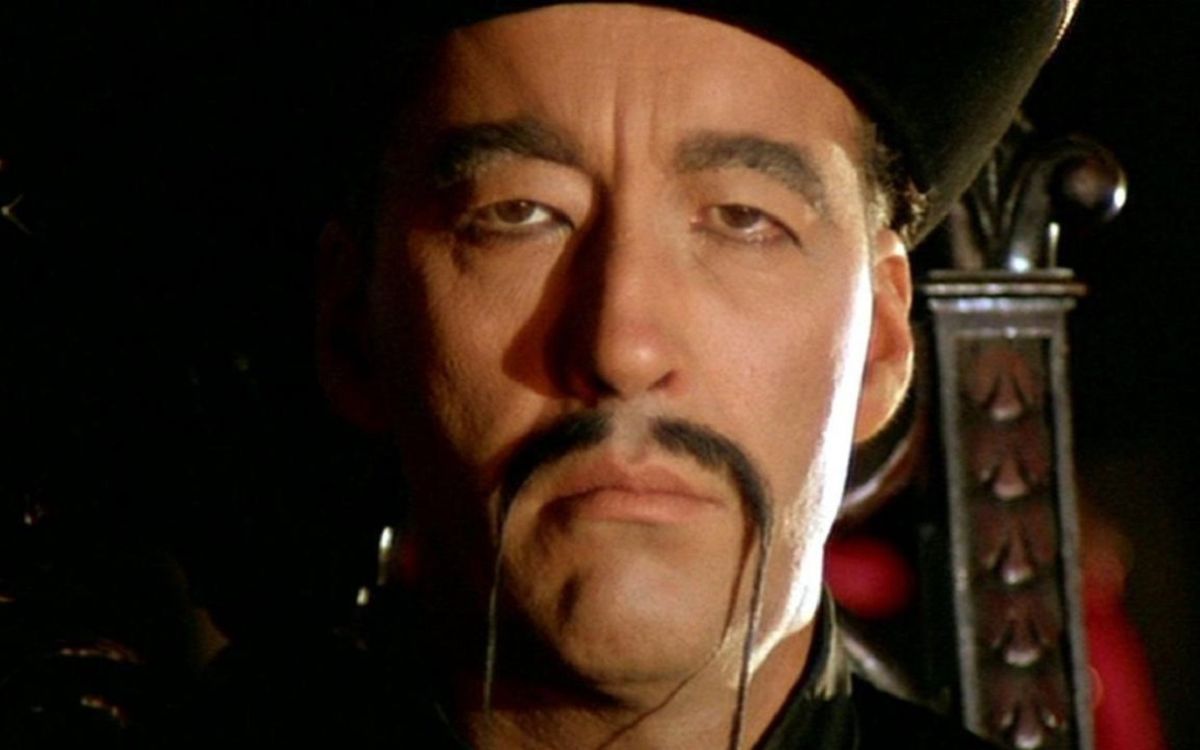
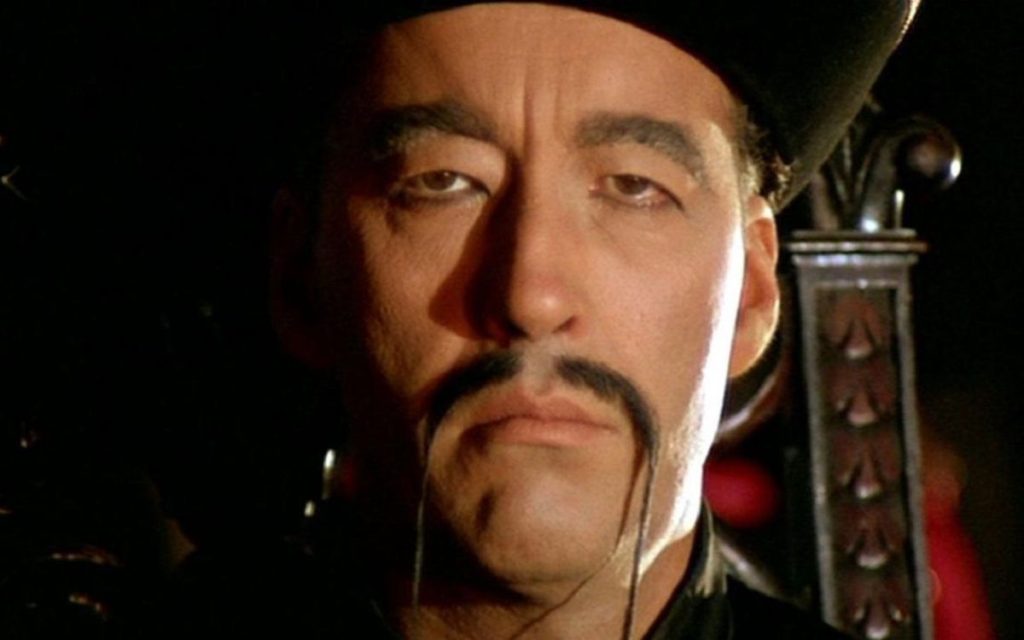
For his version of Fu Manchu Towers chose screen legend Christopher Lee, whose tall, menacing stature and brooding looks were perfect for the criminal mastermind.
The make-up artist tasked with the controversial ‘yellow face’ transformation of Lee into the Devil Doctor was Gerry Fletcher, who would later work with Lee on Dracula AD 1972 and would also be the make-up artist on the cult film A Clockwork Orange.
Lee would spend two to three hours each day having bronze greasepaint foundation applied to darken his skin tone. Spirit gum was used to pull his eyelids down at the sides and putty was used to thicken the bridge of his nose.
His natural eyebrows would be blocked out with wax and replaced with thinner versions designed to enhance a sinister look. Finally, the trademark Fu Manchu moustache would be glued to his upper lip.
Lee himself worked closely with the wardrobe assistants to ensure Fu Manchu’s Mandarin style robes were high-collared and stiff, which helped him maintain the rigid, imposing posture that became a feature of his performance. He was quoted as saying once that he wanted the costumes to feel like ‘ceremonial armour’.
The Fu Manchu Film Cycle: 1965–1969
Lee’s co-star was Tsai Chin. Born in Tianjin, China in 1933, she was the first Chinese actress to study at RADA.
She played Fu Manchu’s daughter, Lin Tang, who she depicted as occasionally being more perceptive than her father and frequently far more sadistic and cold blooded. She was often dispatched to spy on Fu Manchu’s enemies disguised as housekeepers or servants.
Critics often commented that the on-screen chemistry between Lee and Tsai Chin made their portrayal of their villainous characters much more formidable than the ‘heroes’ of the films.
Another mainstay of the Towers’ Fu Manchu cycle was Howard Marion-Crawford in the role of Dr Petrie, the ‘Watson’ to Scotland Yard detective Nayland Smith. In fact, he had played Watson in the 1954 Sherlock Holmes television series.
The role of Nayland Smith was played at different times by three different actors – Nigel Green, Douglas Wilmer and Richard Greene, famous for his 1950s lead role in the Robin Hood television series.
In all Towers produced five Fu Manchu movies over the five-year period between 1965 and 1969.
- The Face of Fu Manchu (1965)
- The Brides of Fu Manchu (1966)
- The Vengeance of Fu Manchu (1967)
- The Blood of Fu Manchu (1968)
- The Castle of Fu Manchu (1969)
The films combined an international Bond spy vibe with a bit of 1960s Batman campness thrown in for good measure. Fu Manchu and Lin Tang would hole up in some exotic subterranean lair with their henchmen, preparing to bring the world to its knees with their latest weapon of mass destruction.
Meanwhile Nayland Smith and Dr Petrie would be hot on their trail.
In each film it would appear that Fu Manchu and Lin Tang had been defeated and killed, only for Lee’s baritone voice to echo an ominous warning to cinema goers – ‘the world shall hear from me again’.
The first film in the cycle starts with Nayland Smith witnessing the graphic and gruesome beheading of Fu Manchu at the hands of the Chinese Imperial authorities. Of course, he is not really dead, and the world is about to hear from him again.
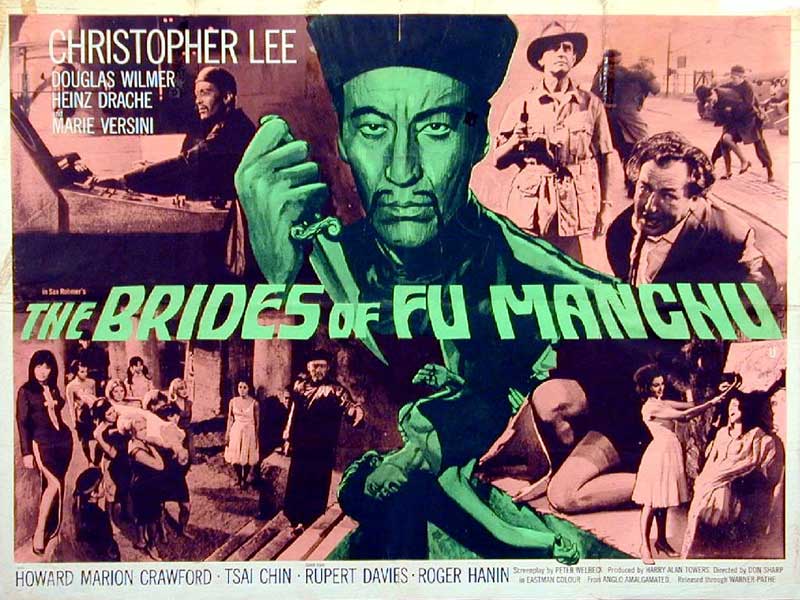
The Face of Fu Manchu and The Brides of Fu Manchu were directed by Don Sharp, who had directed Hammer’s Kiss of the Vampire in 1963. He had also previously directed Lee in The Devil-Ship Pirates (1964) and would also direct him in Rasputin, the Mad Monk, made in the same period as the first two Fu Manchu outings.
Sharp used locations in Ireland to depict Nayland Smith’s Edwardian London and Fu Manchu’s east end Limehouse stomping ground.
For the first film Towers’ Peter Welbeck script sticks with the locale of Sax Rohmer’s early novels, having Fu Manchu’s lair located in the sewers beneath the Thames.
Fu Manchu and his daughter have kidnapped a German scientist and are forcing him to develop a biochemical weapon derived from the Black Hill poppy. To demonstrate its power, they unleash the toxic poppy gas on a village on the Essex marshes, wiping out the entire population.
It is up to Nayland Smith and Dr Petrie to save the day before more atrocities are committed.
The Brides sees Fu Manchu and Lin Tang return from the dead once more. This time their lair is an island fortress off the coast of north Africa.
Here they have the kidnapped wives and daughters of prominent scientists who are chained up in the dungeons and being used as leverage to blackmail the scientists into working on their latest weapon, a radio controlled death ray.
The power of this weapon is demonstrated by the destruction of the Windsor Castle, a pleasure ship where women and children are being entertained on deck.
Burt Kwouk, Cato in the Pink Panther films, is amongst the cast members as Fu Manchu’s assistant, shot dead when he refuses his master’s orders to crank the death ray up to full power.
Again, Smith and Petrie save the day with the destruction of the island fortress.
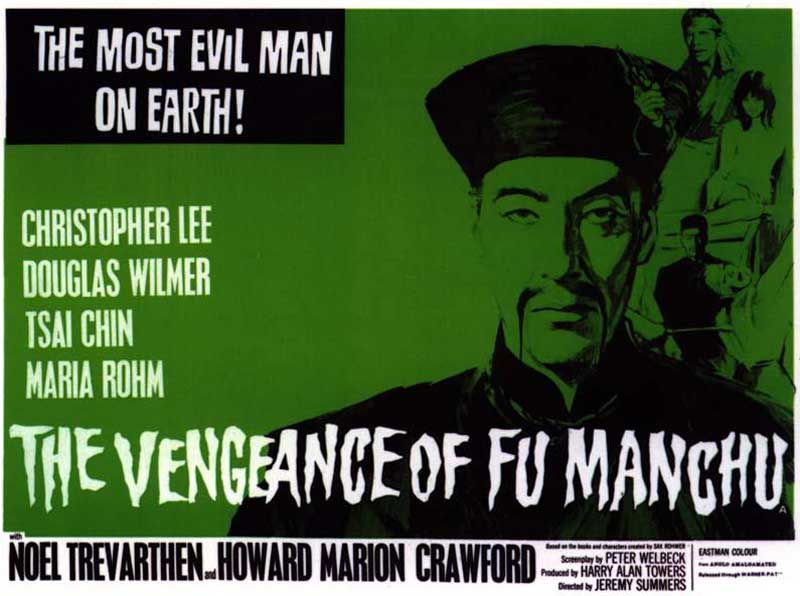
For The Vengeance of Fu Manchu Jeremy Summers, known for his work on 1960s television serials such as The Baron, The Saint and The Avengers, stepped into the director’s chair.
This time Fu Manchu and Lin Tang have taken over a temple in Hong Kong. Towers had made a deal to use the famous Shaw Brothers kung fu studio in Hong Kong.
This enabled him to make no less than three films back to back. Five Golden Dragons, with a cameo appearance from Christopher Lee, was also directed by Jeremy Summers, while The Million Eyes of Sumuru, based on another Sax Rohmer villain, was directed by Lindsay Shonteff.
Towers’ wife, Maria Rohm, appeared in all three films.
The plot of Vengeance sees the kidnap of a brilliant plastic surgeon who is forced to create an exact doppelganger of Nayland Smith. This double is sent to London to commit a series of murders in order to frame the real detective and allow Fu Manchu to extract his revenge.
The film culminates with the destruction of the temple and Fu Manchu and his daughter apparently dead in the rubble. But as we know the world would hear from him again.
For the last two films in the cycle Towers teamed up with legendary Spanish maverick Jess Franco.
The Decline of Fu Manchu on Screen
The Blood of Fu Manchu was filmed in Barcelona. The Fu Manchu lair on this occasion was located in a lost city deep in the interior of the Amazon jungle.
Again, this was filmed back to back with a Sumuru movie, The Girl from Rio, also directed by Franco. Franco spliced some footage from The Girl from Rio into the Fu Manchu film.
It would be several years before Shirley Eaton, who played Sumuru, even realised she appeared in The Blood of Fu Manchu.
In this film Fu Manchu and Lin Tang discover there is a species of snake whose venomous bite has no effect on women. But if these women kiss a man the poison transferred into his system is deadly.
Ten women are assembled as assassins. Each bitten by the snake and sent by Fu Manchu across the globe to bring down his enemies.
Nayland Smith, by now played by Richard Greene, succumbs to the deadly kiss which immediately renders him blind.
It is then a race against time for Nayland and Petrie to find the Amazonian lair and the antidote before the detective dies.
Their assault on the lost city is aided by a local bandit played by Ricardo Palacios, who also had similar roles in A Fistful of Dollars and Once Upon a Time in the West.
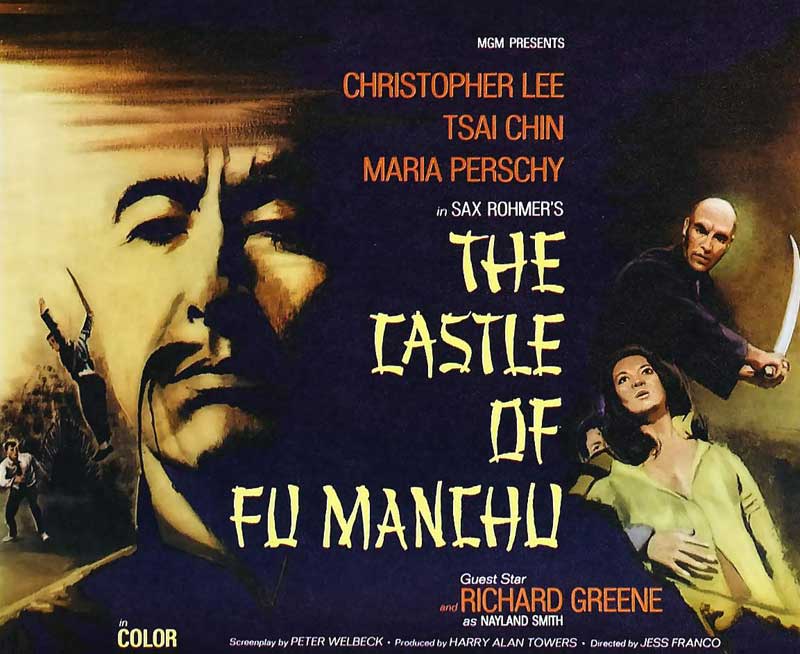
The Castle of Fu Manchu, the last in the series, is considered by critics to be by far the worst.
The castle in question is in Anatolia in Turkey. From here Fu Manchu and Lin Tang are threatening the world with a new weapon which can freeze oceans.
Towers was experiencing cash flow problems and production values had deteriorated. Franco compensated by using stock footage from other films.
For example, the scene where Fu Manchu sinks an ocean liner with an iceberg is culled from the 1958 Titanic movie A Night to Remember.
And the scene from The Brides where Burt Kwouk is shot dead is resurrected as an implausible part of the narrative with no real context.
Fight scenes from The Vengeance of Fu Manchu were recycled and the destruction of the castle at the end is from the first film, The Face of Fu Manchu.
The film flopped. It was panned by the critics.
Lee said it was amongst the worst things he had ever done. It effectively killed the franchise.
Towers and Franco did make up for this by giving Lee a film he genuinely wanted to make. El Conde Dracula aka Count Dracula (1970), a European production, was an adaptation much more faithful to Bram Stoker’s original novel than the Hammer interpretations.
In this version, Dracula starts as an old man with a white moustache and grows younger as he feeds on the blood of his victims.
It was a couple of years before the world heard from Fu Manchu again. In the early 1970s Marvel obtained some rights to use the character in their Master of Kung Fu series in which the main character, Shang-Chi, was the long-lost son of Fu Manchu.
But it was not until 1980 that Fu Manchu returned to the big screen. The Fiendish Plot of Fu Manchu was a comedy vehicle for Peter Sellers.
As owner of the character rights Towers had some involvement in the production. Under his Peter Welbeck pseudonym he wrote the original script which was then so heavily changed that his credit on the film was as writer of the original story on which the script was based.
Sellers, who was quite ill at the time, took on seven different roles in the film. His ‘yellow face’ interpretation of the master villain is accompanied by a dreadful attempt at a Chinese accent, something Lee never resorted to.
Helen Mirren, alongside Dad’s Army stalwarts John le Mesurier and Clive Dunn, are in the cast.
Burt Kwouk appears as Fu Manchu’s servant who unwittingly destroys his 128-year-old master’s elixir of life, kicking off the plot’s hunt for a replacement.
Stratford Johns of Z Cars fame appears in ‘brown face’ make-up as Fu Manchu’s Indian henchman, Ismael.
The film came out around the same time as Charlie Chan and the Dragon Queen, which had Peter Ustinov playing the fictional Chinese detective.
Angie Dickinson, Lee Grant and Battlestar Galactica’s Richard Hatch all appear in ‘yellow face’ make-up as other characters.
Because of this both films provoked another huge backlash, with protests and pickets outside cinemas across America.
Sellers died before his Fu Manchu film was released so an envisaged trilogy never came to fruition.
Plans for a Ustinov Charlie Chan trilogy were also shelved because of the backlash.
Towers attempted to revive the Fu Manchu franchise in the 1990s with The Children of Fu Manchu, which failed to come to fruition due to lack of financial backing.
The world did, however, hear from Fu Manchu again in the fake trailer directed by Rob Zombie for Quentin Tarantino’s Grindhouse (2007).
This saw Nicolas Cage hamming it up in full regalia as Fu Manchu for the imaginary film Werewolf Women of the SS.
Will the world ever see Fu Manchu grace the big screen again?
Is such a thing even desirable these days?
Could it be done in a way which retains the excitement and adventure without being offensive?
I guess we shall have to wait and see.