

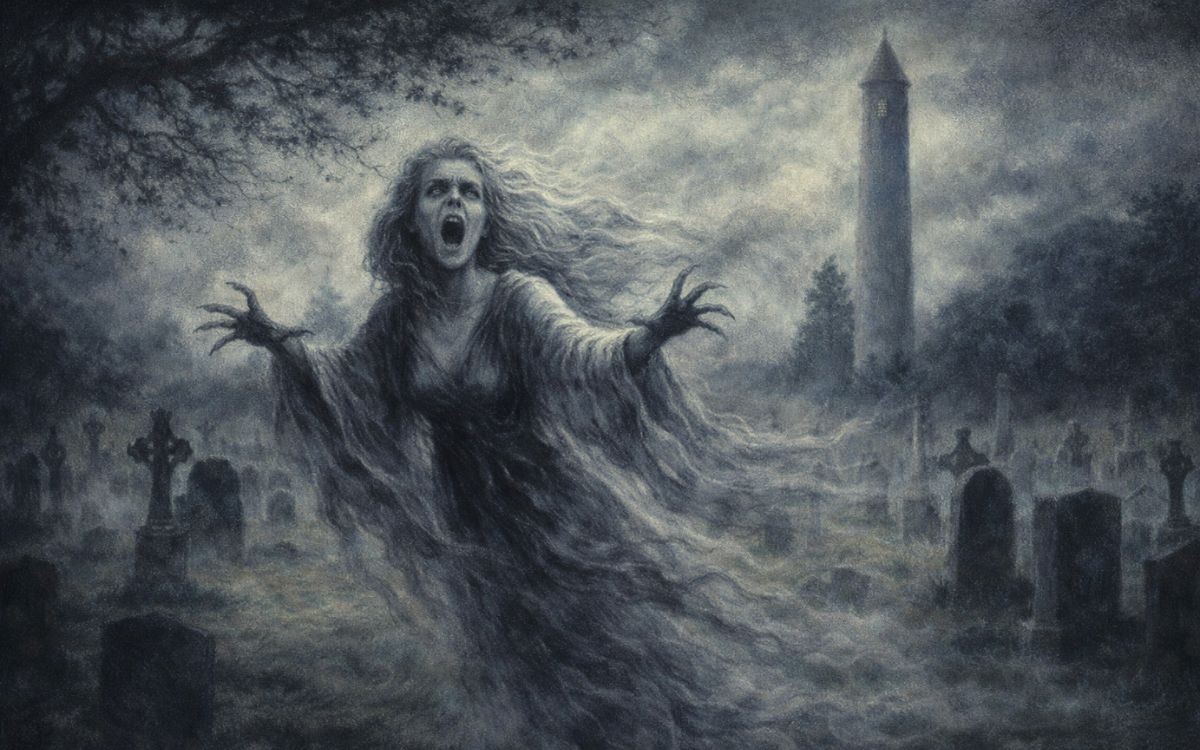
Ireland’s most famous ghost is not a ghost at all, but a herald of death.
The banshee — the bean sí, or “woman of the fairy mound” — has wailed in the imagination of Irish people for centuries.
Though she is often thought of as a rural spirit haunting lonely hillsides or ruined castles, Dublin has its own deep tradition of banshee lore.
From 19th-century memoirs to modern pub stories, the capital is no stranger to the cry that foretells death.
Who is the banshee?
The banshee is one of the oldest and most enduring figures in Irish folklore.
Her appearance varies: sometimes she is a pale young woman with long streaming hair, combing it as she keens; other times she is a wizened old hag in a grey cloak.
Always, she is heard before she is seen.
Her cry is described as unearthly — part keening, part shriek, part song — and anyone who hears it knows a death is near.
Unlike vampires or demons, the banshee is not evil.
She does not cause death, but mourns it in advance, as if acting on behalf of the family.
Traditionally, she is said to attach herself to certain Irish families of ancient lineage, especially those with surnames beginning with O’ or Mac.
In Dublin, this meant that to claim a banshee was a mark of status, proof that your family’s line stretched deep into the Gaelic past.
The Rossmore Banshee: Dublin’s most famous case
The best-documented banshee story in the city comes from the early 19th century.
On the night of 5–6 August 1801, Sir Jonah Barrington, a judge and politician, was staying at his Dublin lodgings.
Around half-past two in the morning, he was jolted awake by an eerie sound outside his window.
Barrington later wrote that it was a woman’s voice, wailing in grief — not once, but three times, growing fainter each time.
He was deeply shaken.
Soon after, news reached him that his close friend General Robert Cuninghame, 1st Baron Rossmore, had died suddenly at Mount Kennedy in County Wicklow, only a few miles from the city.
The time of Rossmore’s death matched almost exactly the moment Barrington heard the wailing.
Convinced he had been visited by a banshee, Barrington published the story in Personal Sketches of His Own Times in the 1830s.
Because it involved well-known figures and gave precise dates and locations, the tale became one of the most famous banshee reports in Irish folklore.
Crucially, the wailing was heard in Dublin itself, making it an urban banshee encounter at a time when most stories were rural.
Glasnevin and the Gravediggers’ Wail
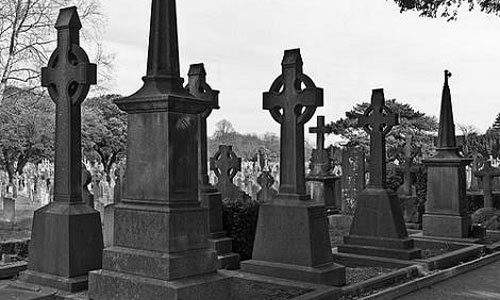
If Dublin has a second banshee haunt, it is Glasnevin Cemetery, opened in 1832 and the final resting place of more than 1.5 million souls.
Locals tell of unexplained cries drifting over the cemetery walls on still nights.
Some say the sound comes before the death of an old Glasnevin family; others believe it is simply the wind whistling through the graves.
Adding to the lore is John Kavanagh’s pub, better known as The Gravediggers, which sits against the cemetery wall.
Founded in the 1830s, it has long been associated with ghost stories.
Drinkers have claimed to hear wailing outside while raising a late-night pint.
Whether these cries are truly banshee keening or the product of imagination, the connection between Glasnevin, death, and mourning makes the stories believable enough to persist.
Banshees and the Geraldines of Kilmainham
Older folklore suggests that the powerful Fitzgerald family — the Geraldines — were shadowed by a banshee.
In Dublin, the Geraldines’ stronghold was Kilmainham, later infamous for its jail.
Nineteenth-century guidebooks hinted at a wailing woman heard in the district before tragedies struck the family.
Unlike the Rossmore case, these stories are harder to pin to specific dates or witnesses.
They may reflect the general belief that great families always had a banshee, or that Kilmainham, with its dark history, simply invited supernatural associations.
Still, for Dubliners, the idea that the Geraldines had their own death-messenger made sense.
They were one of the city’s most powerful dynasties.
Keening women and banshees in the city
Why do banshee stories appear in Dublin at all, a bustling city rather than a lonely rural parish?
Part of the answer lies in keening, the traditional Irish practice of wailing at funerals.
Professional keening women (bean chaointe) were once a common sight at wakes in the city.
Their high-pitched, mournful cries, performed as part of ritual mourning, blurred the line between the human and the supernatural.
For many Dubliners, hearing keening in the street was a regular reminder of death.
In the dark, when a neighbour fell sick or died, it was easy to imagine that a cry outside your window might not be from a mortal throat at all.
In this way, real sounds of grief may have helped keep banshee belief alive in the capital.
Banshees as status symbols
In 18th- and 19th-century Dublin, claiming that your family had a banshee was more than superstition — it was social currency.
Old Anglo-Irish families such as the O’Neills and O’Briens often retold their banshee traditions in drawing rooms and newspapers.
To have a banshee was to show that your bloodline stretched back to Ireland’s earliest rulers.
This is why the Rossmore case carried such weight.
Here was not a peasant tale, but the testimony of a respected judge about the death of a nobleman.
The banshee was not just for the poor or the gullible — she haunted Dublin’s elite.
Other cries in the capital
Although the Rossmore banshee remains the standout case, stories of strange cries in Dublin never quite faded.
Residents along the Tolka River and the back streets of Artane have whispered about sudden wails on still nights.
In some versions, these cries are explained away as foxes, cats, or the wind; in others, they are remembered as death omens.
Even today, if you ask in certain pubs or taxi ranks, you may find people willing to admit they or someone they know once heard the banshee.
They rarely say it openly, but the old belief has never entirely left the city.
Have you ever heard strange cries in the night while walking Dublin’s streets? Could it have been the banshee? Share your story in the comments.