

Somewhere in England stands a village called Weeping Bank.
It has a canal, an old oratory, lonely paths, peculiar houses and enough supernatural history to trouble several generations of villagers.
It even has its own map.
The only problem is that Weeping Bank does not exist.
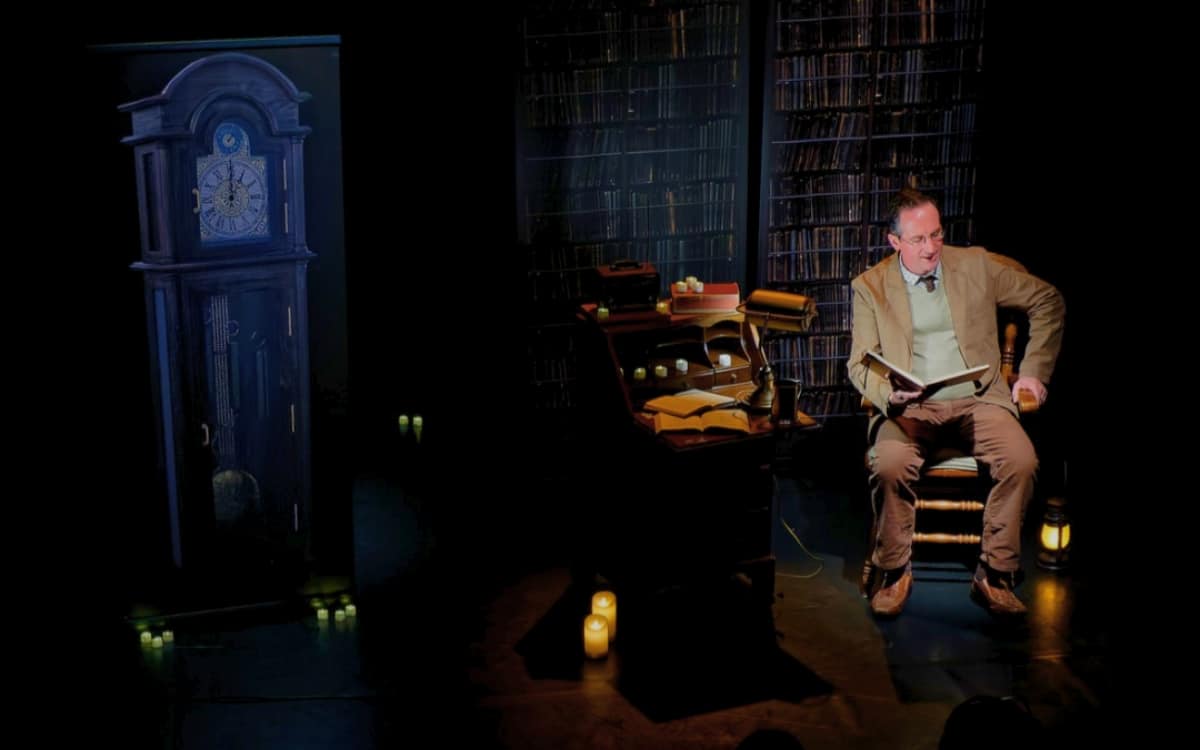
Created by writer and performer A.G. Smith, Weeping Bank is a live storytelling and theatre project which approaches the traditional ghost story differently.
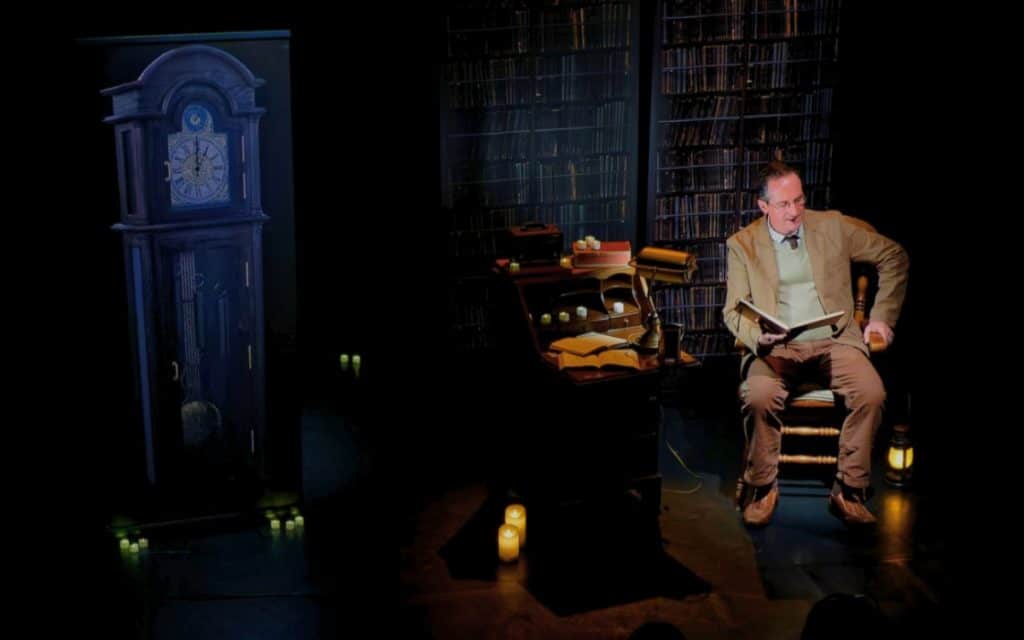
Smith performs as The Librarian, presenting original supernatural tales drawn from the supposed history of his unfortunate village. The project has toured theatres, libraries, festivals and unusual venues across England since 2010.
“Weeping Bank may be a quiet, rural part of England, but it has a surprising number of supernatural happenings,” project manager Rob Whitehouse told Spooky Isles.
“There is a reason why so many things happen at Weeping Bank, but as of yet this is only hinted at in stories and will be revealed more fully in future tales.”
Smith has now been writing the stories for more than 15 years.
“He loves the traditional ghost story writing of M.R. James and Dickens,” Rob says. “But there are echoes of more modern horror writing, as well as cosy crime, where fictional villages become an epicentre for harrowing events.”
The village kept growing.
“Originally, he didn’t imagine it being as broad and wide as it’s become, but that’s what happens when you start building a world – it grows with each story, each new character and each new twist in the tale.”
Where is Weeping Bank?
Although fictional, Weeping Bank has a strong Staffordshire flavour.
“We live in Staffordshire, so it’s definitely an influence,” Rob says. “But the place itself has elements drawn from other places visited around the country.”
It is good country for strange stories.
Rob points to Cannock Chase, long associated with tales of ghosts, black-eyed children, phantom animals and other peculiar encounters.
He also mentions the enduring Bella in the Wych Elm mystery from nearby Hagley Wood in Worcestershire, where an unidentified woman’s remains were discovered inside a tree in 1943.
Other pieces of Weeping Bank come from further afield, including coastal landscapes inspired by Somerset.
Eventually, the fictional geography became detailed enough to need a map.
“It was challenging to turn his vision of all the villages, woods, canals, rivers and piers into a physical map, but it was incredibly rewarding and now graces the pages of our touring programme along with written histories and exclusive stories from The Librarian.”
The world-building has worked almost too well.
“People ask us all the time, ‘Where is Weeping Bank? Is it real?’ It’s one of the most common questions we get.”
Why old-fashioned ghost stories still work
M.R. James was a strong influence on Smith’s earlier work, although the stories have become more contemporary.
Way Marker, for example, moves towards folk horror.
“It follows a lady who goes on a walk once a year through the landscape around Weeping Bank,” Rob says.
“Because of a footpath marker that points the wrong way, or should I say has been moved to point the wrong way, she ends up at a deserted farmhouse with a dark history.”
Yet one old rule remains important: don’t show everything.
“The human mind is so much more powerful than all the graphical depictions in the world,” Rob says.
“With Weeping Bank, you’re listening and your mind is filling in the blanks. You’re picturing things in the way that makes you scared, which makes it so much more powerful.”
That simplicity extends to Smith’s performances.
“These are original stories,” Rob says, “that the audience hasn’t heard before, being read in a very real way, as if they are happening right at that moment, and this draws people in, has them on the edge of their seats and keeps bringing them back for more.”
Taking ghost stories back to the library
Libraries have become central to Weeping Bank, partly by accident.
“Alan started reading in libraries because a friend of his worked there and said he should read some of his stories,” Rob says.
“It made sense because he’s The Librarian. That’s his character from Weeping Bank Library.”
Since then, Weeping Bank has travelled far beyond its Staffordshire roots. Performances have included the UK Ghost Story Festival in Derby, the London Month of the Dead Festival, Leicester Guildhall, Unity Theatre in Liverpool and London’s Old Red Lion Theatre.
Weeping Bank also has a connection with one of Britain’s finest screen ghost stories. Smith and Whitehouse later joined a small group visiting locations used for the BBC’s 1976 adaptation of Charles Dickens’s The Signalman.
Rob believes the appetite for this kind of storytelling remains strong.
“There’s a real resurgence right now,” he says. “There are quite a few talented performance storytellers like Robert Lloyd Parry and Adam Z. Robinson touring around the country, reading and performing the classics.”
Perhaps that is Weeping Bank’s simplest trick.
It gives an old form a new mythology, then lets the audience supply the fear.
And sometimes they believe in it enough to ask for directions.
To discover more stories, the strange geography of the village and forthcoming performances, including an exclusive online reading on 30 September, visit the Weeping Bank website.
