


Yorkshire Television’s 1990s horror anthology series, Chiller, opens with the suitably uncanny Prophecy.
Dealing with the familiar horror trope of “a séance gone wrong”, the episode is based on Peter James’ novel and adapted by seasoned scribe Stephen Gallagher.
The director’s reins are held in the safe hands of genre royalty, Lawrence Gordon Clark, the driving force behind the BBC’s classic A Ghost Story for Christmas strand in its original 1970s incarnation.
A séance goes wrong
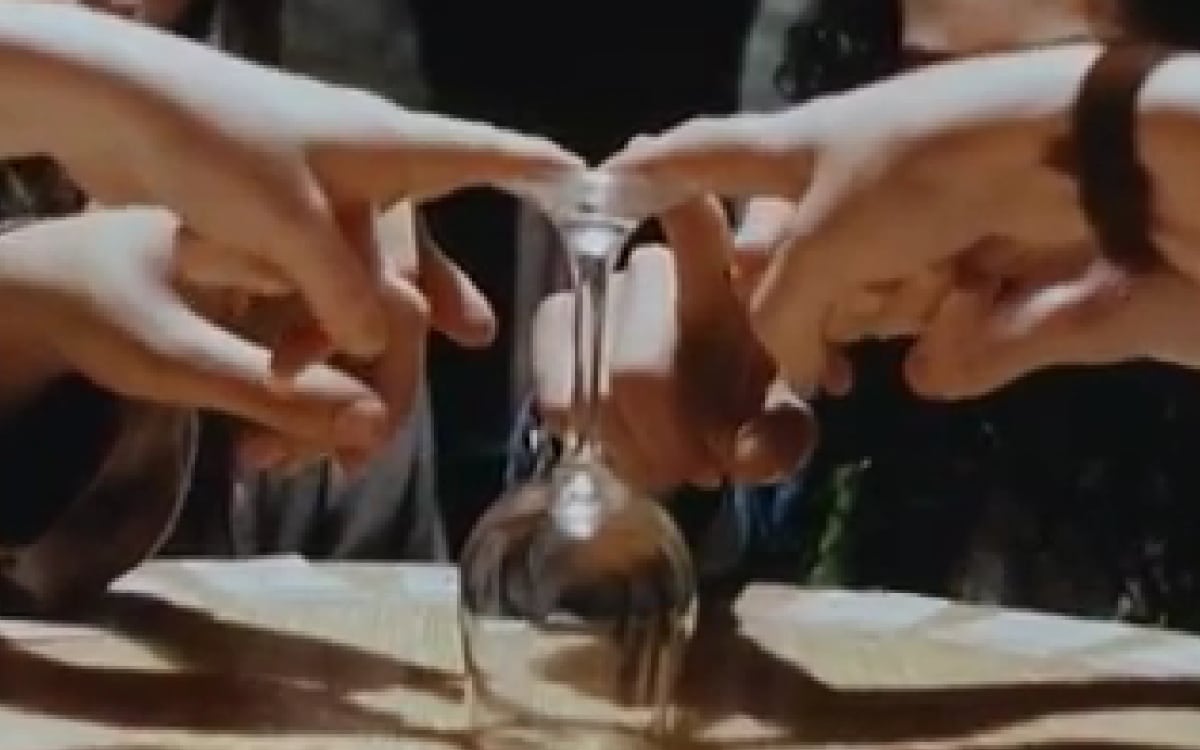
Francesca “Frannie” Monsanto (Sophie Ward) partakes in an ill-advised Ouija session with a group of her thrill-seeking young friends in the creepy basement of her family’s London café.
The session commences slowly, with the only atmospheric disturbance emanating from the sound of a passing Central line train.
After this false start, an unexplained presence makes itself known and causes the glass to spell out the Latin motto Non omnis moriar, which translates ominously to “I shall not altogether die”.
The spirit then indicates it wishes to make a prophecy for the members of the circle. The glass begins to move again.
The action skips abruptly to the following day when Frannie, while waitressing at the café, witnesses the shocking death of a lady who is mown down in spectacular fashion in front of her.
Coincidence? Hmm.
Five years later
The action then moves on five years. Frannie, now working at the British Museum, bumps into charming toff Oliver Halkin (Nigel Havers) and his precocious young son Edward (Tom Piccin) at a train station.
There is a clear and immediate attraction between Frannie and Oliver and, whilst neither party makes a move on their first meeting, Oliver soon reaches out via the newspaper personal ads — this was the nineties, remember — and a romantic relationship develops.
Unfortunately, Frannie’s new-found happiness is tempered by the fact her friends, with whom she had attended the séance, are being killed or maimed one by one in seemingly unrelated circumstances.
However, Frannie is convinced the bizarre events are connected.
This feeling is reinforced after conversing with the disturbed young Edward who, following the death of his mother five years earlier, has not only become obsessed with his satanist ancestor, Francis Halkin, but has compiled a scrapbook of strange deaths which includes newspaper clippings pertaining to the fate of her friends.
Frannie must try to identify and halt the source of this seemingly foretold series of tragedies, as well as ascertain exactly what the séance’s prophecy means for her personally.
Is Prophecy worth watching?
Prophecy is a solid but unspectacular genre piece. While it offers nothing especially new, it does possess a genuine creep factor and its premise, executed surprisingly well despite the restraints of a television budget, will appeal to fans of the Final Destination franchise.
The two leads inhabit their roles effortlessly. Ward is a likeable and sympathetic presence and Havers brings his usual smoothness and an easy sense of humour to his part.
It is a shame, however, that we did not get to see more of Tony Haygarth’s no-nonsense priest, Father Spode, as I found him pleasingly reminiscent of the Father Sandor character (Andrew Keir) from Hammer’s Dracula: Prince of Darkness (1966), a personal favourite, in his brief appearances.
Whilst Prophecy fails to reach the heights of A Ghost Story for Christmas, it nonetheless provides an entertaining enough fifty minutes for horror fans whilst simultaneously whetting the appetite for the rest of the series.
Read more: Richard Markworth reviews Casting the Runes (1979).