

Grim’s Dyke and the ancient ditch
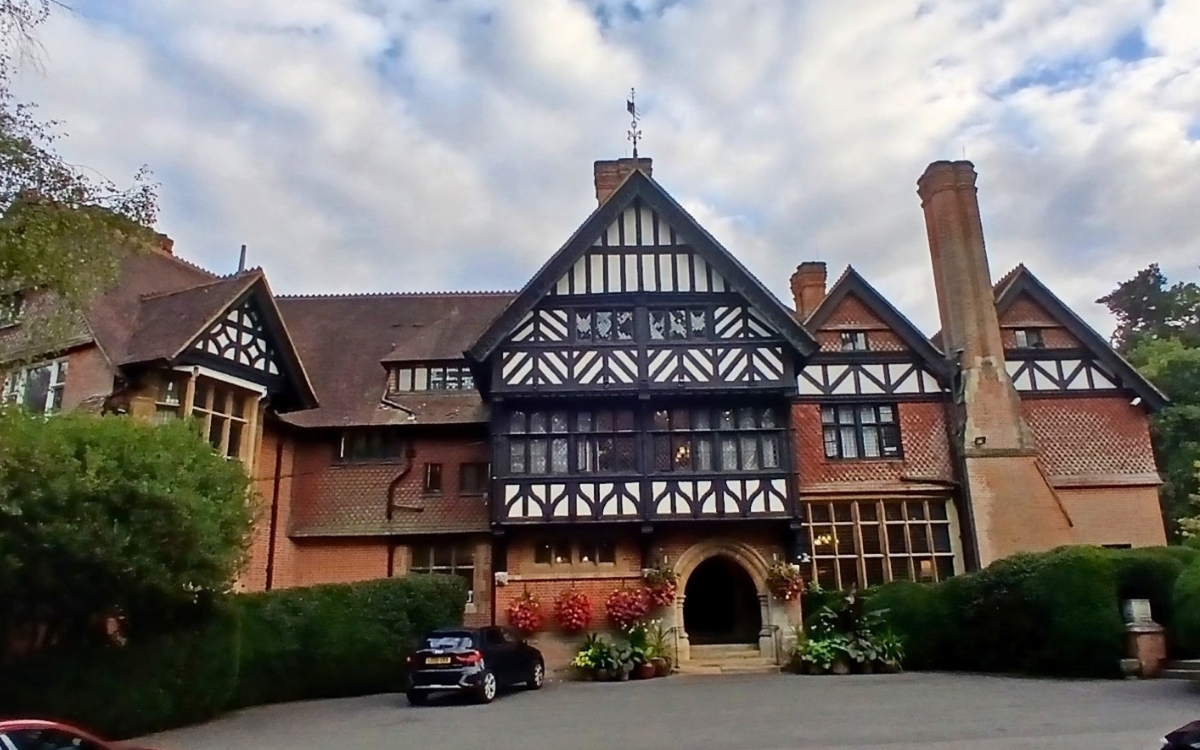
The Best Western Plus Grim’s Dyke Hotel nestles in its own grounds within the ancient and densely tangled Old Redding Wood near Harrow.
It takes its name from Grim’s Ditch, three miles of earthworks which run from Pinner Hill towards Bentley Priory, bounding the edge of the Grim’s Dyke estate. It is thought to have originally formed an ancient boundary.
The Norse name Grimr, meaning ‘the hooded one’, was said to be used by Odin as one of his aliases when he wandered amongst mortal men, using the hood to disguise his missing eye.
When the old pagan gods were demonised by the Christian church the name Grim became associated with the Devil.
Folklore suggests that the spectre of Odin can still be seen riding the boundaries of the ditch, traces of which can also be found in Buckinghamshire and Oxfordshire.
The ditch has an association with sorcery. The word Grima is an ancient term for magician.
This has given rise to sightings of phantom lights accompanied by an oppressive and unnerving atmosphere in the densely wooded areas around the ditch.
From Frederick Goodall to W.S. Gilbert
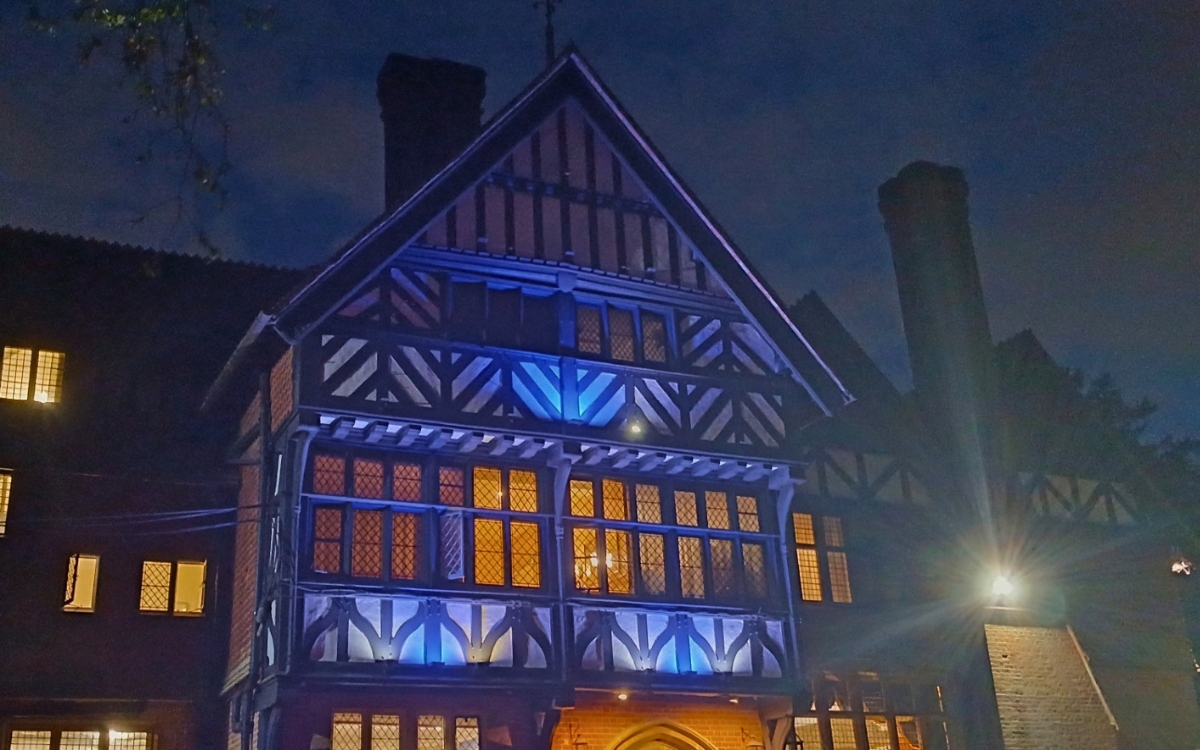
The house, which is now the hotel, was designed by the Victorian architect Richard Norman Shaw in a mock Tudor style. Building work began in 1870, with tall 19th century chimneys built into the mix.
It was commissioned by the artist Frederick Goodall, who had bought one hundred acres of the wooded land from the Marquess of Abercorn in 1856. Goodall only lived in the house for a few years, finding it too isolated from the centre of London.
For the next decade it belonged to a wealthy banker named Robert Heriot, who then sold it to W.S. Gilbert of Gilbert and Sullivan fame in 1890.
Gilbert and his wife, Lucy, carried out extensive work in the grounds, laying out formal gardens, planting an orchard and creating a large ornamental lake. This lake would become Gilbert’s downfall and the source of the ghost story connected to the house.
The tragedy occurred on 29 May 1911. The 74-year-old Gilbert was giving a swimming lesson to two young women from the local area when 17-year-old Ruby Preece got into difficulty.
Gilbert swam out to her and managed to keep her afloat. However, the sudden physical exertion triggered a severe heart attack.
He slipped beneath the surface and was dead by the time his body was pulled from the lake. The subsequent coroner’s inquest concluded that he died of heart failure, rather than drowning.
The ghost of W.S. Gilbert
Consequently, the ghost of Gilbert is said to haunt both the house and its grounds.
Hotel guests and staff over the years have reported lingering presences in the main house, particularly around Gilbert’s old study and the library where he worked on some of his famous writings.
Visitors strolling through the woods and the perimeter of the lake, which was largely drained after his death, have reported seeing a shadowy figure described as an older man with a prominent moustache and wearing the type of Victorian clothing that Gilbert would have worn.
Gilbert and his wife also conducted a considerable amount of renovation inside the house and many of the features can still be seen in the hotel today.
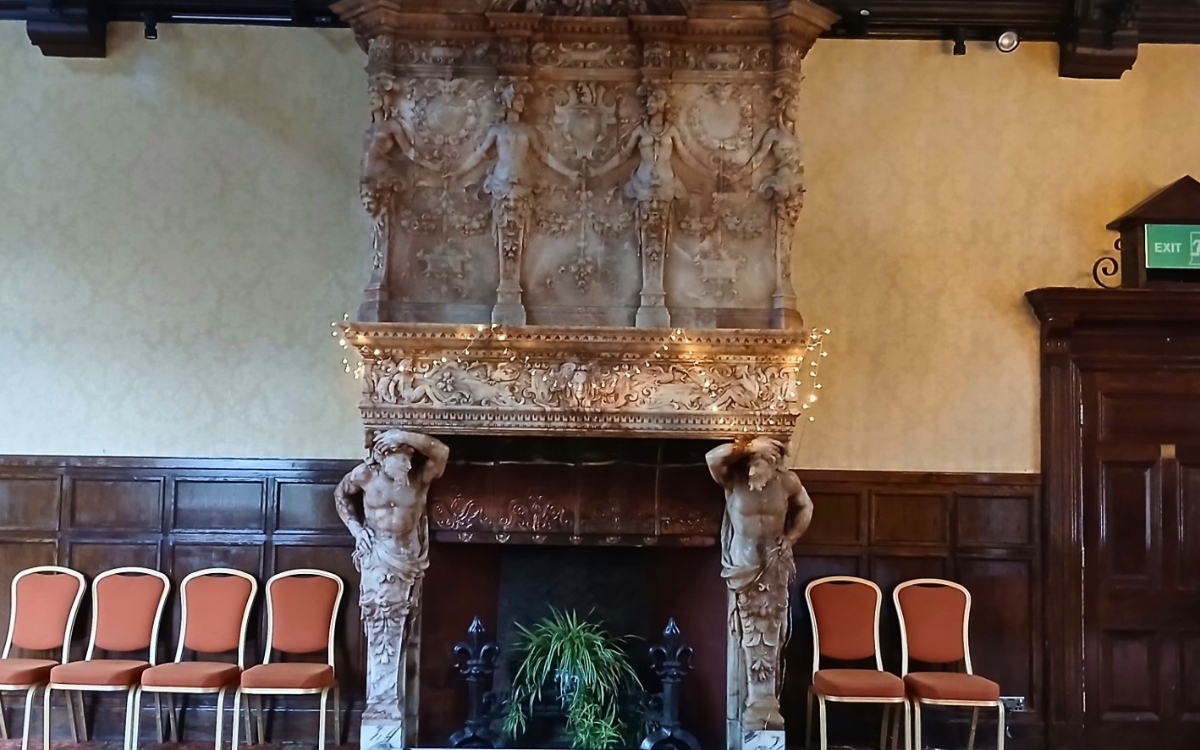
The most stunning of these is the huge alabaster fireplace in Gilbert’s former music room.
It was designed by the architectural firm Ernest George and Harold Peto and based on a sketch drawn by W.S. Gilbert himself.
The features of the fireplace structure display something wild and other worldly, with a pair of tall, grotesquely grinning satyrs supporting a mantle decorated with goddesses and caryatids.
Grim’s Dyke in British horror films
The fireplace makes an appearance in Tigon Pictures’ Curse of the Crimson Altar (1968), which starred both Boris Karloff and Christopher Lee.
The film is loosely based on an H.P. Lovecraft story, The Dreams in the Witch House, with Grim’s Dyke used as the key filming location and becoming Craxted Manor, where Lee’s character dabbles in the occult and Karloff’s witchcraft expert helps bring about his downfall.
As was standard in many horror movies of the era, the wicked house burns down at its climax.
In the same year Tigon used Grim’s Dyke as a filming location for The Blood Beast Terror, starring Peter Cushing as a detective whose investigation has led him to the country home of entomologist Dr Karl Mallinger, played by Robert Flemyng, who has turned his daughter, played by Wanda Ventham, into a blood-craving insect hybrid were-moth.
Cushing famously described this outing as one of the worst films he had ever appeared in.
The house was used in 1969 for some additional shots for The Haunted House of Horror, starring former teen idol Frankie Avalon and mainly filmed at Birkdale Palace Hotel in Southport. Horror icon Vincent Price came to Grim’s Dyke in 1970 for Cry of the Banshee, in which he played the tyrannical 16th century magistrate Edward Whitman, head of a cursed family line.
By 1971 the house had transitioned into a functioning hotel. However, it was still used as a location for the Agatha Christie psychological thriller Endless Night, starring Hayley Mills and Hywel Bennett.
During its heyday as a filming location Grim’s Dyke appeared in a number of classic TV series including The Avengers, The Champions, Department S, The Saint and Randall and Hopkirk (Deceased).
It also served as a primary filming location for the 1967 Doctor Who serial The Evil of the Daleks, with Patrick Troughton as the Doctor and Frazer Hines as his companion, Jamie.
Grim’s Dyke during the Second World War
Another fascinating aspect of the history of Grim’s Dyke is that it was used for secret military work during the Second World War. Exactly what happened at the house remains less clear.
Stories have linked Grim’s Dyke to intelligence work and the examination of captured German technology, but the more dramatic claims surrounding the operation are difficult to verify from the public record.
Nearby Bentley Priory, now a museum, was a former Royal Air Force base. During the Second World War it was used as the headquarters of RAF Fighter Command. An underground bunker there played a key strategic role during the Battle of Britain.
The original priory on the site dates back to the 12th century. There are lots of local ghost stories linked to the former priory. Claims of disembodied wailings and phantom footsteps inside the mansion built on the priory site are woven in with its more recent Air Force history.
There is also a persistent tale of a phantom hound that is said to roam the grounds of the estate.
From horror films to Sliding Doors
Film crews returned to Grim’s Dyke in 1998 when it was used as a location in the Gwyneth Paltrow time-shifting romcom Sliding Doors.
It also provided location shots for EastEnders, Little Britain and Holby City, but, as yet, there’s been no revival of its horror heyday.
