
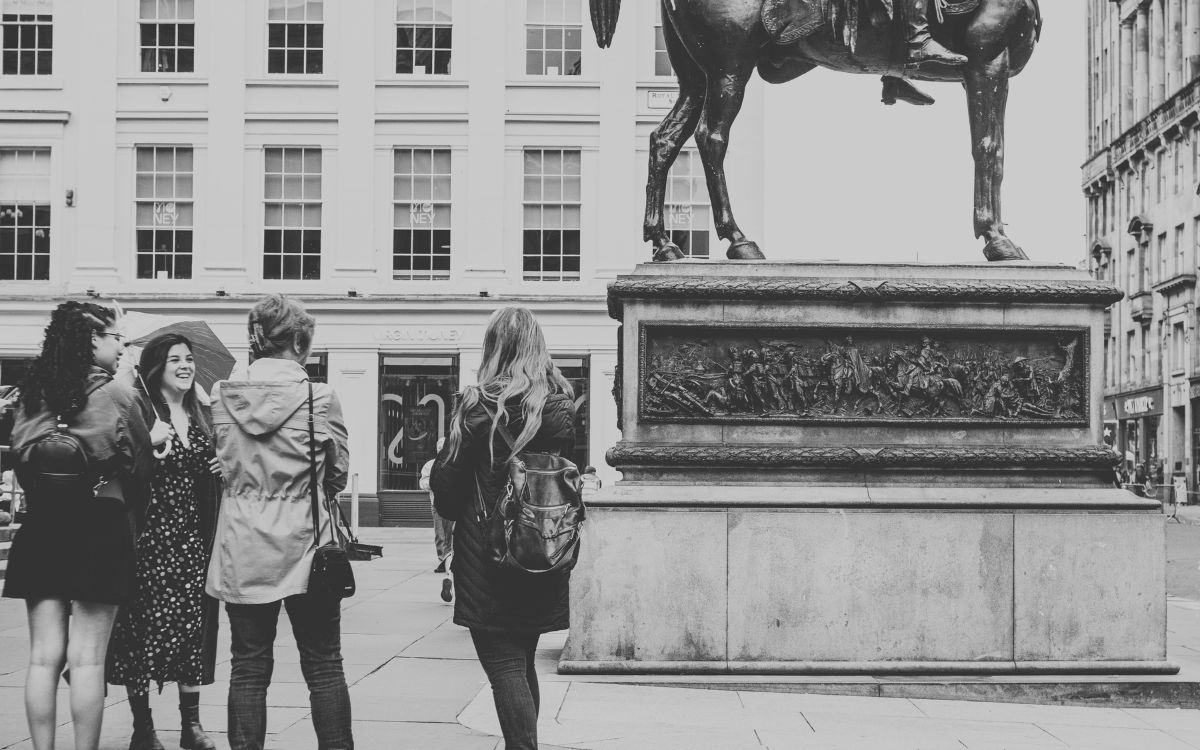
Rhona Mackay grew up listening to stories about Glasgow’s tenements, shipyards and streets. Her family told them with humour, pride and the occasional embellishment. Today, she brings that tradition to The Dark Side of Glasgow, a walking tour exploring criminal history, ghost stories and local legends.
An actor by training, Rhona developed her approach to guiding in Edinburgh before returning to Glasgow during lockdown. She tells Spooky Isles about the Gorbals Vampire, Glasgow’s ghosts and why the city’s history of violence deserves understanding rather than sensationalism.
INTERVIEW: Rhona Mackay of The Dark Side of Glasgow
Could you tell us a little about yourself and how The Dark Side of Glasgow began?
RHONA MACKAY: My name is Rhona Mackay, 32, Glaswegian born and raised, with a love for dark, gruesome history and comedic storytelling.
My tour guiding career was born out of another, my acting career. I was studying Acting and English Literature in Edinburgh and, like all struggling artists, I was looking for ways to make consistent money utilising my acting and storytelling ability.
So I wrote the script for The Dark Side of Edinburgh. This tour became highly rated and very popular as I treated it more like a walking stage play than a simple tour.
I then got a job as an international tour guide for Eastern Europe, but unfortunately lockdown brought me swiftly back to Scotland and to my childhood home in Glasgow. I decided to start The Dark Side of Glasgow, writing the script in lockdown and starting the tours as restrictions relaxed.
This is a very different tour to Edinburgh. As Glasgow is my home, I have a particular soft spot for its passionate, ruthless soul. I now live in the East End and lead the Glasgow tours single-handedly.
What first drew you to Glasgow’s darker history, ghost stories and local legends?
Ever since I was a child, I was always drawn to the darker stories. Perhaps I wanted to be treated more grown up than I was, or because I insisted nothing was left out.
My father read me the Brothers Grimm and Italo Calvino. Whenever he would fall into silence reading a particularly brutal extract, I would urge, “Don’t cut anything out, I want to hear the whole story!”
But it was Glasgow’s unique storytelling ability that was always the best. Broad Scots language, with glittering eyes and mysterious grins. My auntie from Drumchapel, my granddad from Slatefield, my friends from Anderston.
I was a curious child who loved art, puppetry, reading and film. But no one could captivate me like a Glaswegian tongue telling a ghost story.
My family talked of the tenements, the shipyards and the brutality of the streets, but with joy and humour. Almost like they missed the drama of it all. This was when my family members came alive, telling a story from their youth, perhaps with a few added twists and a sprinkling of mistruths.
I try to embody their excitement and passion years after they are gone through these tours.
What makes Glasgow particularly good territory for this kind of storytelling? Does the city have a different atmosphere after dark?
I used to proudly exclaim, as a young woman, that I had walked down many Glasgow streets, schemes and parks in the middle of the night or early hours of the morning and never felt unsafe. And that I couldn’t say the same for other areas of Scotland.
But due to current events, I have to say Glasgow does change after dark. We do not run tours in the evening as our route takes us through chaotic, often violent areas of the centre. And never during particular events like the Old Firm or the Orange March. It can be dangerous and difficult to anticipate.
It’s a big city with lots of people and lots of different areas. Some areas have the most beautiful architecture and history in Scotland, and others are covered in rubbish. The friendliest people who will give you the shirt off their back, and masked individuals looking for trouble.
It was quite a difficult task to organise a walking tour that could hit the major landmarks I wanted to show. Glasgow is not a tourist city, which is what I love about it. You need a local to show the conflicting truths of our city. And our real gems are often hidden.
The Barras and the Glasgow Rhona loves
Is there one Glasgow story or location that you think deserves far more attention than it usually gets?
The Barras Market is a must if you want to see the real Glasgow. We visit it on the tour. You cannot be a true Glaswegian without a story from the Barras. A hotbed of artists, musicians and sellers of everything you can think of.
It’s a slice of working-class Glaswegian tradition, not a fancy flea market that rivals the ones in Paris or Berlin. But it is surrounded by the best food, cocktail bars and cheeky finds in the city.
It has a long history and it’s been through a few changes in its time, especially recently. But as the artwork says, “We can evolve whilst staying true to ourselves.”
We are a city that used to build things by hand, including my carpenter grandfather, and you can still find these handmade treasures in the Barras for a very good price.
A lot of these building and design techniques died with the artist. My grandfather didn’t tell a soul how he created mosaic patterns in wood, but you can still find some of his pieces in Randall’s Antiques.
There’s something interesting behind every corner, including a hidden room filled to the brim with spooky horror toys, a friendly ghost girl or Teddy Tunnock, the Barras bare-knuckle champ.
Experiencing live theatre and music is also a must. A Play, a Pie and a Pint at the Òran Mór, a night at The Stand or catching a band at The Clutha are my highest recommendations. You will leave with so many stories of your own.
How do you research the stories you use on the tours? Are there occasions when the documented history turns out to be stranger than the legend?
I take the research very seriously and tend to rely on published works, interviews and legal documents for authenticity. The Mitchell Library was a big help. I took months to write the full script, which is probably about six hours long as I just can’t stop.
I also relied on my family, friends and regulars at the pub I used to work at: “You need to talk about Arthur Thompson or there’s no point.” “Walter Norval was the most brutal, you have to mention him.” “Everyone talks about Bible John, but Peter Manuel is the one that gives me the shivers.”
At one point I even got the chance to interview a court photographer at Peter Manuel’s trial, now in his 90s, who was happy to tell me everything for a free pint. Sometimes I take quotes directly from them to capture the humour and popular opinion. As we certainly aren’t short of opinions in Glasgow.
Personally, I think the documented history is always stranger and scarier than the legend. We hanged people in the same spot we celebrated the Glasgow Fair. We used decomposing bodies to force visitors into compliance. Our ice cream vans declared war on each other. And the capacity for cruelty in our species is always bone-chilling. In fact, I think the legends are often used to soften the blow.

Ghost stories, poltergeists and the Gorbals Vampire
Are there any Glasgow ghost stories where you have found several different versions of the same tale? How do you decide what to tell people?
That is always the issue with ghost stories instead of historical events. In the instance of the Tron Poltergeist, I can actually rely on my own experience as a cast member of a, let’s say, turbulent production of Pinocchio, which concluded with a woman’s hospitalisation.
I also know a few workers from the subway who told me personally of the smell of lavender they experienced and the jokes they make about the ghost cat. So getting into the community and asking nosey questions is a tactic I apply quite often.
I also try to attach parts of their stories to documented reports. I found written complaints by railway company staff referring to the poltergeist in St Enoch train station, reported assaults to the police for the Gurning Man, etc.
I also quote a short poem, passed down my mum’s family, in regard to the Gorbals Vampire. So I rely, as much as I can, on evidence, then form my own humorous observation or explanation, which I make clear is an opinion.
Without giving away too much from the tour, is there a particular story that consistently gets a strong reaction from guests?
Definitely the section on the Gangs of Glasgow is a high point. I’m hesitant to apply gimmicks at any point in the tour, but especially when I am discussing real people and their deaths. I don’t want to discuss them as villains or the bogeyman.
I frame this section with the question, “Why are we so violent?” Doubling the national average for homicidal murders within Glasgow city limits alone means we must be violent. Here are countless examples. But why?
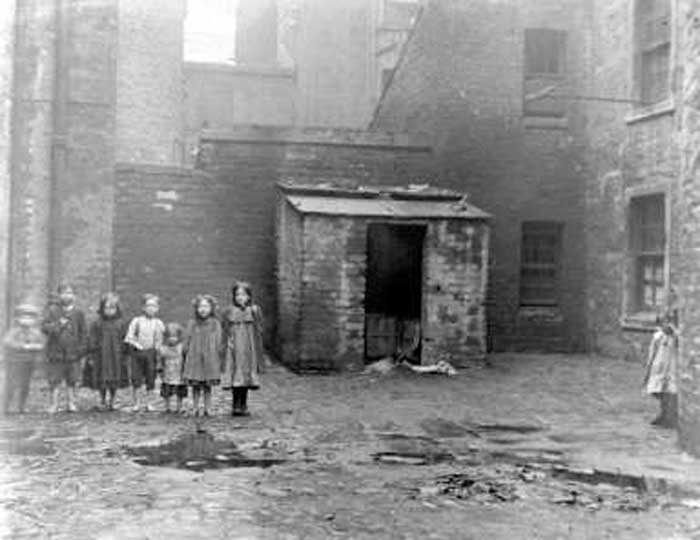
I argue it’s systemic poverty and wider class divide. We are Scotland’s biggest working-class city, after all. I guide the conversation through the tenements that my parents were born in, the overcrowding, the brutal manual labour, protection businesses and the joy of such a close-knit community.
Then to the housing schemes, or “deserts wae windaes”, with the ice cream vans and the drugs. How each surge of crime begins with poverty, cuts to funding and lack of jobs and support, all the way up to the current day.
I myself also work in prisons, rehabilitation centres and unpaid work, which used to be known as community service. We use creativity as a mode of rehabilitation, writing scripts and making films about their experiences in their words. It’s incredible work that I love deeply.
Unfortunately, we are currently seeing a rise in cuts to this work, the violence reduction sector and countless other forms of support for our most vulnerable. And we are also seeing a rise in the violence.
Talking about the gangs in Glasgow shouldn’t be used as entertainment but as education and as a warning to help progress change and empathy. Not apathy.
Have you or any guests ever experienced anything genuinely odd or difficult to explain while out on a tour?
We have countless unexplained photographs of strange apparitions from our Edinburgh tour, taken within Greyfriars Kirkyard. In regard to our Glasgow tour, we have had a creepy jack-in-the-box suddenly start ticking and burst open with no one near it in the Barras hidden room. Might have been the ghost of Sally having a play.
But the locals can be the best addition to the tour. A hilarious older gentleman who waits for the perfect moment to jump out and say, “It was me,” when talking about an unnamed serial killer of the area.
A chain-smoking man outside the High Court who claimed to have known Bobby Glover, who was “really funny and could make anyone laugh. But aye, definitely killed a few people.” His lawyer didn’t look too happy.
Our tour has witnessed arrests, cycling championships, film crews, media outside the High Court, giant colourful puppets and bumped into Bobby the barman from Still Game. But talking to the locals who don’t hesitate to jump in with their own anecdotes and jokes are my favourite odd and difficult-to-explain moments.
The history still visible in Glasgow’s streets
Glasgow has changed enormously over the years. Are there places where layers of the older, darker city are still especially visible if you know where to look?
Glasgow Green is our oldest park, established in the 15th century. We visit it on the tour. It was the city’s first steamie, where the women would bring their clothes, bedspreads and tea towels to the River Clyde, wash in the burn and hang them up to dry. The clothes poles they used are still standing to this day.
Alongside the Doulton Fountain, the Templeton Carpet Factory, the People’s Palace and the first monument erected for Admiral Nelson, there is also the Glasgow Humane Society, the oldest lifeboat and lifesaving organisation in the world! Absolute heroes.
And let’s not forget, you can stand on the spot where the city executed the Human Crocodile.
The Gallowgate is decorated with very, very old institutions like the Britannia Panopticon Music Hall, the oldest music hall in Scotland and still open today! Their balcony and upper auditorium were sealed and untouched from 1938 to 1997, so it’s a perfect way to step back in time.
The clock tower, Tron Steeple, is one of the oldest pieces of architecture, built in the 1500s. We walk past all of them on the tour, and my favourite is walking along the Gallowgate through the historic entrance of Glasgow.
Where crimes and taxes were dealt with at the Tolbooth and bodies hanged from its side. An excavation about a year ago discovered rare medieval remains that date back to the 13th century in this area. You can’t get any older than that!
Has running the tours changed the way you personally see Glasgow?
I have always had pride for my home city. I have travelled all over the world and have always been welcomed for being Glaswegian. South Africans and Africans celebrating me for being born in the home city of Rangers. Mexicans being impressed with my “tough” background. Indians singing our national anthem at me.
It’s bizarre that we are so small but have affected the world in such big ways. Glaswegians have always got around and always told stories. After all my research, I learned so much more and can now strongly argue this is one of the most historically rich and interesting parts of the world.
If you could point a Spooky Isles reader towards one Glasgow story, person or place to investigate further, what would you choose?
The Gorbals Vampire has always been a personal favourite. Although it proves you should be more scared of children from the Gorbals than any 10ft-tall vampire with iron teeth!
Book The Dark Side of Glasgow: Rhona Mackay’s three-hour walking tour visits Merchant City, Glasgow Green and the Gallowgate. Tickets are listed at £25 per person. Find out more and book through the official tour website. Check the latest dates and meeting details before travelling.