

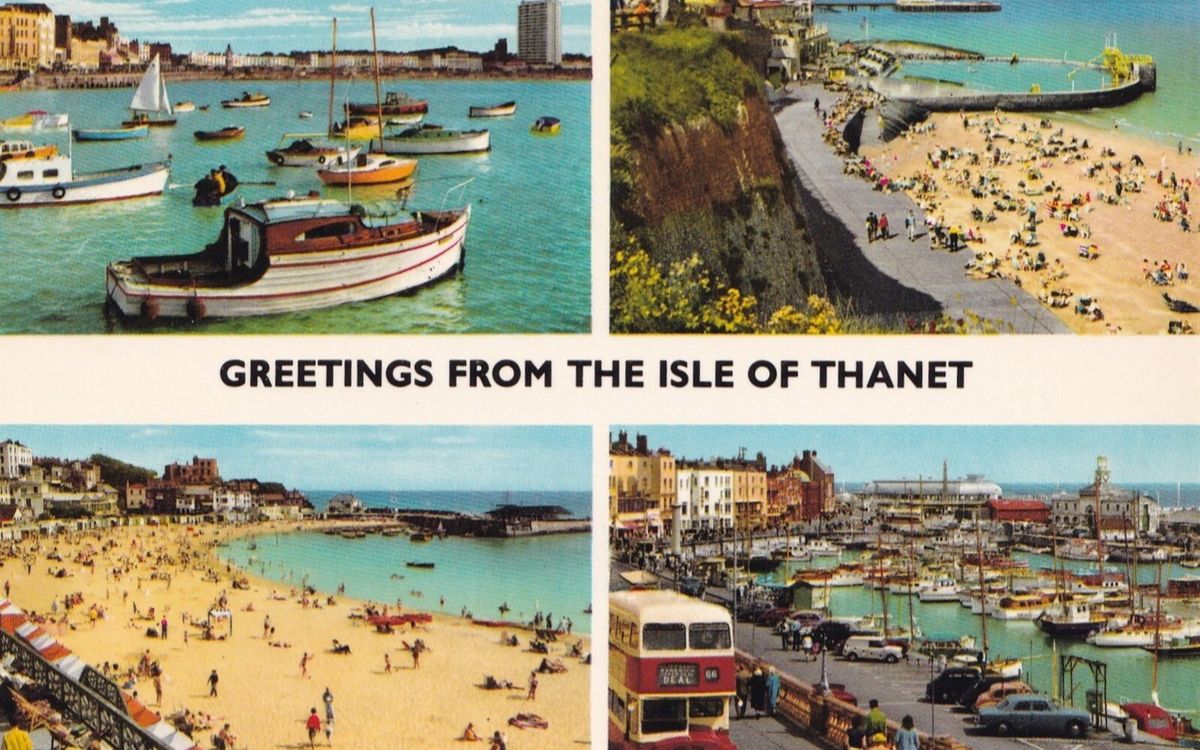
At the easternmost edge of Kent, the Isle of Thanet’s long history as a frontier between Britain and Europe has fostered a rich landscape of ghost stories rooted in invasion, faith, war and the sea.
At the far eastern edge of Kent, where England narrows and leans towards the Continent, lies the Isle of Thanet. Once separated from the mainland by the Wantsum Channel, it was a true island — a threshold place.
This is where Roman ships approached. Where Augustine landed to begin England’s Christian story. Where smugglers crept along chalk cliffs and where, during the Second World War, whole families sheltered beneath the earth.
Facing Europe across open water, Thanet has always felt like Britain’s frontier.
The last stretch of land before the sea. The first sight of England for those arriving from abroad.
Margate, Ramsgate, Broadstairs, Birchington and Minster all sit within this tight coastal triangle, layered with invasion, religion, maritime tragedy and seaside spectacle.
It is exactly the sort of landscape where ghost stories settle and stay.
St George’s Church, Church Hill, Ramsgate, CT11 8LD
High above Ramsgate Harbour, St George’s dominates the skyline.
The church has long been associated with sightings of a dark-clad woman seated silently in the pews after closing time.
She is described as mourning, head bowed, dissolving when approached.
Given Ramsgate’s deep maritime history, local tradition links her to the loss of a sailor.
Cold spots and a persistent feeling of being watched have also been reported.
The elevated position of the church, overlooking sea routes that carried both trade and death, gives the legend emotional weight.
Ramsgate Tunnels, Marina Esplanade, Ramsgate, CT11 0JD
Beneath Ramsgate lies one of Britain’s largest civilian wartime tunnel systems.
Expanded during the Blitz, it sheltered thousands from bombing.
Today, guided tours recount reports of footsteps echoing in empty passages and distant voices carrying through chalk corridors.
Some visitors describe the sound of children crying or doors closing underground.
Whether acoustic trick or something more, the atmosphere is undeniably heavy.
Fear sometimes leaves an imprint.
In places where thousands once waited in darkness, it is easy to imagine that not everything moved on.
Margate Old Town, Margate, CT9 1JD
Margate’s Old Town is a tight web of lanes close to the harbour, filled with centuries of trade, poverty, entertainment and crime.
Among its persistent legends is the Grey Lady, a veiled figure drifting along alleyways after dusk.
Shopkeepers have spoken of sudden chills while locking up and the sense of movement in empty streets.
The Old Town changes character quickly once crowds thin.
Shadows pool between buildings, and the harbour wind whistles through stone passages that have seen more than their share of human drama.
Margate Caves, Northdown Road, Margate, CT9 1FG
Discovered in the 18th century, the Margate Caves remain an mystery.
The chalk cavern is covered in strange carvings whose purpose is still debated.
Visitors often report a feeling of oppression in certain chambers.
Stories persist of shadowy figures glimpsed at the edge of vision and the sensation of being watched.
One local legend claims the spirit of a harsh judge lingers here, though there is no firm historical link.
Even without folklore, the subterranean setting and carved walls create an atmosphere that unsettles.
Kingsgate Castle, Kingsgate Bay, Broadstairs, CT10 3LG
Sitting above the sea, Kingsgate Castle looks exposed and solitary.
Local tradition tells of a phantom coach heard galloping along the clifftop before vanishing without trace.
Some accounts include a headless coachman; others describe only the thunder of hooves.
The castle’s dramatic coastal setting, combined with centuries of smuggling and maritime activity nearby, feeds the legend.
On misty evenings, when the cliffs blur into sea haze, the story feels almost plausible.
Broadstairs Cliffs, Viking Bay to Kingsgate Bay, Broadstairs, CT10
The cliff paths between Viking Bay and Kingsgate are closely tied to smuggling lore.
One recurring tale speaks of a lantern-bearing figure walking the edge on foggy nights, believed to be a betrayed smuggler.
Walkers have reported unexplained lights and footsteps behind them on otherwise empty paths.
With steep drops to the sea and wind rising suddenly from below, the environment itself amplifies unease.
These are frontier paths, always close to danger.
Quex Park, Park Lane, Birchington-on-Sea, CT7 0BH
Quex Park’s historic house and grounds have generated reports of a crying child heard in empty rooms.
Staff have described footsteps on staircases and doors closing without explanation.
The estate’s long Victorian and Edwardian history gives context to the sadness often reported.
The feeling described most frequently is not fear, but melancholy — a sudden heaviness that lifts as quickly as it arrives.
All Saints Churchyard, Canterbury Road, Birchington-on-Sea, CT7 9QX
All Saints Churchyard is associated with sightings of a White Lady moving silently between graves at dawn or dusk.
Witnesses say she fades as she is approached, leaving behind a noticeable chill.
Graves here span centuries.
The proximity to sea air and the soft light that settles across headstones in early morning create a naturally spectral setting.
Even sceptics admit the atmosphere can shift unexpectedly.
Ramsgate Harbour, Harbour Parade, Ramsgate, CT11 8LN
Ramsgate Harbour has witnessed naval movements, lifeboat launches and wartime departures.
Stories persist of a uniformed naval officer pacing the harbour wall at night, gazing towards the dark water.
He is said to disappear if followed.
The harbour’s long defensive history, including Napoleonic fortifications, gives depth to the legend.
Sea-facing towns tend to collect ghosts, especially those tied to unfinished voyages.
Minster Abbey, Minster-in-Thanet, CT12 4AU
Founded in the seventh century, Minster Abbey is one of Thanet’s oldest religious sites.
Reports include shadowy figures and the sound of footsteps when corridors are empty.
Some visitors claim to have glimpsed a nun-like presence.
The abbey has survived invasion, reform and centuries of upheaval.
Ancient religious sites often gather layered stories, and Minster’s long continuity of prayer and occupation adds quiet intensity to its reputation.
Thanet’s position as Britain’s historic gateway has left more than military and religious traces.
Across churches, tunnels, harbours and cliffs, stories endure of figures that linger between land and sea, past and present.