
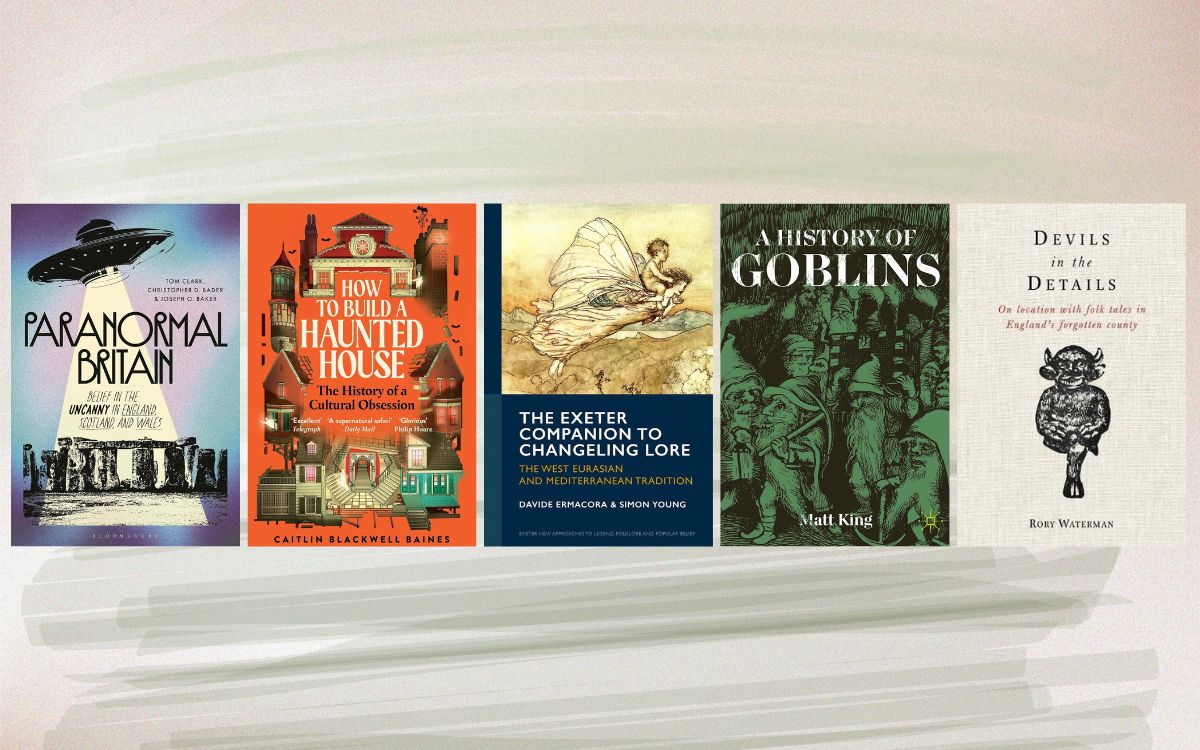
Five books spanning paranormal belief, haunted houses, changeling lore, goblins and English folk tales are in the running for the Katharine Briggs Award 2026 after The Folklore Society announced its shortlist this week.
The winner will be revealed in London on 10 November, giving readers a month to discover the five shortlisted titles before the award is announced.
The winner will be announced during the Katharine Briggs Lecture and Book Award at The Warburg Institute in London. The event is open to the public, with tickets available through The Folklore Society.
Katharine Briggs Award 2026 shortlist
Paranormal Britain: Belief in the Uncanny in England, Scotland and Wales
Tom Clark, Christopher D. Bader and Joseph O. Baker examine paranormal belief and experience across Britain, looking at ghosts, hauntings, UFOs and other uncanny phenomena and what such beliefs reveal about contemporary life. Published by Bloomsbury Academic.
Read more about Paranormal Britain on Spooky Isles.
How to Build a Haunted House: The History of a Cultural Obsession
Caitlin Blackwell Baines explores why certain buildings become identified as haunted and how the haunted house developed through architecture, folklore, literature and popular culture. Published by Profile Books.
Read more about How to Build a Haunted House on Spooky Isles.
The Exeter Companion to Changeling Lore: The West Eurasian and Mediterranean Tradition
Edited by Davide Ermacora and Simon Young, this scholarly collection examines changeling traditions across West Eurasia and the Mediterranean, including beliefs involving fairies, trolls, jinn and demons. Published by the University of Exeter Press.
Read more about The Exeter Companion to Changeling Lore on Spooky Isles.
A History of Goblins
Matt King traces the goblin from medieval belief to modern fantasy, exploring how the creature has changed through folklore, literature and popular culture. Published by Palgrave Macmillan.
Read more about A History of Goblins on Spooky Isles.
Devils in the Details: On Location with Folk Tales in England’s Forgotten County
Rory Waterman investigates thirteen Lincolnshire folk tales in the landscapes where they developed, combining folklore, local history and a strong sense of place. Published by Five Leaves Publications.
Read more about Devils in the Details on Spooky Isles.
What is the Katharine Briggs Award?
The Katharine Briggs Award is The Folklore Society’s annual prize for the book judged to have made the most distinguished contribution to folklore studies during the year.
The award covers a broad range of folklore scholarship, including traditional and popular culture, narrative, belief, customs and folk arts. The winning author or authors receive an engraved goblet and a £300 prize.
Find out more about the Katharine Briggs Award at The Folklore Society.
Who was Katharine Briggs?
Katharine Mary Briggs (1898–1980) was one of Britain’s most influential folklorists and a major authority on fairy lore, folk tales and supernatural tradition. She served as president of The Folklore Society from 1969 to 1972 and wrote important works including A Dictionary of British Folk-Tales in the English Language and An Encyclopedia of Fairies.
The annual award commemorates her life and work and continues her contribution to the study and preservation of folklore.
When will the Katharine Briggs Award 2026 winner be announced?
The winner will be announced on Tuesday 10 November 2026 during the Katharine Briggs Lecture and Book Award at The Warburg Institute, Woburn Square, London WC1H 0AB.
Doors open at 6.30pm and the event runs until 8.30pm. Dr Yinka Olusoga of the University of Sheffield will give this year’s lecture, Carving, Mining, Weaving and Forging of Identities, Connection and Belonging: A Personal Exploration of Children’s Folklife and Why It Matters.
The event is open to the public. Tickets cost £10, or £5 for Folklore Society members with the promotional code. See event and ticket details at The Folklore Society.
Spooky Isles will update this article when the 2026 winner is announced.
Find out more at The Folklore Society.