

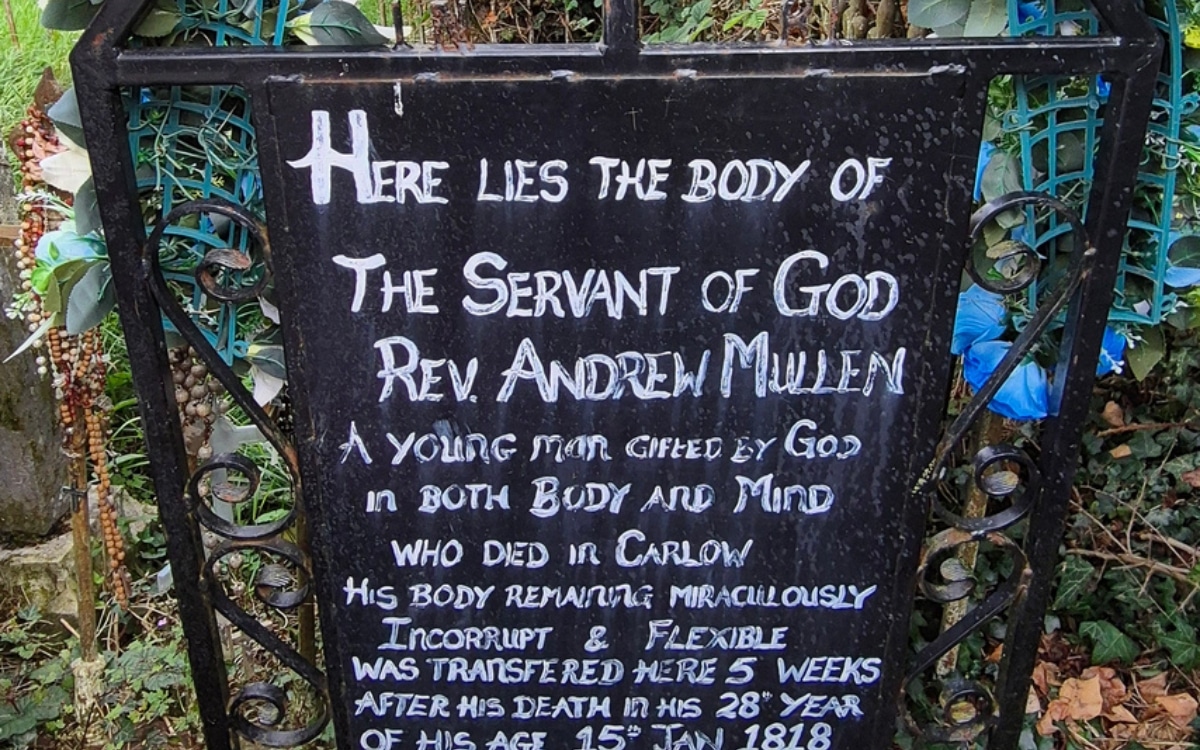
In Old Killaderry Cemetery near Daingean, County Offaly, lies the grave of Father Andrew Mullen.
He died aged only 28, yet his short life left behind a reputation powerful enough to transform his tomb into a place of pilgrimage. Within years of his death, people were travelling to his grave seeking cures.
More than two centuries later, the devotion surrounding Father Mullen has not entirely disappeared.
Who was Father Andrew Mullen?
Andrew Mullen was born around 1790 in Philipstown, the town now known as Daingean.
He entered Carlow College in 1809 before continuing his studies at St Patrick’s College, Maynooth. After ordination and further theological study, he was appointed curate at Clonmore on the Carlow-Wicklow border around 1815.
His ministry would be brief.
Mullen became particularly known for his generosity towards the poor. Stories describe him giving away food, fuel and clothing even when it meant leaving himself with little.
He also developed a reputation for healing. People travelled to receive his prayers and blessing, and he became remembered locally as a “Blest Priest” — a holy clergyman around whom popular devotion developed without formal sainthood.
Mullen died while still only 28 years old.
Surviving records disagree over the precise date of his death, but he was buried at Clonmore. Almost immediately, the grave began attracting visitors.
Folklore & Legend
People came to Mullen’s first burial place seeking healing and carried away earth from the grave. So much clay was reportedly removed that his coffin was left partly exposed.
Then came one of the strangest episodes surrounding his burial.
A Protestant man named Whitfield was buried in the same section of the churchyard, reportedly above Mullen.
In the religious atmosphere of early nineteenth-century Ireland, placing a Protestant burial over the grave of a Catholic priest caused deep resentment among Mullen’s followers.
Whitfield’s coffin was dug up during the night and left above ground. The authorities reburied it.
It was removed again.
The dispute continued until Whitfield’s remains were eventually taken elsewhere. Not long afterwards, Mullen’s own coffin would also leave Clonmore.
Around five weeks after his burial, a group travelled from Daingean to recover the young priest and bring him home to County Offaly.
Tradition describes a journey carried out secretly and under darkness.
The wheels of the cart were wrapped to dull their sound against the road. The pony’s hooves were said to have been covered with sacking, while another version claims the horseshoes were reversed to confuse anyone attempting to follow the tracks.
At Clonmore, the men opened the grave.
According to tradition, a strange light appeared above the disturbed earth. It hovered over the burial place while they worked.
Those present took it as a sign that Father Mullen wished to return home.
Sacred and Supernatural
When the coffin was opened, the story took another remarkable turn.
Five weeks after burial, Mullen’s body was said to remain flexible and incorrupt.
After the body was returned to Offaly, people reportedly touched and kissed the dead priest’s still-supple hand. Tradition also tells of a sweet floral fragrance surrounding his remains.
For those who already regarded Mullen as a holy man, the condition of his body strengthened that belief.
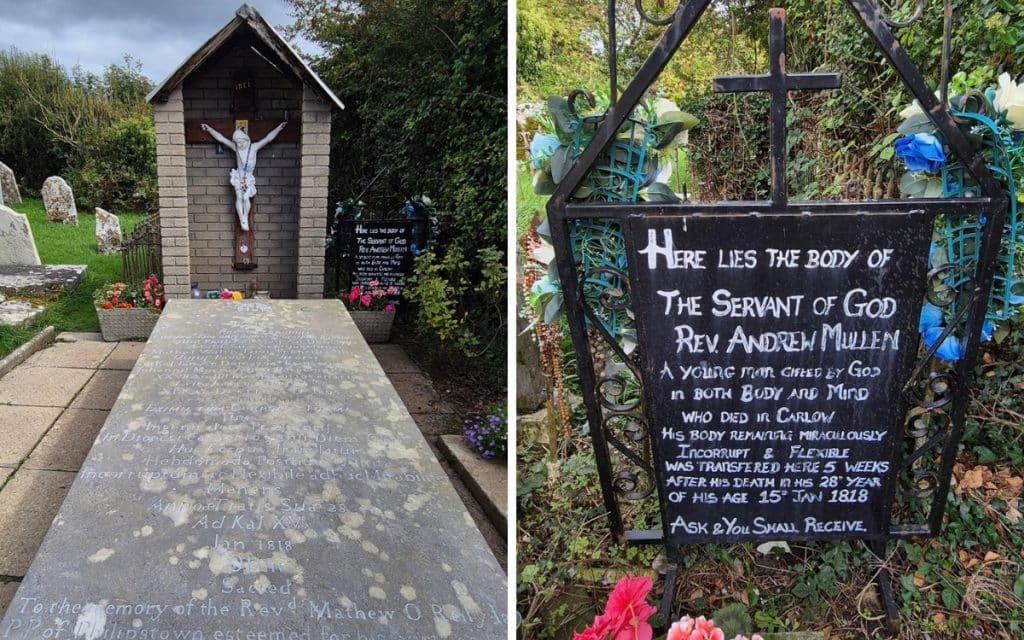
He was reburied at Old Killaderry Cemetery near Daingean beneath the raised stone tomb that remains there today. The devotion followed him.
By the 1830s, traveller Jonathan Binns recorded sick people coming to Killaderry and spending the night beneath Mullen’s tomb.
The ritual was physical and intimate.
Pilgrims lay close to the dead priest, sometimes remaining beneath the stone until morning. They also brought bottles of milk.
Clay from the grave was mixed into the milk and drunk in the belief that it could bring healing.
Pieces of clothing were left around the tomb by people who believed they had received cures, while others carried away small quantities of earth.
Holy Thursday night and Good Friday became particularly associated with the grave. Pilgrims prayed around the tomb, performed devotional stations and sometimes remained in the cemetery through the night.
Good Friday gradually became Father Mullen’s unofficial pilgrimage day.
The Unexplained
The supernatural elements surrounding Father Mullen are striking because they appear again and again at key moments in his story.
There is the light above the opened grave at Clonmore. There is the body said to remain flexible and free from decay weeks after burial.
There is the floral scent surrounding the corpse. There are the generations of visitors who believed they had been healed after coming to Killaderry.
One of the more curious details is that devotion continued even at Mullen’s empty grave in Clonmore after his remains had been removed.
The body was gone, but the place itself continued to hold meaning.
In that sense, the story of Andrew Mullen became larger than the man.
His first grave, his second grave, the earth around both, the body itself and the traditions surrounding him all became part of the same belief.
Soul-O Paranormal at Killaderry
I visited Old Killaderry Cemetery on 5 September 2026.
The age of the burial ground is immediately visible. Among the weathered memorials are striking examples of old funerary symbolism, including skull-and-crossbones carvings and other traditional reminders of mortality.
Father Mullen’s tomb stands apart.
The large stone slab is raised above the earth, leaving a narrow space beneath it. Seeing the grave in person makes the old descriptions of pilgrims spending the night there much easier to visualise.
There is physically enough room beneath the stone for someone to lie close to the burial place.
During my visit, I followed part of the old tradition myself and lay upon the slab covering Father Mullen’s grave.
What interested me most, however, were the signs that this devotion may not belong entirely to the past.
Beneath the tomb and around the grave were coins, rosary beads, holy medals, crosses, jewellery and small handwritten prayers left by visitors. A bottle of red wine had also been placed among the offerings.
More intriguing still was a small piece of metal that appeared to be part of a sleeping-bag zip.
Beside a grave where people traditionally spent the night, it immediately stood out.
It cannot tell us when or why it was left there, but it raises an obvious possibility: that at least some visitors may still be following the old overnight tradition.
I also collected a small amount of earth from around the grave, another practice with direct roots in the historical healing custom.
Standing at Killaderry, the old accounts stop feeling distant.
The raised tomb is still there. The offerings are still there.
And so is the belief.
Legacy & Belief
Andrew Mullen was never formally canonised, but his reputation eventually travelled far beyond Daingean.
Research into his life and the traditions surrounding him brought his cause to the attention of Church authorities.
His name appears under Vatican Protocol 2043, identifying him as:
Servant of God Andrew Mullen, Diocesan Priest.
The title places Mullen within the formal process through which possible sainthood may be considered.
More than two centuries after his death, several versions of Andrew Mullen now exist side by side.
There is the young priest who studied at Carlow and Maynooth. There is the “Blest Priest” remembered for generosity and healing.
There is the figure of folklore whose grave was opened beneath a mysterious light and whose body was said to remain incorrupt.
And there is the Father Mullen whose tomb still attracts prayers, rosaries, medals and offerings today.
That is what makes Killaderry so compelling.
The story did not end when Andrew Mullen was buried. People kept returning.
And more than 200 years later, they still leave evidence that Father Mullen has not been forgotten.
