

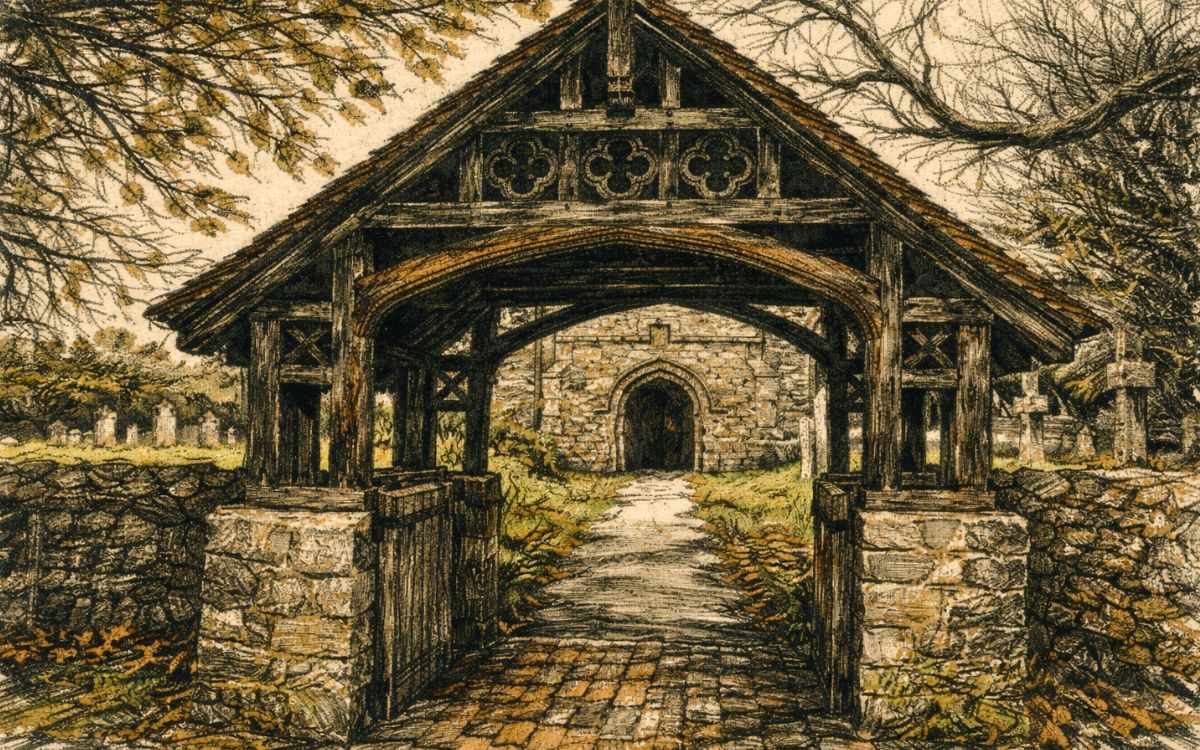
Venture into an old churchyard in Britain and you may pass beneath a weathered wooden roof before reaching the graves.
This is the lychgate – its name drawn from Old English līc, meaning “corpse”. Far from being a quaint rustic feature, the lychgate was once central to the ritual of death, a symbolic threshold where the dead were received into consecrated ground.
Gateways Between Worlds
The lychgate wasn’t just an entrance.
In medieval custom, the funeral procession paused here, and the priest met the body at the gate to begin the burial service.
The coffin – often only a shrouded corpse resting on a wooden bier – would be placed on a flat “lych-stone” or coffin rest, sometimes with benches for the bearers.
The Book of Common Prayer of 1549 (repeated in 1662) instructed clergy to start the rites at the churchyard gate before leading mourners inside.
With no mortuaries in earlier centuries, the body might remain under the roof overnight, guarded by watchers until burial. The gate sheltered mourners from the weather and protected the corpse from animals or even body-snatchers.
In folklore, the lychgate took on an eerie aura.
Some believed that if the gate creaked or swung at midnight, it foretold a death in the parish. Others claimed that the ghost of the last buried soul lingered by the gate until another coffin came through.
Across the UK and Ireland
While the lychgate is most characteristic of English churches, the tradition is not confined to England alone.
Hundreds of examples exist across the country, from medieval originals to Victorian rebuilds. The oldest surviving example is at St George’s, Beckenham, dating to the 13th century.
After the First World War, many new lychgates were erected as war memorials, combining ancient symbolism with modern remembrance.
Wales also preserves many lychgates, sometimes known locally as lychau. Welsh folklore ties them to the canwyll corff – the corpse candle, a ghostly flame said to trace the path of a funeral long before the mourners arrive.
Scotland has fewer timber lychgates, but traditions of coffin rests at the kirk gate, and later memorial gates influenced by English models, keep the threshold symbolism alive.
Scottish folklore more often focused on protecting the grave, with watch-houses and “mort-safes” standing guard at the churchyard entrance.
Ireland rarely built roofed lychgates, but coffin roads – long funeral paths – were common.
Across bog and hill, the dead were carried to consecrated ground, resting at great stone slabs along the way. These pauses echoed the same liminal moment at the lychgate, where the journey to the otherworld seemed to hover between worlds.
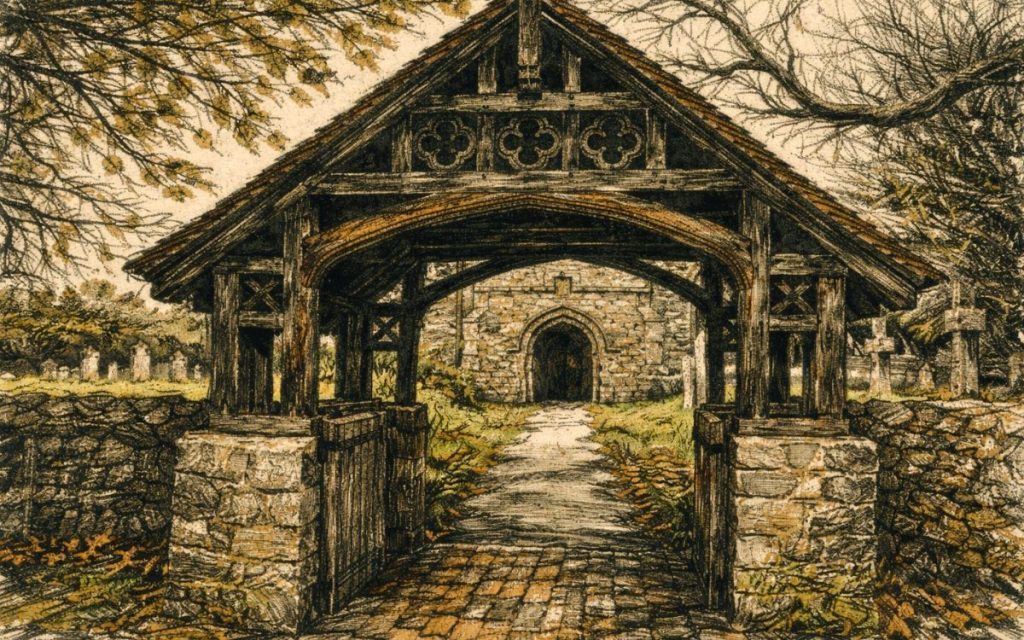
Lych Ways and Corpse Roads
The word lych also lives on in lych ways – funeral paths also known as corpse roads.
These were the tracks carved into the countryside by generations of coffins borne on shoulders to distant parish churches.
Such paths were thought to be sacred by use.
Carrying a coffin along a track could even establish a legal right of way, as if the dead themselves had blessed the route. They were usually straight lines across fields and moors, for spirits were believed to move in direct courses.
In the Lake District, resting stones still survive on the Ambleside coffin route. In Yorkshire and Dartmoor, ancient paths still bear names like “Lych Way” or “Corpse Road”.
Folklore clings to them.
People told of ghostly processions gliding along the paths at night, or of flickering blue corpse candles darting over the route. These lights – a kind of will-o’-the-wisp – were seen as omens of death, their size and speed said to match the age and fate of the coming funeral.
Shakespeare captured the image in Hamlet, writing of spirits that “in the church-way paths to glide”.
Haunted Gates Today
Lychgates still stand today, their timbers mossed and their inscriptions faded.
Some bear carved mottos. One famously reads, “This is the Gate of Heaven.”
In parts of Britain, children once barred newlyweds at the lychgate until they paid a toll – a playful echo of the older belief that no one should pass through unbidden.
In darker tales, suicides – denied burial in consecrated ground – were laid to rest just outside the gate, as close as they could come to sanctity.
Though many pass through without thought, each lychgate is a relic of a time when death shaped both landscape and imagination.
Together with the corpse roads that fed into them, they form a forgotten network of thresholds – paths of the dead, gates of the grave – that still whisper of centuries of ritual, superstition and ghostly lore.