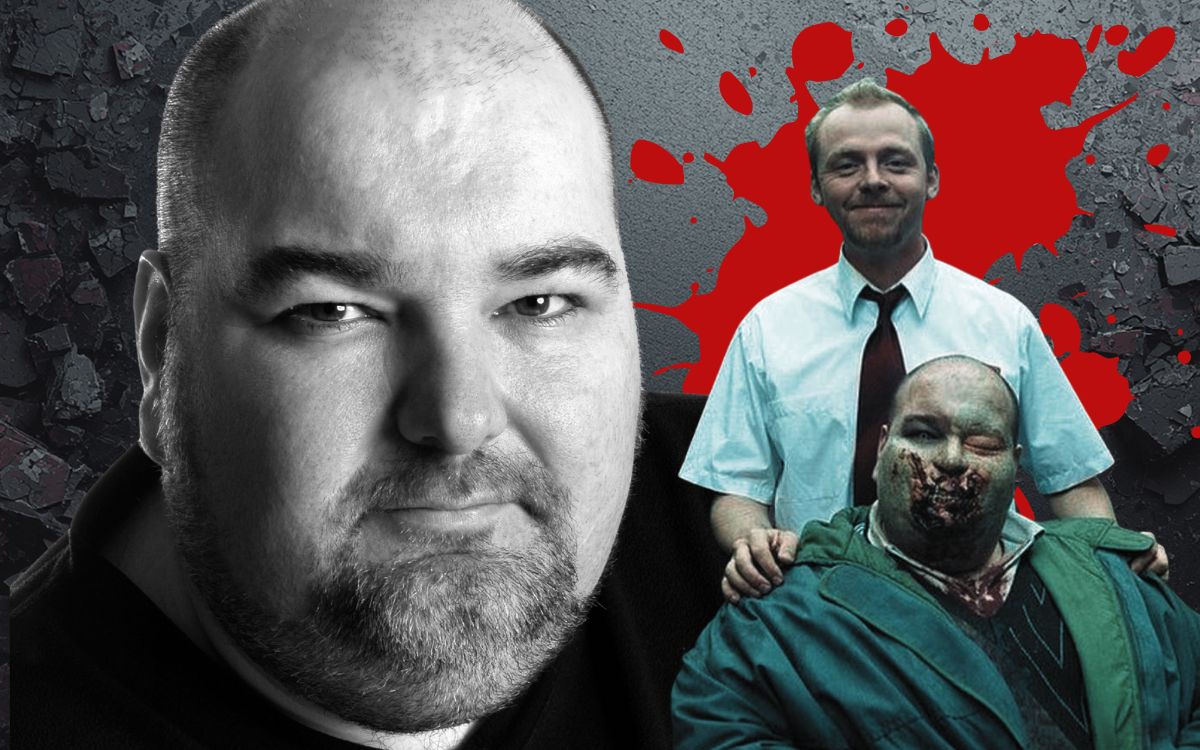
Actor Mark Donovan talks to WILLIAM BOVE on his unforgettable role in Shaun of the Dead, his journey into horror, and the art of bringing characters—living and undead—to life
If you find a zombie in your backyard—or even your garden—it’s unlikely they’re there to help you plant anything. Unless it’s you.
You certainly won’t find them out back jamming to their favourite hits. While some zombies are partial to music, they are not fans of vinyl.
Especially not when said vinyl comes rocketing towards their face, embedding itself in their eye—and killing them. Zombies are definitely not partial to that.
When it comes to vinyl, the quickest way to a zombie’s heart is not through its chest.
The vinyl will just shatter like a child’s toy thrown at a brick wall.
No, the quickest way seems to be directly in the eye. Which would, in fact, kill any zombie. It sure killed this one—or so we thought.
The other “zombie in the garden”, the one who survived, is Mark Donovan.
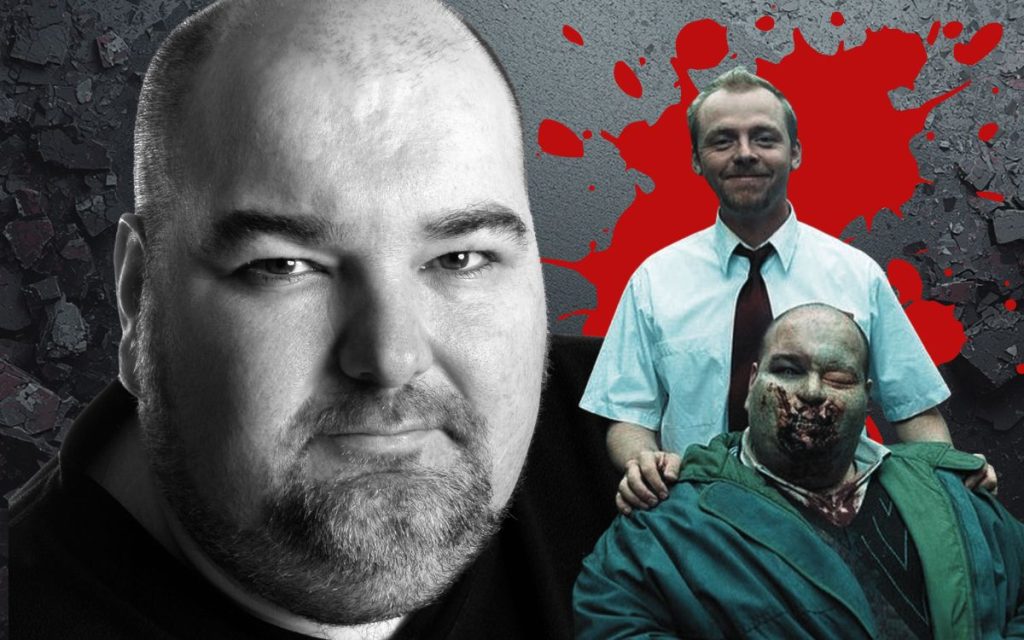
When I met Mark Donovan, he was sitting next to “the girl in the garden” from Shaun of the Dead. Mark, of course, played the other “zombie in the garden” in one of the greatest zombie comedies we all know and love.
It’s certainly one of the funniest.
It takes a hell of an actor—and one hell of an acting talent—to pull off a silent role and leave the audience speechless. Mark has a presence that steals the show and demands your attention.
The man himself is friendly, jovial and personable.
His presence instantly put me at ease, and I didn’t want to stop talking to him.
Mark is just a fun guy to engage with. There is an effortless quality to his demeanour that draws you in.
It’s hard not to feel completely relaxed around him.
I met Mark Donovan at the Dark History and Horror Con in Champaign, Illinois, recently.
I had a limited amount of time to speak with him, but in that time, he agreed to this interview.
So in a way, I get to spend more time talking with him.
Without further ado, I give you Mark Donovan.
William Bove: Please introduce yourself and give everyone a quick overview of your latest project.
Mark Donovan: I’m originally from the UK, a small market town in South Wales called Bridgend. I moved to London in the late ’80s—originally to train as an elementary school teacher—but after five years of terrifying the under-tens I thought better of it and embarked on a thirty-plus year career in stage, film, TV and radio. I have been fortunate enough to work in some of the greatest theatres, with a number of the best actors and crews, and in some of the most gorgeous (and some not-so-glamorous) locations all around the world.
A couple of years ago we relocated to the United States (my wife is from the US), and since arriving I have been primarily working on the convention circuit. In July 2024, I was invited to attend a solo event which combined a screening of Shaun of the Dead with an autograph signing session, a Q&A, and some interval games and quizzes.
It was a huge success, and the organisers and I are in the process of arranging a 15-day tour of the show this summer that would take in seven venues across seven different states.
It’s daunting, and details are still being finalised, but it’s very, very exciting! Stay tuned…
What drew you to your role in Shaun of the Dead?
Shaun of the Dead was the first (and so far, only!) time a role was actually created with me in mind.
Back in 2001 I was cast in an episode of a BAFTA award-winning sitcom in the UK called Black Books. As it was made by the same production team as Edgar Wright and Simon Pegg’s fantastic TV series Spaced, it was kind of a sister show to it.
I was a big fan of Spaced, and Nira Park, the producer of both, knew this.
We had our wrap party for Black Books in the smoky basement of a Soho bar in the West End, and whilst chatting with Nira over a large bourbon, she said, “You HAVE to meet Edgar! He’s as big a geek as you are!”
She took me over to the bar and, over another few drinks, Edgar and I bonded over our mutual love of all things sci-fi, horror and pop culture.
After an enjoyable hour reminiscing about shared childhood memories of Doctor Who, scary public information films, and fuzzy third-generation video nasties from the ’80s, the conversation eventually turned to zombie movies.
We discussed the works of Fulci, Argento and Romero, our shared preference for the classic slow, shambling zombie as opposed to the modern trend for fast, running zombies, and his love letter to the genre in the cold open to one of the episodes of Spaced.
He then casually dropped the line, “Hey, we’re trying to get a full zombie movie off the ground. If we ever manage it, you have GOT to be in it!”
I wholeheartedly agreed but filed it in the “What a lovely thing to say, but, you know, who’s going to think of a half-remembered conversation at a party one year on?” folder.
I’ll tell you who—Edgar Wright, that’s who.
Early in 2003 I got a call from my agent asking me to go to Ealing Studios for a screen test—and the rest is history.
Are there any experiences involving your role in Shaun of the Dead that stand out among the others? If so, can you describe them for us?
They were all great, even the days when we got rained off and had to stay in the trailer from dawn till dusk (how often do you get to kick back and chill with a cast like that?).
There was one day, however, that brings back rather vivid memories—even if it is for all the wrong reasons.
We had spent some time in the rehearsal studio doing trust exercises with the throwing of the records. Simon and Nick would throw the fake rubber records at us, and in turn, we got to throw the records at them.
We had a few laughs and got used to not flinching as they zoomed past our heads.
These rubber records were about a quarter of an inch thick so that they would hold their shape and not wobble in flight, so they were pretty heavy.
On the first day of shooting, towards the end of the day, we were filming with these records and doing a forced perspective shot where we were only a few feet away from the boys.
We shuffled forward and Nick threw his record, but he misjudged the angle and it hit me full force in the face.
It was like being hit in the eye by a baked potato!
I reeled back, and for the only time in my career, I stopped the take.
I was shaken, but Nick Frost, bless him, was inconsolable! He was so upset that I’d been hurt.
We were at the end of the day anyway, so Edgar called the wrap so I could get checked over by Morag, the unit nurse.
She was initially worried as it was the eye with the contact lens, but it was all absolutely fine—the only damage was a painless blood blister on the eyelid.
Nick came to check on me and I assured him all was well. I think he was more shaken up than I was!
I considered showing up the next day with an eye patch and a neck brace, but in the end decided that would be far too cruel!
Your horror effects makeup for your zombie role in Shaun of the Dead is fantastic. Can you describe the process it took to get into makeup and into character?
Stuart Conran, who both designed and applied the make-up, managed to create the effect in just one piece. The piece covered the whole of my lower face (with a gap over my mouth), my nose, and one eye.
The make-up started with a set of upper and lower teeth which were glued above and below my lips. Stu would then black out my own lips so that they couldn’t be seen by the camera.
The main piece was then applied over my face, and the edges skilfully melted so there was no visible join with my own skin.
The piece was then coloured and shaded to get the required effect, and the final touch was to add stringy “danglers” around the mouth area.
On the first day, this process took about an hour and a quarter, but after doing it a few times it came down to about 45 minutes.
The final touches—the application of sugar syrup blood to the piece and the zombie contact lens—were not added until we reached the set.
As for getting into character, it was more a case of getting OUT of character!
Usually, acting involves knowing the choices that your character would make in any given situation—what drives them and how they would react.
A zombie is pretty single-minded—it is driven by one thing and one alone: to get to you and eat you!
You have to divest yourself of all humanity, all emotion, and ignore all external stimuli. Effectively “you” cease to exist.
What do you enjoy most about acting?
Well, it’s not the money or the glamour!
Seriously though, I suppose it’s the chance to step inside someone else’s head.
The freedom to react in a way that you personally never would. The permission to say the unsayable, do the unthinkable, knowing that when the curtain comes down or the camera stops rolling, you are absolved of all wrongdoing—as the sins are those of your character, not yourself.
That freedom to know a character so well that you know how they would react in any given situation, and can instinctively react as they would.
I worked on a play about the comedian Lenny Bruce in the West End where Lenny was played by Suzy Eddie Izzard.
Eddie, as he was known at the time, reserved ten minutes at the end of Act One to improvise comedy—not as himself and his well-honed stage persona, but as Lenny Bruce.
Sometimes it worked, sometimes it didn’t go anywhere and Eddie would cut it short and go to the interval—but it was never less than thrilling to watch.
I asked Eddie why he put that extra pressure on himself? I mean, it wasn’t in the script—it was a bit he added himself.
“It’s because it terrifies me. To stand there not as myself, but as someone else. To try and get so far into his head that there is no Eddie—only Lenny. Just him, and 2,000 people waiting for him to speak. I have always tended to run towards things that scare me, and this is the scariest thing I’ve ever done. To have the guts to believe that I can do the job so well that just for ten minutes, Lenny might just live again—and when he does, it’s the biggest rush in the world.”
What do you enjoy most about horror acting?
The money and the glamour. 🙂
Do you have a favourite dramatic role you have done? Would you tell us about it?
I think the one I have a soft spot for is a character called Klemp.
It was in a Doctor Who audio play that was released on CD, and was my first job in a long line of collaborations with a company called Big Finish.
Big Finish specialise in audio drama based on genre properties such as Doctor Who, V, Space: 1999, Torchwood, Judge Dredd, etc.
As a HUGE Doctor Who fan from my youth, I was beyond excited to get to play in this particular sandbox, and Klemp was a wonderful character.
A fawning but undeniably devoted assistant to Madame Salvadori, the owner of an intergalactic auction house, played in a gloriously over-the-top fashion by the actress Caroline John.
Caroline had previously been the assistant to Jon Pertwee’s Third Doctor in the 1970s, and was joined in the cast by her husband, Geoffrey Beevers, who was also Doctor Who royalty—as he was one of the actors who played The Master, the Doctor’s arch enemy.
In this, Geoffrey was playing the mysterious, jewel-encrusted mask-wearing “Seta”.
One of the best things about classic Doctor Who was the dramatic cliff-hanger endings to the episodes, and I was delighted to find that my character was involved in one of the biggest cliff-hangers of the range to date.
All pre-publicity and marketing was geared towards the return of Caroline John, and very little said about Geoffrey’s involvement.
Imagine the audience’s surprise and delight when, at the end of episode two, I asked Seta, “Who… who ARE you??” and he slowly removes his mask and replies, “I am the Master—and you will obey me…”
Cue theme music.
They pulled off the surprise return of the decade, and the thought of it still sends chills down my spine even now!
Midway though episode three, Klemp gets to make the ultimate sacrifice for Mme Salvadori—so I even got to play a memorable death scene! What fun.
What is the hardest part of acting? Have any of your roles given you trouble?
I guess it comes back to getting inside the head of the character.
There is nothing more frustrating for an actor than not being able to “find” the character, because it becomes nigh-on impossible to play the scene realistically.
Actors make much of what is known as the “truth” of the scene, which is just a fancy way of saying making the scene believable.
If the actor doesn’t believe what the character is doing or saying, how can you expect the audience to buy into it?
I did one radio play where I just couldn’t get a handle on who this politician was, and scene after scene the director—bless him—would say “maybe he’s more this” and “maybe he’s more that”, which meant the character was never the same two scenes running.
I got frustrated, the director got frustrated, and when I listened to the finished play it was hard to even recognise the character as one person and not a string of unrelated MPs putting in their two cents.
It’s the only time I’ve finished a job and felt that I let the piece down.
Still, you learn from it, move on, and try to be better on the next one.
What was the best advice you’ve ever received?
An actor called Mike Lloyd once told me: “If you’re ever offered a job whilst waiting to hear back from another one, ALWAYS take the job that has a firm offer on the table. The universe has a way of making sure that you end up where you’re supposed to be.”
It’s served me well.
What was the worst or strangest advice that actually turned out to be surprising wisdom?
Don’t eat the yellow snow.
Did you study acting?
Interesting question.
I didn’t have any formal training, no. I didn’t go to drama school, take any courses at the Actor’s Centre or wherever, but that’s not what you asked.
You asked if I studied acting—and boy, did I ever! Ever since I was a kid.
As far back as I can remember, it’s what I wanted to do. I would watch my favourite shows as a young child of maybe four or five and think, “I’d love to do that when I grow up. Someone has got to do it. Why can’t it be me?”
I would study my favourite actors—how they would convey a thought with just the flicker of an eye or the twitch of a lip. The art of saying something using silence.
I would go to the theatre—firstly kids’ shows and the British Christmas tradition of pantomime, which (unknown to me at the time, of course) has its roots in the traditions of the Italian Commedia dell’arte—and learned how to work a live audience.
As I grew older, I would travel up to London to see plays and musicals—everything from kitchen sink drama to Shakespeare to rock ’n’ roll jukebox musicals.
When I went to university to train as a teacher, I paid my way through college by working front of house in the West End theatres.
Always watching, always studying. That was my training!
How do you think you’ve improved as an actor from when you first started until now?
To be honest, I suppose that’s not really for me to say.
My style has changed, definitely, but it’s up to others to say if it’s an improvement or not!
The first decade of my career was solely in theatre, where everything has to be bigger so that you can reach the people way at the back of the upper circle.
After doing that for so many years, when it came to my early TV work, I struggled to adapt at first and bring the performance down to such an intimate level.
I was fortunate that, at the same time I started doing screen acting, I also began working in my true love—audio drama—which sadly doesn’t seem to be a very big thing in the States.
Things have improved with the advent of Audible and the popularity of audiobooks, but a full-cast audio drama is a wonderful beast.
It is as intimate as you can get.
You have a picture of how the scene looks in your head and you get to convey that to the listener using just sound.
It is just your voice, in the darkness, whispering into the listener’s ear and creating worlds, creating drama, manipulating feelings and making an emotional connection.
When you can do that with just your voice, visual cues don’t need to be large and in your face, and I think my TV and film work has benefitted from that experience.
Who are your favourite writers, movies, artists, poets or historical figures?
I have quite eclectic tastes, really, and enjoy what some would deem low art just as much as high art—sometimes more.
As I’ve got older, I’ve come to appreciate the writing of Dickens and Shakespeare far more than I ever did in school.
There’s a Welsh author called Malcolm Pryce who wrote a series of novels in the style of “Welsh Noir”, which I really enjoy.
Douglas Adams, author of The Hitchhiker’s Guide to the Galaxy and so much more, was a genius.
For movies, I love the lowbrow post-war comedies I grew up with like the Carry On series, 1980s blockbusters and cult/horror films, as well as classics like The Wizard of Oz, It’s a Wonderful Life and Metropolis.
A personal favourite is the much-maligned Robin Williams movie What Dreams May Come, which leads us neatly into art and artists.
As the saying goes, “I don’t know much about art, but I know what I like!”
Van Gogh, Hieronymus Bosch, Munch, Grant Wood and Bruegel tend to feature heavily on my screensavers.
I’m not big on poets, but can appreciate the classics—the war poets, Wordsworth, Coleridge—as well as modern poets like Ted Hughes and Roger McGough.
Historical figures? Aneurin Bevan. Paul Robeson. The Apostle Paul. Ed Wood.
What do you like to do when you’re not acting? Any hobbies or hidden talents?
I enjoy messing around on the computer and doing audio/video editing.
I started a YouTube channel called Zombie Adventures, which is a vlogging channel where my wife and I visit various places of interest in the Midwest—the Iowa State Fair, the Field of Dreams, the Surf Ballroom where Buddy Holly played his last concert, the American Gothic House, and so forth.
“Join ussss…” 😉
What has been your favourite Horror Con experience? Do you have a favourite Horror Con you’d like to appear at?
I very much enjoyed Halloweenapalooza in Ottumwa, Iowa.
It’s a combined horror convention and film festival—not too big, not too small, and run by people with a real passion.
One year, the Saturday of the convention fell on my birthday, and when their Zombie Walk returned from town I was presented with a cake in the shape of the head of the Hulking Zombie and the horde sang/groaned an approximation of Happy Birthday to You!
I was a guest there two years in a row, and was asked to come back for a third, but didn’t want to wear out my welcome with the attendees.
When the weekend came, I was shocked to realise how much I missed the event—and if they ever want me back, I’ll be there like a shot!
The event I’d really like to do is Chicago Flashback Weekend—if only to get a chance to meet MeTV horror host Svengoolie!
What has been your favourite experience to date as an actor?
In 1996, I played Inspector Clay—the Tor Johnson role—in a UK tour of Plan 9 from Outer Space – The Musical!
As a cult movie fan who was more than au fait with the work of Ed Wood, to be involved with a project that I had such enthusiasm for was a real blessing.
Up until that point I’d always had thick hair and a beard, which obviously had to come off for the part.
Sadly, just before taking the role my mother had passed away, so I decided to use the ‘big shave’ as a fundraising opportunity for the Haemophilia Society, with whom she had worked for many years.
Luke Goss, who was heading up the cast (you may remember him as the villain in Blade II), and I decamped to a local hair salon and the press covered the event.
I figured if the hair had to go, why not do it in style?
The show toured for six months. It was moderately successful, but not a huge hit—it was a difficult sell, and the tagline “One of the worst movies in history is now one of the funniest musicals you’ll ever see” may not have been the wisest move.
Audiences didn’t know what to make of it.
With a good audience, the show was amazing. If they didn’t get it, it was like wading through treacle!
Someone has put the entire show on YouTube, so track it down and see what you think for yourselves.
However, as a company, we had an amazing time.
As well as Luke, we had Adele Anderson from the award-winning cabaret troupe Fascinating Aïda, the West End legend Peter Straker, countertenor Kinny Gardner (who had just come hot-foot from the Lindsay Kemp company), and a talented bunch of actor-musicians whose talent was off the scale.
It was a strange mix of people that really shouldn’t have worked—but we all just gelled immediately.
We had as much fun offstage during that tour as on, and I remember it very fondly.
What is your favourite thing about horror as a genre?
Most people love to be scared, as long as it’s in a safe, controlled environment.
That’s why our forefathers told ghost stories around the fire, why people ride white-knuckle rides at theme parks, and get jump-scared at Halloween horror haunts.
It’s that rush of adrenaline—the fight-or-flight response that keys into our very basic, primal survival instincts.
The horror genre allows us to flex (and hone) those mental reflexes in a fun and safe way.
The body’s response to fear and hilarity is closer than a lot of people realise—very similar endorphins are released in the aftermath of both a good scare and a good laugh.
High drama and comedy are two sides of the same coin, and in Shaun of the Dead I was blessed to be in a film that had both.
I’ve lost count of the people who’ve come up to me and said, “My partner doesn’t like horror films but they loved Shaun of the Dead.”
The horror genre is such a broad church.
It can be visceral or cerebral. It can be unsettling or peel-me-off-the-ceiling scary.
It can be camp, it can be corny, or it can live rent-free in your head for the rest of your life.
Whether you prefer buckets of blood or the unseen figure whose horror is limited only by the bounds of your own imagination, there is something for everyone.
Sweet dreams…