

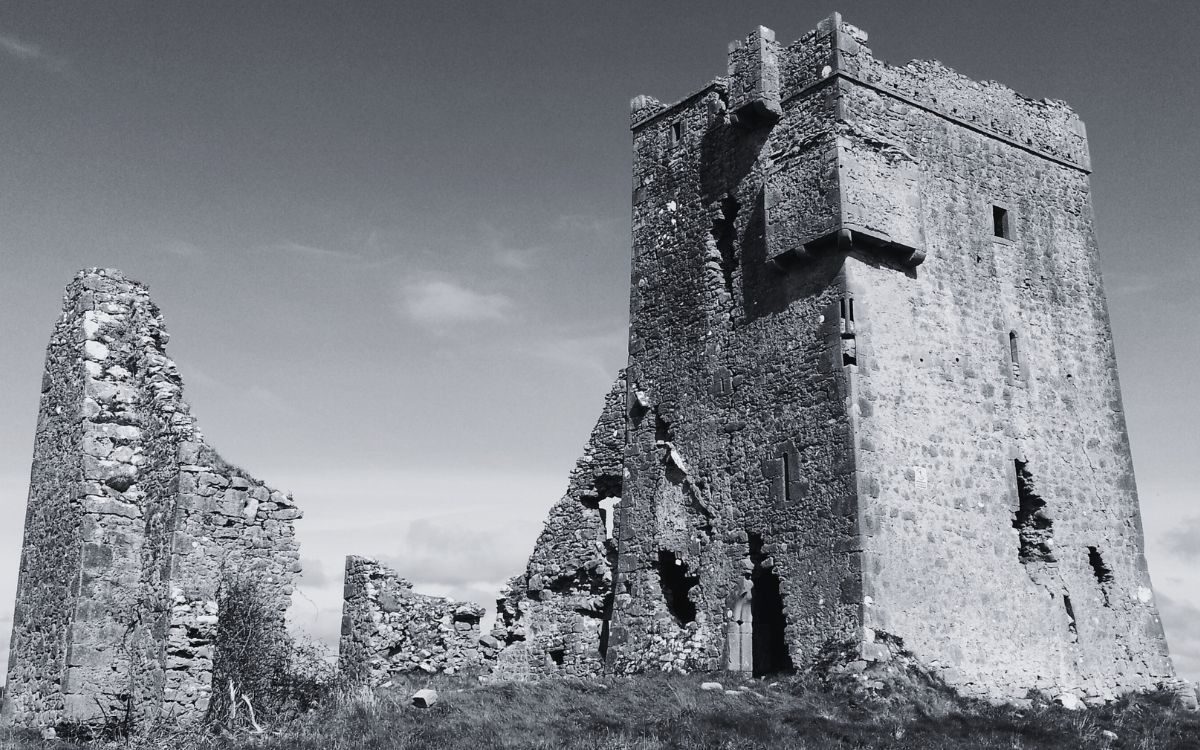
Just outside Tullamore, County Offaly, where the Grand Canal glides silently through the fields, stands the brooding ruin of Srah Castle.
Built in 1588 by John Briscoe, an Englishman from Cumberland, this tower house was both a fortress and a declaration. Tall, angular, and commanding, it rose with four storeys of defensive might.
Gun loops peer from its stone like unblinking eyes. A murder hole above the entrance once allowed boiling oil and stones to rain down on unwelcome visitors.
Bartizans, the overhanging turrets, protrude from its corners. One has long since fallen, leaving a gaping wound in the wall.
Behind the tower stood a seventeenth-century hall, now reduced to a skeletal gable clinging to memory.
Srah suffered heavily during the Cromwellian campaigns of the mid-1600s. The tower was damaged, its defenders scattered, and its walls left to face the centuries alone.
Unlike many Irish strongholds, no grand restoration followed. The spiral stair crumbled, the corridors hollowed, and the tower settled into ruin beside what would later become the canal.
Today, its battered base leans against centuries of neglect.
Though forgotten by many, it remains one of Offaly’s truest late-Elizabethan tower houses.
Folklore of Srah Castle
Srah does not boast the loud legends that cling to castles like the nearby Leap or Charleville.
Instead, it is wrapped in quiet folklore, stories whispered between locals and passed through the generations.
The Briscoes were outsiders planting their stone in Gaelic soil. Some say the land never truly accepted them.
The tower’s coldness is often remarked upon by walkers on still nights. Animals refuse to linger near the western wall.
Locals speak of a presence that watches the canal path, especially near the breach where the bartizan once stood.
Beside the tower lies a bullaun stone, an ancient basin carved into rock. These stones predate the tower by centuries and are often linked to pre-Christian ritual or early Christian blessing.
Its quiet presence beside the castle adds a layer of mystery — an older spirit lying beneath the Elizabethan skin.
Paranormal Aftermath
Srah still tells a story to those willing to brave its ominous presence.
Investigators and late-night walkers have reported sudden, unnatural drops in temperature when approaching the ruin after dusk.
Torchlights falter. The silence deepens into something tangible.
Inside, the broken stairwell amplifies even the softest footstep until it sounds like pacing overhead.
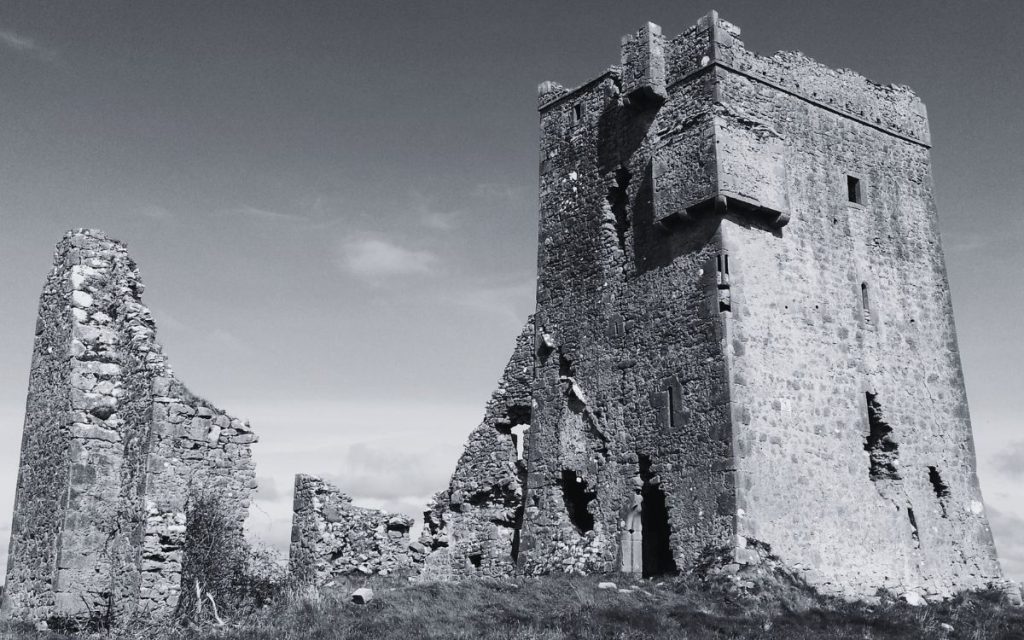
A recurring experience is the “Window Watcher.” Several visitors claim to have seen a dark, motionless figure in the upper window.
Tall, human-shaped, and observing.
The moment they blink, it vanishes, leaving only the stark frame and the sky beyond.
Electronic equipment often glitches near the base of the tower.
EVP attempts have captured soft sighing sounds, faint but human in tone.
One recording, made by a local paranormal group in the late 2000s, caught a low, breathy whisper that seemed to repeat the word “Return.”
Even the canal plays a role.
Some night walkers say the tower’s reflection in the water seems wrong. Slightly delayed, as if whatever stands inside the ruin is not bound to the same time as the rest of us.
Time Stands Still
Srah Castle is not a place of grand hauntings or theatrical spectres.
It is a place of subtle unease, where history has not faded.
The tower beside the dark water carries memories in its stones. Elizabethan ambition. Cromwellian ruin. Rural whispers. And perhaps, something still standing guard.
Would you brave a visit to Srah Castle at dusk?
Have you ever walked the canal path near Srah Castle? Share your story in the comments below!