


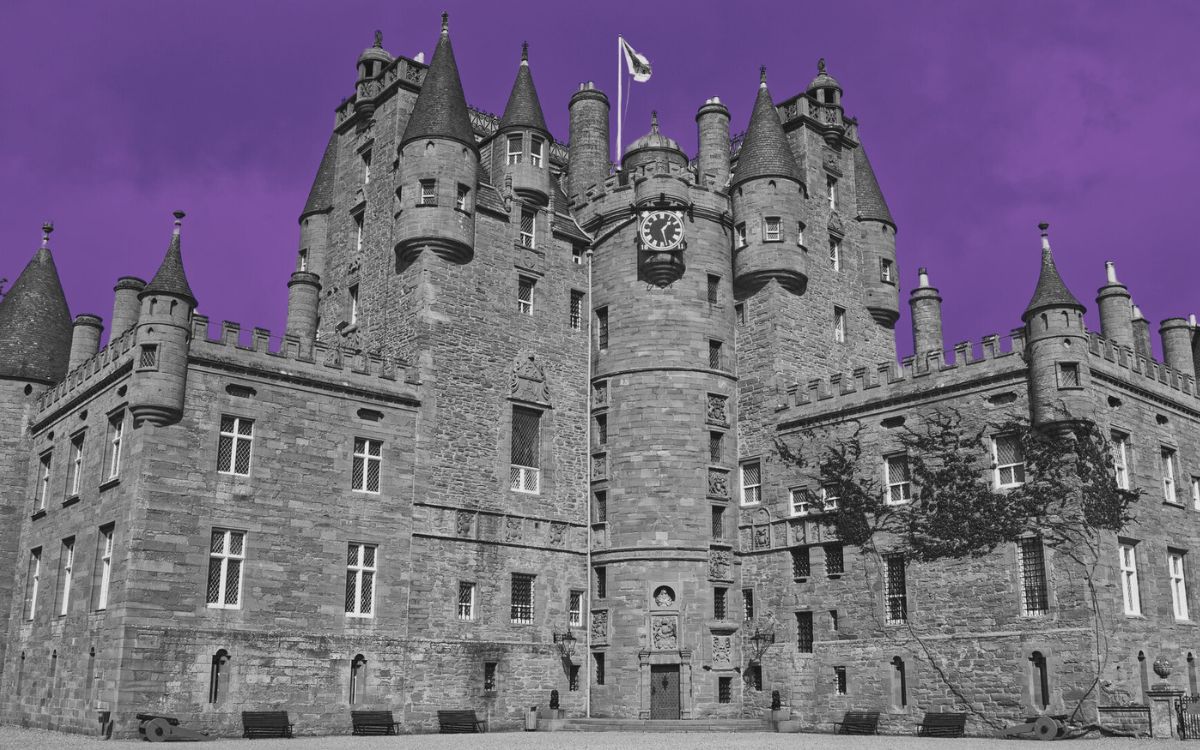
Behind the walls of Britain’s castles and country houses lie hidden chambers, secret staircases and concealed passages. Some were designed to shelter fugitive priests or provide a means of escape. Others became associated with imprisoned relatives, family scandals, unexplained deaths and ghostly apparitions. Over time, the distinction between architectural fact and supernatural folklore became increasingly blurred.
The secret of Glamis Castle
Few places have inspired more speculation than Glamis Castle in Angus, famous for rumours of hidden chambers, family secrets and shadowy figures seen on its ramparts at night.
According to the best-known legend, a severely deformed member of the Bowes-Lyon family was secretly confined within the castle, hidden from the outside world in a secret chamber. Yet no convincing evidence that such a prisoner ever existed has emerged.
Another legend concerns the ghost of Earl Beardie, traditionally identified with Alexander Lindsay, 4th Earl of Crawford, who is said to have gambled with the Devil and been condemned to play cards for eternity. His restless spirit is associated with a genuine sealed space behind the walls of the Crypt, where the sounds of an endless card game are supposedly heard.
The castle’s unsettling atmosphere was noted long before these stories became widely known. Sir Walter Scott, recalling his stay in the summer of 1793, described being conducted to a remote apartment:
“I must own, that as I heard door after door shut, after my conductor had retired, I began to consider myself too far from the living, and somewhat too near the dead.”
Glamis was far from the only ancestral seat to mirror the Gothic fiction of the period.
At Littlecote House in Wiltshire, Bruntsfield House in Edinburgh and Sizergh Castle in Cumbria, certain gloomy apartments acquired reputations as ‘ghost rooms’. Such chambers were sometimes associated with unexplained disturbances, while others possessed genuine architectural secrets.
At Cefn Mably, near Caerphilly, the ancestral home of the Kemeys family from the fifteenth century until 1923, the house was once said to be ‘hopping’ with ghosts.
A haunted staircase possessed a hanging beam overhead, while the west wing contained a mysterious chamber known as the Priest’s Room. Nearby, a sliding panel concealed steps leading towards an underground passage.
Servants reportedly went in awe of the room, from which the unexplained sound of tinkling bells was sometimes heard.
Knebworth House and its windowless chamber
At Knebworth House in Hertfordshire, the Victorian novelist Sir Edward Bulwer-Lytton recalled a series of mysterious apartments that seemed to have stepped directly from the pages of Gothic fiction.
Fascinated by the supernatural, Bulwer-Lytton described a long gallery terminating in gloomy, tapestry-draped rooms reputed to be haunted.
But an even stranger feature lay in one of the gateway towers.
He remembered:
“In another room…was a curious trapdoor that gave access to a chamber beneath…which had neither doors nor windows…”
This dungeon-like space was known as the ‘Hell-hole’.
Bulwer-Lytton believed the name might have originated with his ancestor Sir William Lytton, who was imprisoned following Pride’s Purge of 1648 and supposedly named the chamber after a Westminster tavern called ‘Hell’.
Its original purpose remains a mystery. The Lyttons were Protestants, making its use as a priest hole unlikely.
Unfortunately, the north wing containing the chamber was demolished in the early nineteenth century, leaving its secrets unresolved.
Although Knebworth’s haunted apartments have disappeared, the house is full of antiquities and still possesses a hidden library door, a reminder of the architectural features that helped inspire Bulwer-Lytton’s Gothic imagination.
Claydon House: The haunted muniment room
At Claydon House in Buckinghamshire, a long-forgotten hiding place was associated with phantom footsteps and the ghost of a Royalist soldier.
The ancestral seat of the Verney family since 1620, Claydon is closely connected with the English Civil War. Sir Edmund Verney, chief standard bearer to Charles I, was killed at the Battle of Edgehill in 1642. According to family tradition, only his severed hand was recovered, still clutching the royal standard.
When the family vault was opened many years later, there was reportedly no coffin for Sir Edmund, only a small casket. His ghost is said to haunt both the house and neighbouring church, searching for his missing hand.
But Claydon’s most intriguing supernatural mystery concerns a secret chamber within the house itself.
Rediscovered during repairs in the 1860s, the Jacobean or Civil War-era hiding place was large enough to accommodate ten men standing upright. It lay beside the great chimney at the centre of the building and was entered through a trapdoor in the muniment room above.
Frances Parthenope Verney, writing in the nineteenth century, explained that such hiding places were:
“known only to the owner of a house and his eldest son, and were passed down with solemn secrecy to the next generation.”
The muniment room also contained a hidden doorway leading to a secret staircase, designed to allow fugitives to escape unseen. Although the staircase has since disappeared, remnants of its upper stone steps survived.
Curiously, Lady Verney recorded that the muniment room was regarded as the haunted chamber of the house.
Decades later, in the early 1920s, two independent witnesses reportedly heard heavy footsteps approaching the trapdoor at night. On each occasion, the phantom footsteps stopped at precisely the same spot.
Sir Harry Verney subsequently related these experiences to the ghost hunter Peter Underwood.
Could the room’s sinister reputation have served a practical purpose? Lady Verney’s account raises the intriguing possibility that stories of hauntings were encouraged to deter servants and visitors from investigating the family’s secret hiding places.
Today, Claydon House is cared for by the National Trust, while descendants of the Verney family continue to occupy its south wing.
Chingle Hall, Lancashire: Knocking from the priest hole
Chingle Hall has long been regarded as one of England’s most haunted houses.
This white-walled former manor and farmhouse is associated with a spectral monk, a mysterious lady in black and several other restless spirits. It is also traditionally believed to have been the birthplace of the Catholic martyr John Wall.
Two cavities within the building are identified as priest holes, reminders of the dangerous years when Catholic clergy were forced into hiding.
One lies in the front wall of the Priest’s Room above the kitchen, while another, beneath the flagged floor of the kitchen fireplace, is thought to have served a similar purpose.
But it is the cavity in the Priest’s Room that has attracted some of the strangest supernatural reports.
Visitors have claimed to hear mysterious knocking sounds coming from within the concealed space, while on one occasion a disembodied hand was allegedly seen there.
Whether these experiences have a natural explanation or something more mysterious remains uncertain, but the combination of genuine hiding places and ghostly traditions has helped sustain Chingle Hall’s eerie reputation.
Plas Mawr, Conwy: The haunting of the White Chamber
A vanished doctor, a tragic family death and mysterious cries from a chimney have given this Elizabethan townhouse a spooky reputation.
Built between 1576 and 1585 by the wealthy merchant Robert Wynn, Plas Mawr is one of Wales’s finest Elizabethan houses. But behind its ornate plasterwork lies a legend involving a secret passage and a doctor who disappeared without trace.
According to the story, the pregnant mistress of the house and her young daughter were fatally injured in a fall. A young doctor, known as Dr Dick, was summoned but subsequently locked in the Lantern Room, where he mysteriously vanished. When the master returned, he discovered his wife, daughter and newborn infant dead. He too was found dead the following morning.
Legend claims Dr Dick attempted to escape through the chimney, became trapped in its hidden passages and suffocated. On stormy nights, cries and muffled voices are supposedly heard from the great kitchen fireplace, while the master’s ghost is said to wander the house searching for the missing doctor.
Intriguingly, a genuine secret hiding place survives within the chimney stack between the Lantern Room, now known as the White Chamber, and the Great Chamber, lending an unsettling element of reality to the tale.
Loseley Park, Surrey: The stepmother’s secret
Built between 1562 and 1569 for Sir William More, Loseley Park is one of Surrey’s finest Elizabethan houses.
Its magnificent interiors include a Great Hall containing panelling said to have come from Henry VIII’s lost palace of Nonsuch. In the King’s Room, a seventeenth-century tapestry depicting a night hunt with hounds is reputed to come to life when illuminated by firelight after dark.
But behind the splendour lies a disturbing family legend.
According to tradition, the second wife of a sixteenth-century owner murdered her young stepson to prevent him inheriting the estate.
When her husband discovered the crime, he supposedly imprisoned her in a small room on the upper floor.
The chamber subsequently acquired a sinister reputation.
It is claimed that terrifying screams were heard from this room on the same night each year, prompting the family to leave the house on that date.
Loseley also has stories of a secret passage leading from the cellars towards the former moat, although its existence remains uncertain.
Whether the tale preserves a genuine family tragedy or is simply an elaborate ghost story, the idea of a room so feared that its occupants abandoned the house annually is difficult to forget.
Billingham Manor and the severed head of Charles I
With its ghostly duellists, smuggling traditions and secret passages, Billingham Manor on the Isle of Wight is one of Britain’s most intriguing mansions.
Dating partly from 1631 and once owned by playwright J. B. Priestley, the house contains a double cellar with a tunnel running beneath it. But its most remarkable secret lies in the oak-panelled Drawing Room, where a sliding panel reveals an eighteenth-century rotating bookcase concealing a narrow chamber.
Legend claims Charles I hid here after escaping from Carisbrooke Castle, only to find the coffin-like space so cramped that he preferred to return to captivity.
In 1928, the house was rented by Irish diplomat and author Sir Shane Leslie and his wife, Lady Marjorie. According to ghost hunter Peter Underwood, the couple were disturbed by heavy footsteps and clashing swords. One night, investigating the noises with other occupants, they noticed a strange light seeping through the drawing room’s sliding panel.
Opening it and swinging the bookcase aside, they were confronted by an extraordinary sight: the severed head of Charles I, suspended in a phosphorescent glow. The witnesses reportedly recognised his soft ringlets, pointed beard and sorrowful expression before the apparition faded, leaving the chamber empty.
Intriguingly, Leslie published A Ghost in the Isle of Wight in 1929, a fictionalised haunting set in a manor called Killington, featuring similar mysterious footsteps and clashing swords. The resemblance raises questions about the relationship between Leslie’s story and Underwood’s later account.
Whether a genuine haunting or a story embellished through retelling, the tale captures the peculiar fascination of Britain’s secret corners.
After all, a locked door invites curiosity. A hidden room invites speculation.
But a secret chamber with a ghost story is something altogether more unsettling.
ALVIN NICHOLAS is co-author of Lost Chambers & Subterranea: The Explorer’s Guide to Secret Britain, which explores the hidden secrets of Britain’s castles, manor houses, crypts and caves, together with the legends, ghostly encounters and dark histories associated with them. The book is available from Bookshop.org, Central Books, Amazon and other booksellers.