
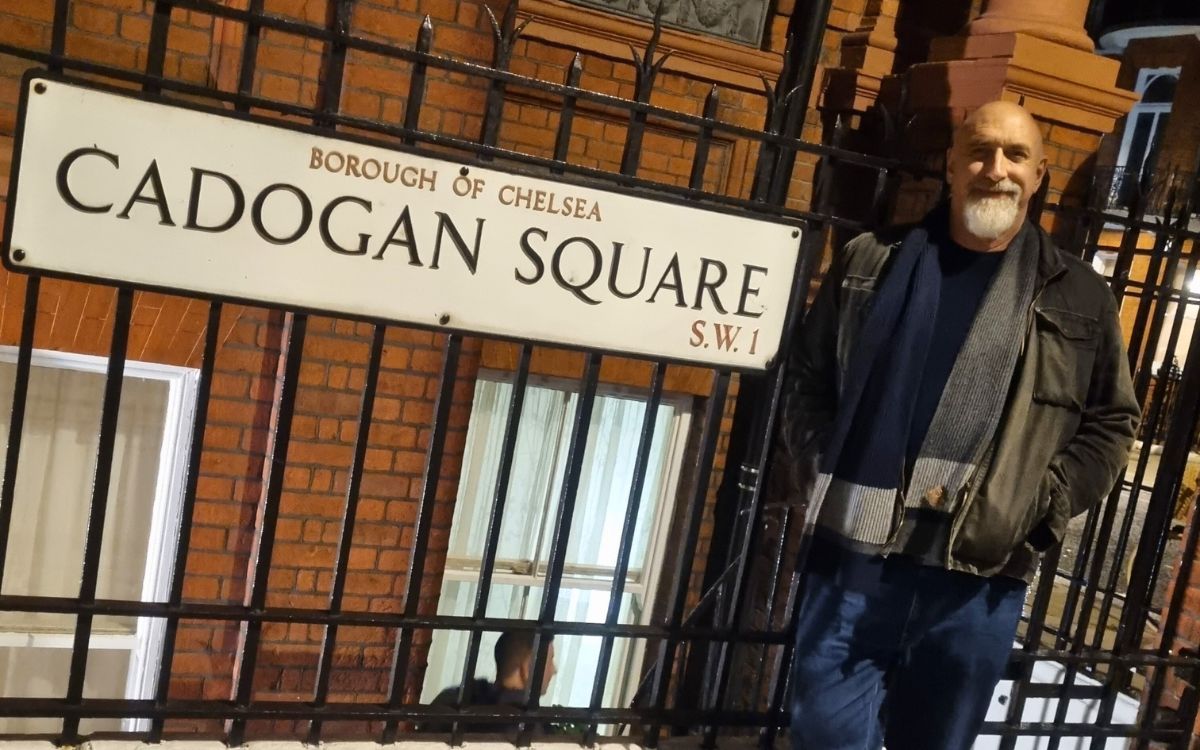
Cadogan Square in Chelsea is one of London’s most sought-after addresses.
Average prices for one of its Victorian townhouses currently run to £1.7 million. At the peak of the London property boom in 2015, houses on the square were changing hands for as much as £5 million.
Named after the Earl of Cadogan, the square was built over a 10-year period spanning 1877 to 1887, on what had previously been the croquet, cricket and tennis lawns of the Prince’s Sports Club.
In the 20th century, its list of former residents reads like a who’s who of horror.
Chelsea’s Who’s Who of Horror
Lord Dunsany (Edward John Moreton Drax Plunkett, 18th Baron Dunsany), fantasy, horror and sci-fi author, lived at 66 Cadogan Square in the 1920s.
Dunsany’s novels, which blended fantasy with elements of the gothic and supernatural, were cited by H. P. Lovecraft as a major influence on his own brand of weird fiction.
Dunsany’s ghost and horror stories were anthologised in collections such as The Gods of Pegāna, The Sword of Welleran, and Gods, Men and Ghosts.
Arnold Bennett was another writer who lived on the square in the 1920s.
A blue plaque can be found at 75 Cadogan Square, where he lived between 1921 and 1931.
A prolific author and close friend of H. G. Wells, Bennett is not immediately associated with horror. However, his 1907 novel The Ghost concerns the supernatural experiences of a young doctor obsessed by an opera singer and subjected to a spectral haunting.
Bennett also wrote the script for the 1929 film noir Piccadilly, starring Anna May Wong, who went on to appear as the daughter of Fu Manchu alongside Warner Oland in Daughter of the Dragon (1931).
Christopher Lee, 45 Cadogan Square
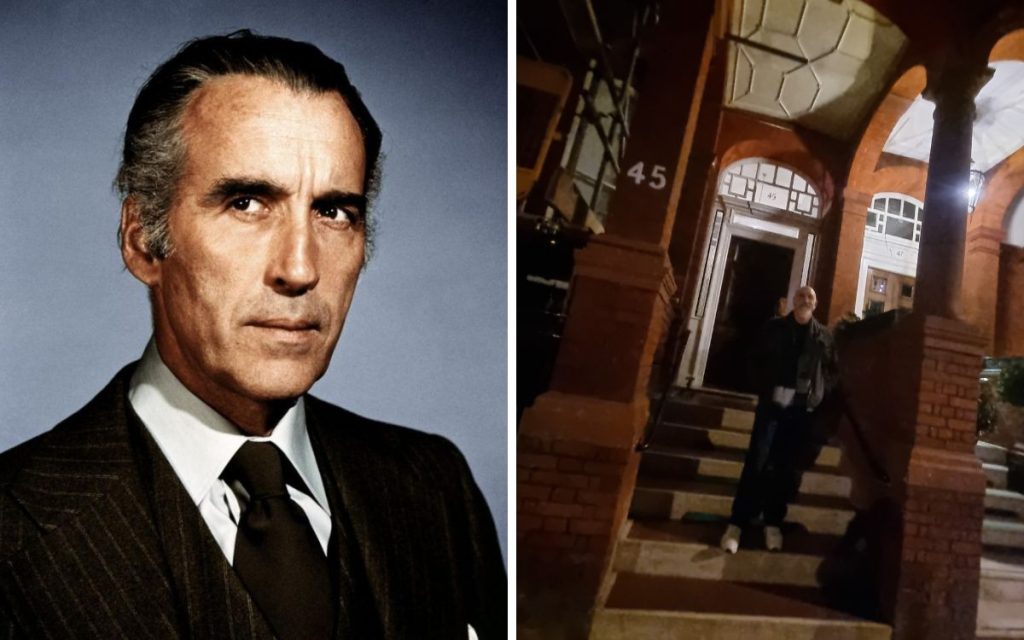
Christopher Lee played Fu Manchu in no fewer than five movies in the 1960s.
The horror legend lived at 45 Cadogan Square from the 60s until his death in 2015.
While living on the square he recorded a video there to accompany his 2006 version of the Frank Sinatra hit My Way.
His cinematic output in that period saw him transition from Hammer and Amicus horror movies to roles in international blockbuster franchises such as James Bond, Star Wars and The Lord of the Rings.
Two of the Hammer Productions films he appeared in during his early years at Cadogan Square were the adaptations of Dennis Wheatley’s novels The Devil Rides Out and To the Devil a Daughter.
Dennis Wheatley, 60 Cadogan Square
Dennis Wheatley lived at 60 Cadogan Square from 1961 until his death in 1977.
Another Hammer adaptation was The Lost Continent (1968), based on his 1938 novel The Uncharted Seas.
Whilst he had built his reputation on highly acclaimed occult thrillers, his output during the period he lived on Cadogan Square was partly focused on an editorial role for horror anthologies and collections.
A Quiver of Horror for Target in 1964. First Book of Horror Stories and Second Book of Horror Stories for Hutchinson in 1968.
The 45-volume Dennis Wheatley Library of the Occult, published by Sphere in the 1970s, was a collection of classic horror fiction and nonfiction, each book with an introduction by Wheatley.
Boris Karloff, 43 Cadogan Square
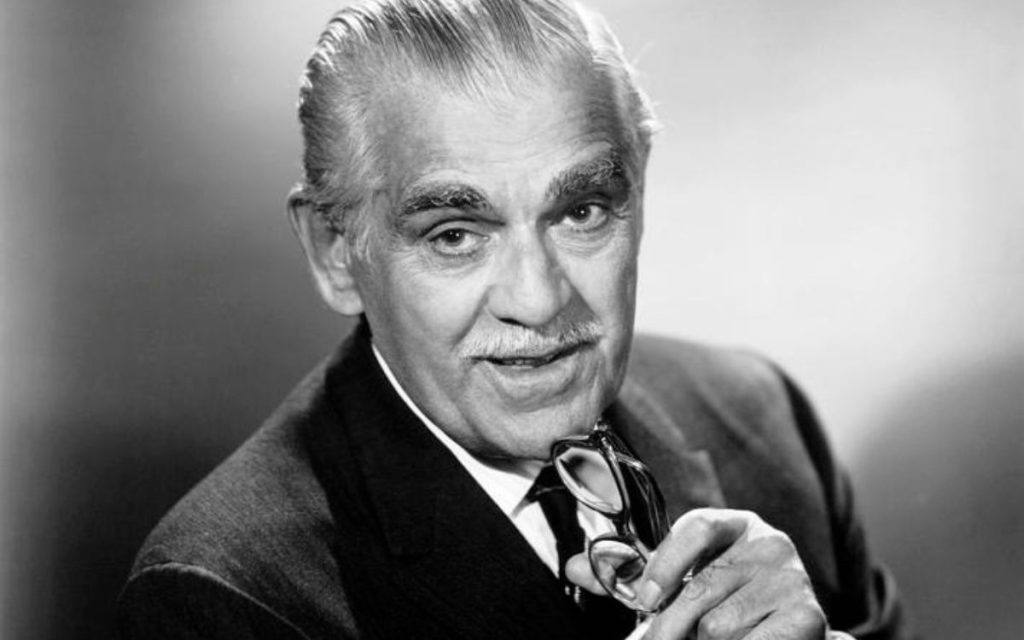
When Boris Karloff relocated back to London in 1959, he moved into 43 Cadogan Square, the house where he would become Christopher Lee’s next-door neighbour.
Karloff famously kicked off his career as a horror icon with his role as Frankenstein’s monster in the 1931 Universal classic.
Lee mirrored this with his first horror role as the monster in Hammer’s 1957 The Curse of Frankenstein.
Although he was in his seventies by the time he moved to Cadogan Square, Karloff carried on making films for the next decade during his residence there.
His films in the 1960s included the Roger Corman-directed The Raven and The Terror (both 1963), and Tigon Pictures’ The Sorcerers (1967).
In 1968 he co-starred with his neighbour in Curse of the Crimson Altar, another Tigon film, loosely based on an H. P. Lovecraft story, The Dreams in the Witch House.
Lee plays Morley, owner of Craxted Hall and head of a Satanic cult.
Karloff plays Professor John Marsh, an expert in the occult.
Grim’s Dyke in Harrow, said to be haunted by the ghost of Gilbert of Gilbert and Sullivan fame, provided the location for Craxted Hall.
The film was Karloff’s last on British soil, although he did make four more back-to-back movies before his death in 1969.
Special effects wizard Ray Harryhausen provided the stop-motion work for the dinosaurs featured in Hammer’s One Million Years BC (1966).
Harryhausen was another of the square’s long-time residents, moving there from his native America in 1960 and remaining for over 50 years until his death in 2013.
One of the reasons for his permanent relocation to the UK was his British wife, Diana Livingston Bruce, a direct descendant of famed Scottish missionary David Livingstone.
Amongst the other films he provided special effects for from 1960 onwards were The First Men in the Moon (1964), The Valley of Gwangi (1969), and Clash of the Titans (1981).
John Barry, famed for his James Bond scores and those of many other films, including the 1973 King Kong remake and Disney’s 1979 sci-fi thriller The Black Hole, lived at 82 Cadogan Square.
After his death, the Bond franchise paid tribute to him by using number 82 as a filming location to depict M’s home in Skyfall and Spectre.
Ian Fleming’s Bond character was partly inspired by Dennis Wheatley’s secret agent Gregory Sallust, who was often pitted against supernatural forces.
Cadogan Square also has its very own horror story, gaining notoriety as the scene of a gruesome murder.
American socialite Barbara Daly Baekeland, granddaughter of the inventor of Bakelite, lived there with her schizophrenic son Anthony, with whom she allegedly had an incestuous relationship.
In July 1972, he was prevented by a family friend from attempting to murder his mother by throwing her under a moving car on the square near their penthouse flat.
After spending time on a psychiatric ward, he returned to Cadogan Square.
On 17 November 1972, he stabbed his mother to death in the flat with a kitchen knife.
He was committed to Broadmoor until July 1980, when he was released into the care of his 87-year-old grandmother in New York.
Less than a week after moving in with her, he attacked her with a knife, stabbing her eight times and breaking several of her bones.
Miraculously, she survived.
He was incarcerated on the notorious Rikers Island and committed suicide there in 1981.
The film Savage Grace (2007), starring Julianne Moore and Eddie Redmayne, tells the story of the troubled mother and son relationship up until Anthony’s arrest for murder in Cadogan Square.
