

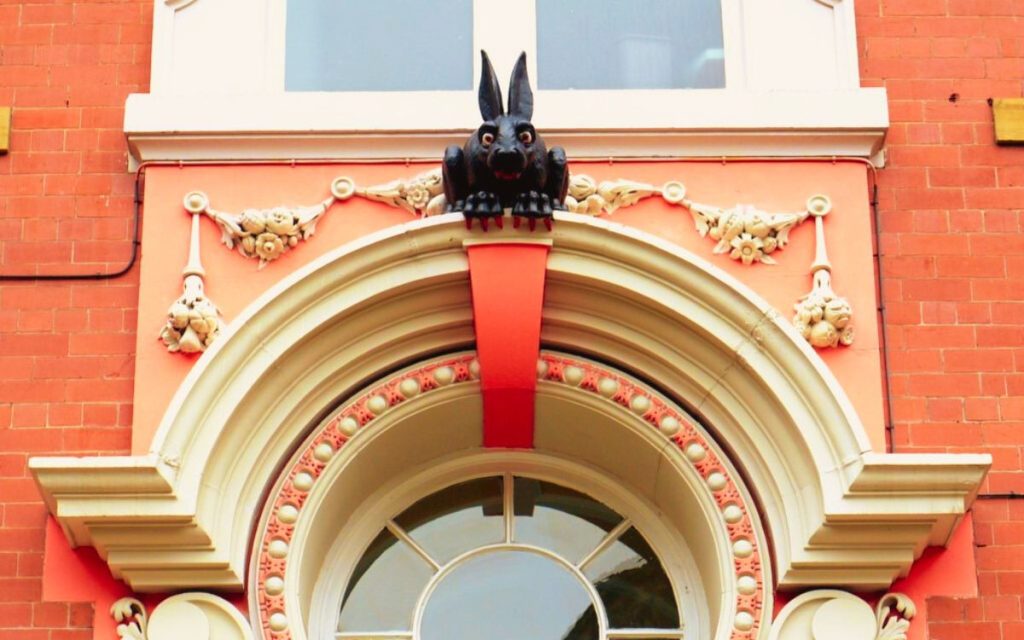
Walk up from the Quayside, past Newcastle Keep, and around a side street to the rear of St Nicholas Cathedral, and come face to face with a terrifying creature of unknown origin – the Vampire Rabbit!
When I say terrifying, I mean terrifying in an animated Tasmanian Devil kind of way!
However, the unknown origin is more or less on the mark. There are many notions as to the origin, purpose and meaning of the Vampire Rabbit, but nothing definitive.
The grotesque perches menacingly above a doorway on Cathedral Buildings. The building dates back to 1901 and was designed by architects Oliver, Leeson and Wood.
There is no attribution of the rabbit to the architects, although one must assume this would be likely.
Additionally, the rabbit was not originally painted, but matched the surrounding stone – the painting clearly done at a later date. The black fur and red mouth add to its menacing caricature.
It also seems the ears were originally shorter than its current pinnae, having possibly been elongated in the 1980s.
Some have suggested the grotesque was intended to ward off local grave robbers, or maybe to stand watch over the hallowed ground of the adjacent cathedral.
It is not thought grave robbing was rife at this location at the time.
As for the relationship to the cathedral, that may hold more water. One of the architects, William H. Wood, was renowned for his religious or church-related work, and the rabbit or hare certainly has a place in Christian symbology.
They are referred to as creatures unable to defend themselves, seeking safety from predators in rocks or crevices – symbolising Christians seeking safety and protection in Christ.
There is also an interesting article on the Co-Curate Newcastle website which suggests William H. Wood had a connection to Freemasonry.
It posits the rabbit was a tip of the hat by the architect to a physician at Newcastle Royal Infirmary, Sir George Hare Philipson.
The physician was also the founder of the University of Durham Masonic Lodge in 1903.
The hare is often used in symbology relating to fertility or rebirth.
In Masonic imagery, Osiris is a significant figure, again relating to rebirth, fertility and renewal.
In a further interesting connection with Egyptian deities, Amen (or Amun) was originally the god of wind but later merged with Ra to become the composite deity Amen-Ra (or Amun-Ra), god of fertility and creation.
Amen was also father to the moon god Khonsu. The moon is another symbol of fertility and rebirth.
And what sits directly adjacent to the Vampire Rabbit and St Nicholas Cathedral in Newcastle city centre?
Nowhere other than Amen Corner.
Coincidences? Tenuous links? Maybe. Sure, even. But a wonderful story nonetheless!
So, as mentioned earlier, the origin, purpose and meaning of the Vampire Rabbit is uncertain.
Even its appearance has changed over the years.
Do bear this in mind with one last thought…
The Trickster figure in mythology and folklore is an archetype who disrupts the norm, creates chaos and uncertainty, promotes confusion, has secret knowledge, shape-shifts, and has variable form and character.
And what is a common form the Trickster takes?
That of a rabbit or hare.
Still doing his job then…