
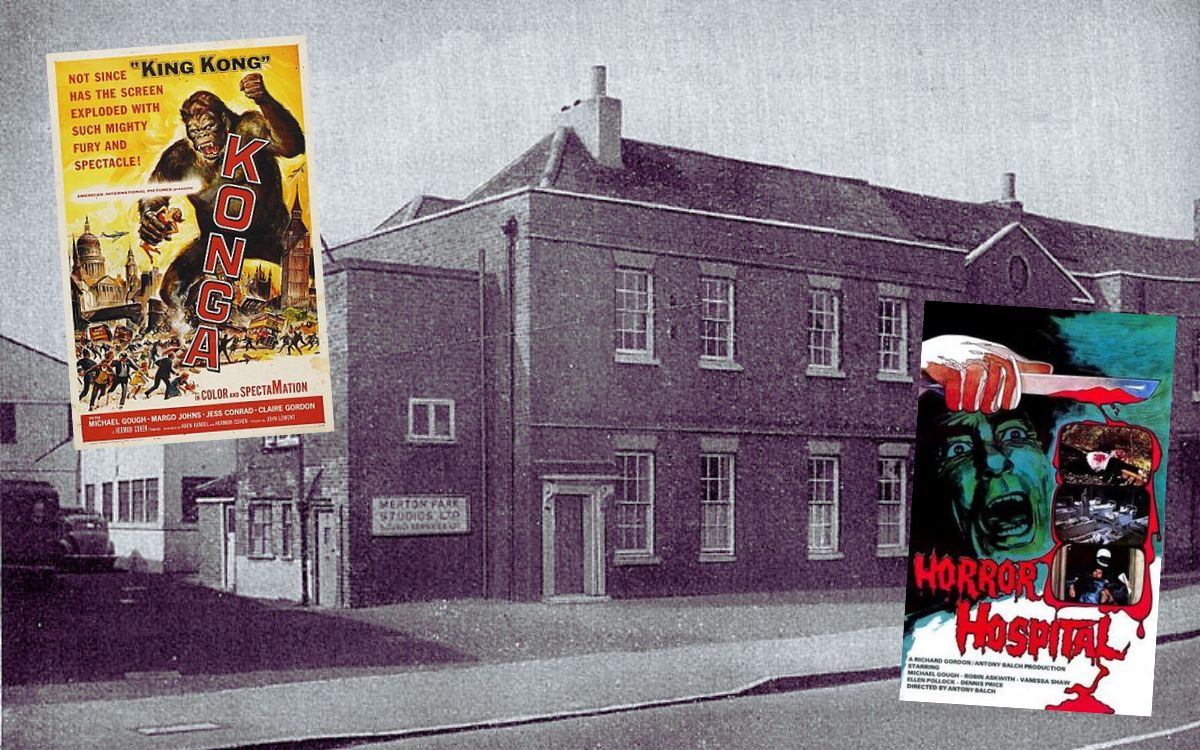
Merton Park Film Studios, located on Kingston Road in South London’s Wimbledon area, had a prolific output from the 1930s to the 1960s.
It gained a reputation as a fast-turnaround, rolling production line for B-movies and crime thrillers. This included no fewer than 47 adaptations of the crime novels of Edgar Wallace, collectively known as the Edgar Wallace Mysteries.
In its last decade or so, Merton Park became the unsung hero of the British horror scene, specialising in plots involving mad scientists and other similarly deranged individuals.
Michael Gough and the Binocular Murder
Michael Gough, a mainstay of both Hammer and Amicus productions, made some of his best-known horror films at Merton Park. He also appeared in two Edgar Wallace mystery films: Candidate for Murder (1962) and Game for Three Losers (1965).
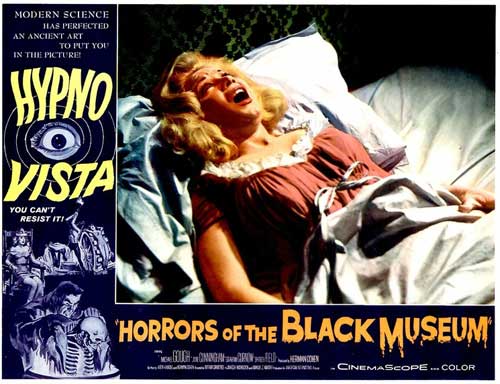
His first foray into Wimbledon horror came in Horrors of the Black Museum (1959), where he played Edmond Bancroft, a true-crime writer who uses a secret museum of torture devices to carry out a series of gruesome murders.
The film became infamous for the ‘Binocular Murder’ scene, in which one of Gough’s victims, Gail Dunlap (played by Dorinda Stephens), is grotesquely impaled through the eyes by booby-trapped binoculars containing four-inch spring-loaded spikes.
Other victims meet similarly macabre ends, via a guillotine suspended over a bed and a bath of acid.
Directed by Arthur Crabtree, who had started his career with comedies for the likes of the Crazy Gang, Will Hay and Arthur Askey, the film was preceded in cinemas by a 13-minute gimmick documentary called Hypno-Vista. In it, American psychologist Emile Franchel falsely claims he will hypnotise the audience so they experience the film’s shocking scenes as if they were real.
Konga Takes a Stomp Through Merton Park
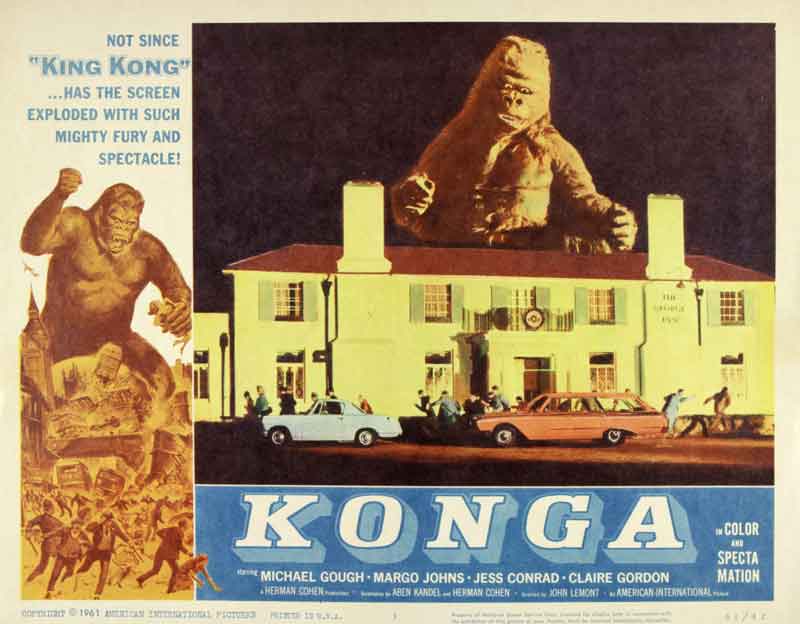
Gough returned in Konga 1961 REVIEW, playing botanist Charles Decker, who creates a serum from carnivorous plants and injects it into a baby ape. The ape grows to 100 feet tall and wreaks havoc in London.
Dubbed the “British King Kong”, Konga even uses Big Ben as a stand-in for the Empire State Building. Street scenes of the panicked population fleeing were filmed around the Merton Park area.
The film’s producer, Herman Cohen—also responsible for Horrors of the Black Museum—was known in the US for B-movies like I Was a Teenage Werewolf (1957) and I Was a Teenage Frankenstein (also 1957). He later brought Gough to America for Black Zoo (1963) and Beserk! (1967).
Roddy McDowall and the Golem’s Revenge
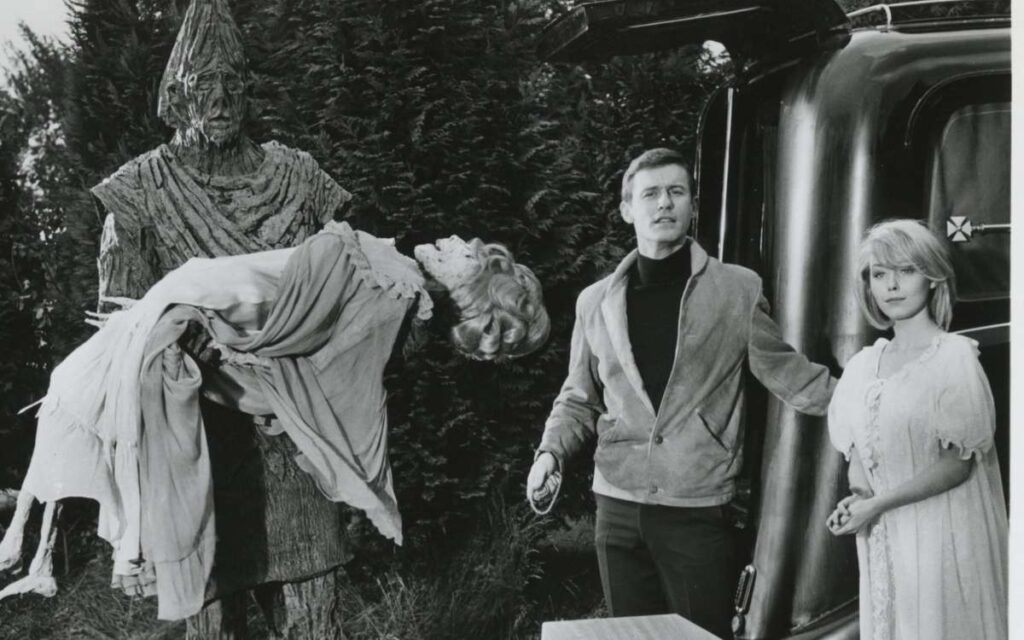
Another actor with strong horror credentials was Roddy McDowall. Born in Herne Hill, he returned to South London in 1967 to star in It, filmed at Merton Park.
McDowall plays Arthur Pimm, a mild-mannered museum curator with a sinister secret: the mummified corpse of his mother, kept at home. He animates a seven-foot-tall Golem of Jewish myth and sends it on a murder spree, which includes the destruction of Hammersmith Bridge.
The Imperial War Museum on Lambeth Road stood in for Pimm’s workplace. Canadian actor Paul Maxwell—better known as the voice of Steve Zodiac in Fireball XL5—plays Pimm’s rival for the affection of Ellen Grove, played by Jill Haworth.
Frozen Nazis and Electrifying Experiments
American director Herbert J Leder made another Merton Park film the same year. The Frozen Dead stars Dana Andrews, who had appeared in Night of the Demon (1957), shot at Elstree Studios.
Here, Andrews plays a Nazi scientist living in an English country estate, plotting to revive over a thousand frozen Nazi stormtroopers to begin a new Reich. Merton Park train station—now part of the Wimbledon to Beckenham tram line—features as one of the locations.
Bryant Halliday, another American actor who often played Gough-type roles, stars in The Devil’s Doll (1964). Also known as Vengeance, the film features a hypnotist-ventriloquist whose evil dummy becomes possessed by a human soul.
Halliday led a strange double life: in the US, he co-founded Janus Films, which introduced American audiences to directors like Ingmar Bergman and Akira Kurosawa. At the same time, he spent frequent “vacations” in London starring in British B-movie horrors.
High Voltage Horror and Industry Legends
Halliday’s other major Merton Park film was The Projected Man (1966), in which he plays Dr Steiner. Steiner’s teleportation experiments using lasers go horribly wrong, turning him into a mutated creature that kills with high-voltage electric shocks.
Described in promotional material as wielding “a million volts of death”, Steiner’s touch causes pyrotechnic flashes to burst from his victims’ clothing.
Both of Halliday’s Merton Park horrors were produced by his friend Richard Gordon, born in Hampstead. Gordon also produced Curse of Simba (1965) and Tower of Evil (1971), filmed at Shepperton Studios.
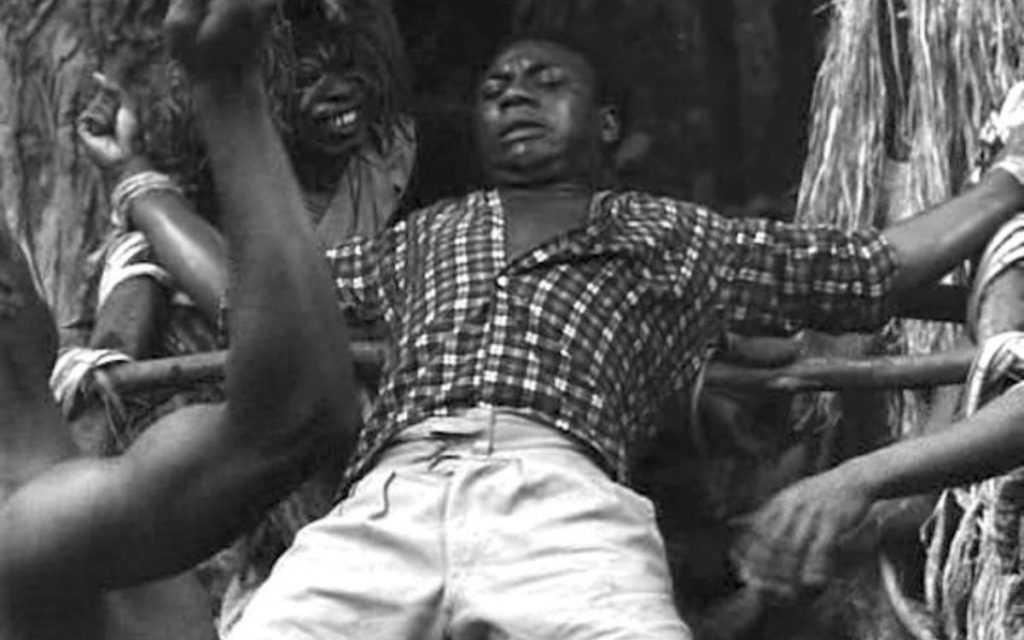
Gordon had long-standing horror connections. He and his brother brought Bela Lugosi to England in 1951 for a doomed Dracula stage tour. Gordon later negotiated Lugosi’s appearance in Old Mother Riley Meets the Vampire (1952), filmed at Walton Studios.
He was also behind the first joint appearance of horror icons Boris Karloff and Christopher Lee in Corridors of Blood (1958). That same year, Gordon produced Fiend Without a Face, directed by Arthur Crabtree—who would go on to helm Horrors of the Black Museum.
Gordon played a major role in distributing Merton Park’s horror output in the US. He often retitled films and paired them with American productions for drive-in double features.
The End of the Line at Merton Park
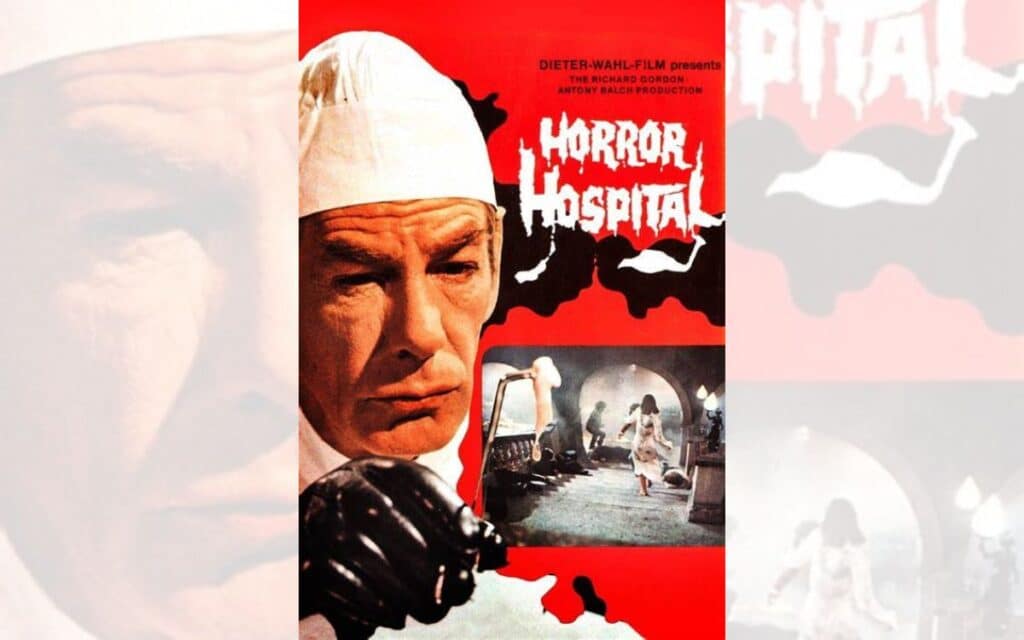
The last film Gordon was involved with at Merton Park was also one of the studio’s final productions: Horror Hospital (1971), directed by Antony Balch.
Balch had met Bela Lugosi in Brighton during the 1951 tour and was clearly influenced by his legacy. In Horror Hospital, Michael Gough plays Dr Storm, a mad doctor using a phoney health farm to lobotomise hippies and create an army of zombie slaves.
He is assisted by Fredrick (played by Sydenham-born Skip Martin), a chainsaw-wielding dwarf, and Aunt Olga (Ellen Pollock), a former brothel madam turned accomplice. A zombie biker gang provides hospital security.
Though Merton Park had largely ceased regular production by this point, the film used both the studio and local locations, including Merton Park train station, Waterloo mainline and Battersea Town Hall.
Quentin Tarantino has cited Horror Hospital as his favourite British horror film.
A Plaque Marks the Past
Today, the former site of Merton Park Studios has been developed into housing. However, Long Lodge, the studio’s front office, remains as a Grade II listed building, now functioning as an office block.
A ‘Cinema 100’ plaque, installed in 1996 to commemorate the centenary of British cinema, marks the spot. This quiet piece of horror history can be found at 267–269 Kingston Road, London SW19.