

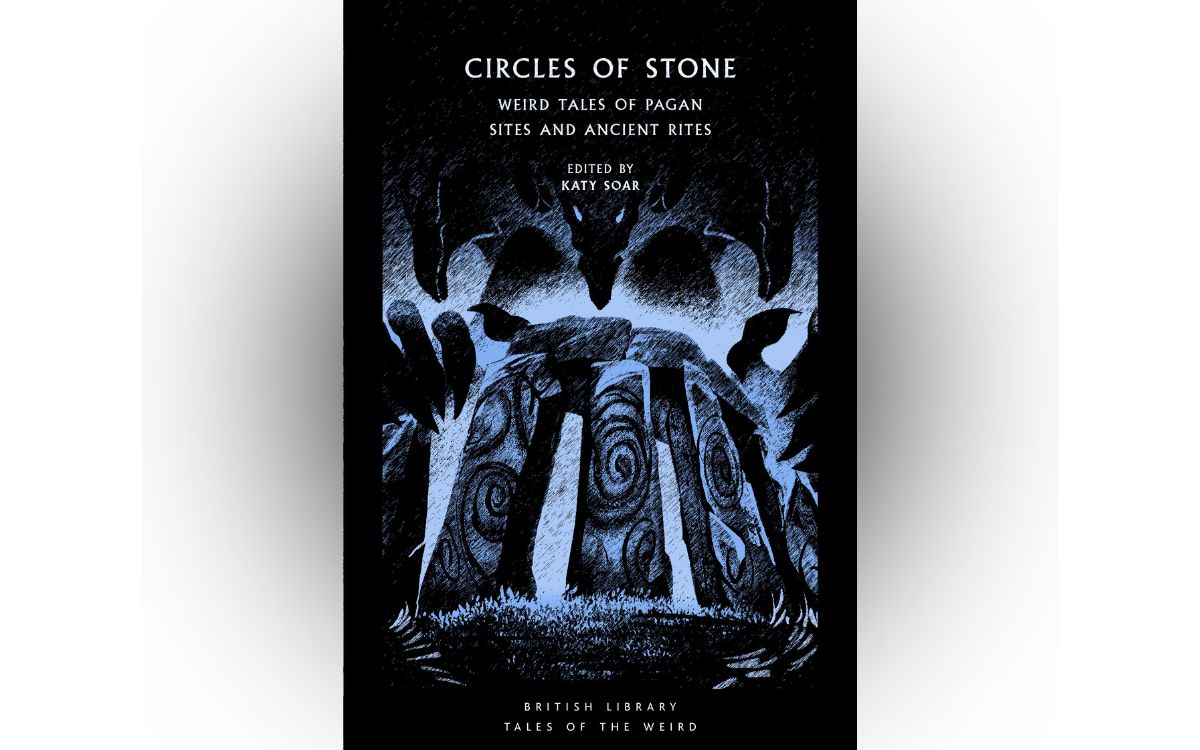
Circle of Stones: Weird Tales of Pagan Sites and Ancient Rites, edited by Katy Soar, is a new collection of stories in the British Library’s Tales of the Weird series.
A most excellent series. Fourteen short stories (ranging from 1894–2018) and an extract from Sarban’s novel Ringstones (1951). There are some old favourites such as Algernon Blackwood, Arthur Machen, E.F. Benson, and a contribution from Nigel Kneale before he became well known as a scriptwriter.
A surprise comes with a tale by A.L. Rowse, most known as an esteemed historian of the Elizabethan era. Two writers, Elsa Wallace and Lisa Tuttle, are still living.
What is noticeable about all the tales is that the featured stone circles, or the odd individual menhir, are indifferent to human hopes and woes, or even blatantly hostile. There is little evidence of a 1970s/1980s ‘good vibes’ kinship evoked by the Free Festival circuit.
The stones operate under different laws, particularly as they have existed far beyond the known written record. They also have their own cycles of existence, albeit very different from that of man or beast.
Several stories describe sacrifices, such as E.F. Benson’s The Temple or The First Sheaf by H.R. Wakefield. The latter offering, from 1940, is a vital read for any 21st-century ‘folk horror’ devotee — Herbert Russell Wakefield was compared to M.R. James by Sir John Betjeman.
What’s more, stones change into living entities at times, particularly in Lisa Tuttle’s Where the Stones Grow, where three standing stones were once human.
Rituals are secret, to be attended only by those who are initiated or invited, invariably after nightfall. Rosalie Muspratt, writing as Jasper Johns, in Spirit of Stonehenge from 1930, featured in this collection, is a world away from the New Age travellers converging openly at Stonehenge in front of TV cameras at the winter and summer equinoxes.
The aforementioned The First Sheaf (1940) is quite a distance from the corn dollies once sold in Dorset craft shops to tourists, known locally as ‘grockles’.
A.L. Rowse takes the M.R. James-type setting of Cambridge dons gathering at Christmas to present his story The Stone That Liked Company. A masterpiece, which manages to draw in 18th-century antiquarianism, Cornish folklore and Sibelius’ Fourth Symphony.
Not surprisingly, Cornwall — with at least 15 stone circles in the county — is a setting for several stories.
A great bonus of this series is that each author has a short biography before their tale starts, with references to their main work for further exploration. The introduction by Katy Soar is very informative and a little too short, making a connection between archaeology, language and the weird tales themselves.
Find out more at The British Library Shop.
MICHAEL BULLY was born in Dorset, 1961. Left school before 16th birthday. Gained qualifications later in life, now semi-retired. Recently moved to Worthing, West Sussex. A compulsive history researcher and blogger. Fields of study include World War 2 Poetry, 17th history, particularly the Gunpowder Plot. Now mainly concerned with 19th century ‘dark’ history and literature. Avid ‘Fortean Times’ reader. Ecclectic music tastes ranging from Post Punk, Prog rock, Folk, Dark Ambient, Jazz and Classical. Website: https://bleakchesneywold.blogspot.com