

Throughout the British Isles you are never far away from history and folklore. The cities, towns and villages of these islands all have buildings and sites that tell stories of our past.
Some are well known and well visited; others are frequently passed by. Many of these places have folklore and supernatural stories attached to them.
Here we will visit some of the lesser-known haunted ruins in the English county of Shropshire.
Moreton Corbet Castle
Turning off the A49, just north of Shrewsbury and near the RAF training station at Shawbury, you eventually come to the ruins of Moreton Corbet Castle.
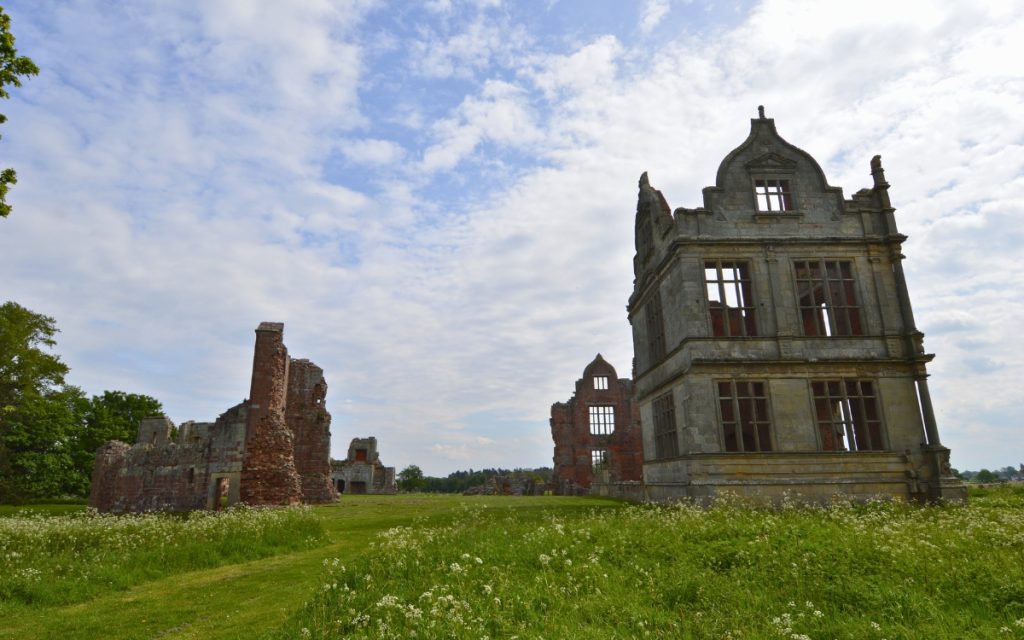
A timber castle was first built on this site in around 1100 and was replaced a hundred years later by one built of stone. This fortification was besieged during the First Barons’ War (1215–17). By the 16th century the site was undergoing major building work, the most notable part of this being the construction of an impressive mansion along the southern range of the castle.
During the English Civil War the castle’s owner, Sir Vincent Corbet, fought for the King, and Moreton Corbet Castle became a base for Royalist operations in the area. In September 1644 the castle was stormed by Parliamentarian forces, who held it for the rest of the war. The ruins still bear the scars of the fighting today, with damage caused by lead shot clearly visible in a number of places.
Although the Corbets returned after the war, the castle fell out of favour with them and was eventually abandoned in favour of other residences.
The story of the curse of Moreton Corbet Castle pre-dates the Civil War and has its roots during the reign of King James I. At this time persecution against the Puritans was gathering pace. The then owner of Moreton Corbet, Sir Vincent (the grandfather of the Sir Vincent who was to fight in the Civil War), wasn’t himself a Puritan, but he had pity on a neighbour by the name of Paul Holmyard who was.
Sir Vincent did not like seeing his neighbour being ill-treated, so offered him sanctuary at Moreton Corbet Castle. As Paul became more fervent in his views, he also became more radical and outspoken. Eventually Sir Vincent felt that he could no longer give sanctuary to Paul and he was told to leave the castle.
For a while Paul lived in the surrounding woodland, surviving on whatever he could find. Eventually, though, he found his way back to Moreton Corbet Castle, where he confronted Sir Vincent. It is said that during this confrontation he cursed the family, saying that they would never inhabit the castle again.
According to lore, Sir Vincent and his family became scared to live at the castle and spent less and less time there. Whatever the truth of this, it is certainly the case that within a few generations of this tale the Corbet family had all but abandoned Moreton Corbet Castle.
That may not be the end of the story, as it is said that the spirit of Paul Holmyard still stalks the evocative ruins of Moreton Corbet Castle today, ensuring that his curse that no descendants of the Corbet family inhabit the site is not broken.
Maybe he is the bedraggled spectre that has been seen among the ruins. There have also been reports of visitors experiencing unexplained cold spots in the area of the mansion, as well as faults with electrical equipment while visiting the site.
Both of these happened to me while I was visiting the site with my daughter as part of the research for this article. While standing in the ruins of the mansion we experienced a cold spot which we couldn’t quite explain.
After talking about this for a few minutes I reached for my camera so I could take a few shots, something I’d already done when we arrived on site. To my surprise I noticed that a number of settings had changed, ones which I certainly hadn’t altered and which could not have been accidentally changed as it would have required navigating a number of menus.
Had the spirit of Paul Holmyard made his presence known? Maybe, maybe not. However, it was time to move on to our next site.
If you ever find yourself driving in the lanes around Moreton Corbet during the day, you could encounter a rather strange apparition. Quite a few local people have encountered a multi-coloured witch who is said to attach herself to cars, staying with them for about a mile before disappearing.
Acton Burnell
Following the A49 south past Shrewsbury, you come to a turning for the village of Longnor. Taking this junction and driving through some of the lanes will bring you to Acton Burnell and the remains of Acton Burnell Castle.
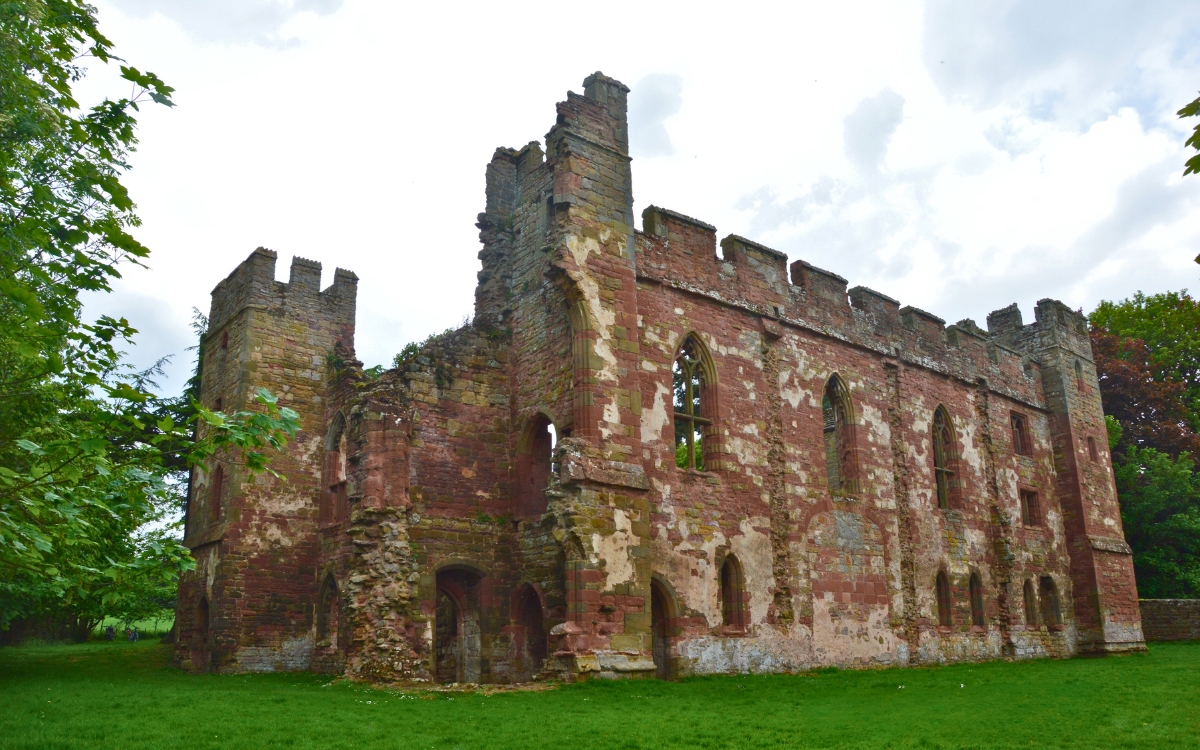
A licence to fortify the residence at Acton Burnell was first obtained in 1284 by Robert Burnell. Burnell had been in royal service for some years and had risen to the position of Chancellor of England. In 1283 King Edward I held Parliament at Acton Burnell. The remains of the tithe barn in which it is said to have been held can still be seen in the field next to the castle.
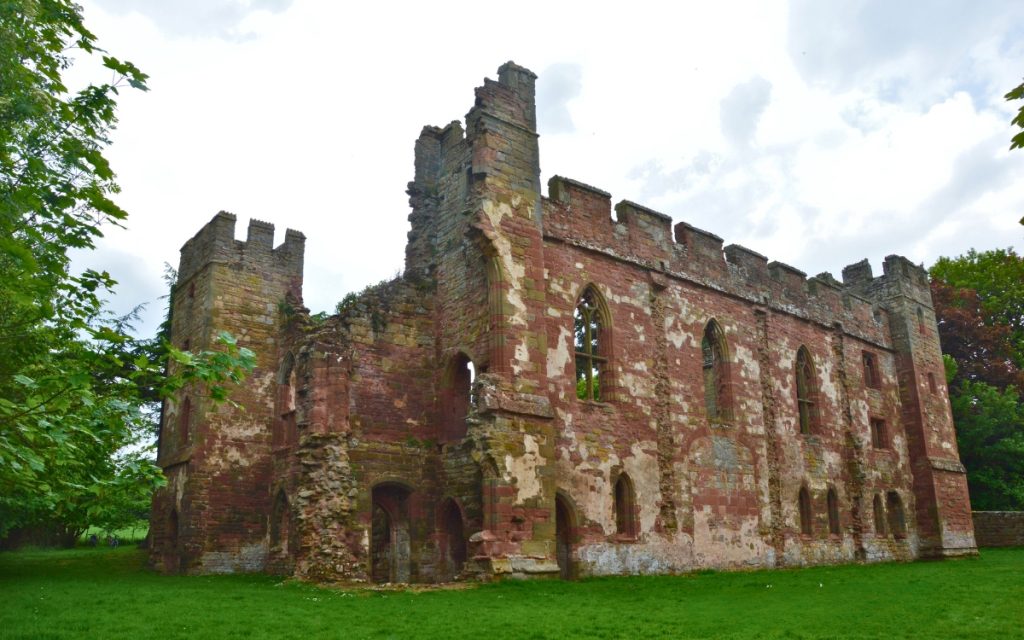
It’s likely that work at the castle was still ongoing when Robert Burnell died in 1292. By 1420 the castle had been abandoned and eventually a new house was built next to it.
Today the only resident of the castle is said to be a ‘woman in white’, a type of ghost found throughout the country. She has been seen standing in one of the doorways of the castle. Little is known about who this lady is, but some stories say that it is the spirit of a young woman who was killed when thrown from her horse, while others claim she fell from a window.
Travelling back to Longnor along the road to the A49, you will drive over a small bridge just before reaching the junction. This too is said to be the haunt of a White Lady.
The story goes that a young woman fell deeply in love with a local farmer. When he proposed she happily accepted and preparations for the marriage were made. On the day of the wedding the bride arrived at the church, but there was no sign of the groom. Then a note arrived from him breaking off the engagement.
The heartbroken woman ran from the church to the bridge, which she threw herself off. Her body was found the next day, several miles downstream.
That bridge has since been replaced by a modern road bridge, but the ghost is still seen on or around it. Some witnesses say she stands staring at the water below before fading away. Others claim that she drifts through the parapet of the bridge into the stream below.
Hopton Castle
Leaving the sad stories of Acton Burnell and Longnor behind and heading south, you can find the small village of Hopton Castle. Although peaceful and beautiful now, the ruins of the castle which gives the village its name were the scene of a brutal and bloody episode in history.
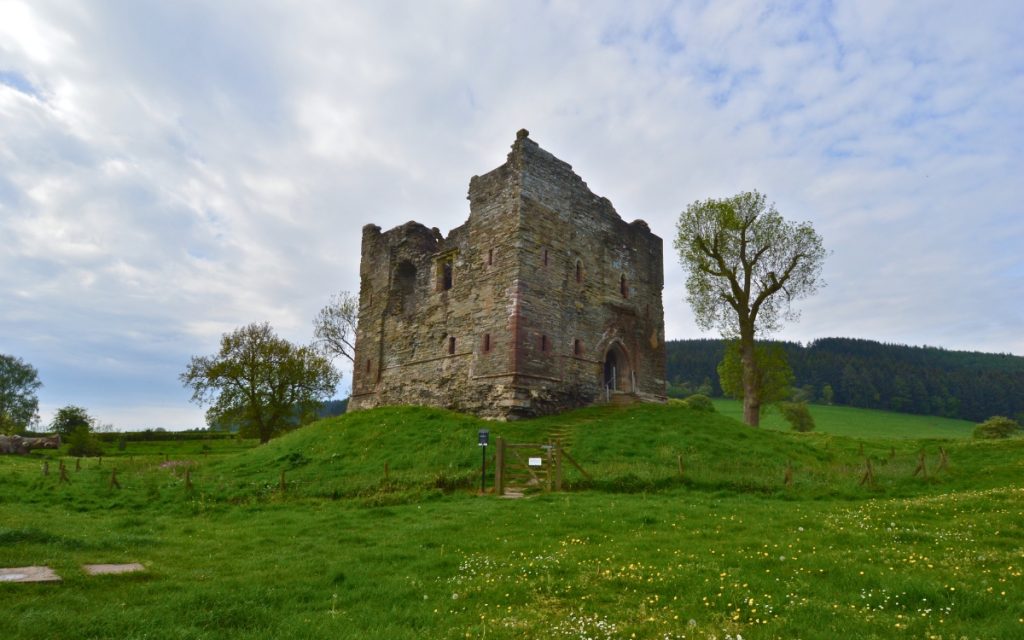
During the Civil War Hopton was one of only a few Parliamentarian-held garrisons in an otherwise mostly Royalist Shropshire. In early 1644 Royalist forces under the command of Sir Michael Woodhouse attacked.
After failing to breach the walls of the castle the Royalists withdrew, but not before a demand for surrender had been delivered to the defenders of the castle. The commander, Samuel More, refused.
Woodhouse returned, this time with a larger force. Once again More refused to surrender and the Royalists launched another assault. Heavy fighting ensued, with the Royalists losing up to two hundred men. But, as before, they were beaten back.
When Woodhouse returned again, his forces were armed with heavy siege guns. He warned the defenders that, according to the prevailing code of war, if surrender was again refused then they should expect no quarter.
This had no effect on More and fighting resumed. The Royalists gained the upper hand, undermining the castle walls and setting fire to the door of the tower the beleaguered defenders were now sheltering in.
More requested that his surviving troops be allowed to surrender and march away armed. This was refused and the defenders eventually surrendered, placing themselves at the mercy of Sir Michael.
Samuel More was taken away and questioned, but his soldiers weren’t as lucky. There are a number of accounts as to exactly what happened next. One account has the unfortunate men having their hands cut off and then being stoned to death in a ditch. Whatever unfolded, news of it was sent to other Parliamentary outposts to warn them of the consequences of resistance.
Such a traumatic event may well have left its mark on the castle. The ghosts of Civil War soldiers have been seen, and it is said that on moonlit nights a spectral re-enactment of the surrender and ensuing massacre can be witnessed.
Not every ghost seen there is that of a soldier. A figure has been seen by the pond on the site. It is said that she is the heartbroken lover of one of the soldiers killed, returning to the scene of her beloved’s death.
If you find yourself in the ruins of Hopton Castle, make sure to listen for the ghosts too. People have also reported hearing the ‘Hopton sigh’, a disembodied sigh along with the sound of breathing.
Although the fighting at Hopton Castle has long passed, it seems that spirits linger on.
Of course, these are only a small selection of hauntings from this corner of England, but they just go to remind us that even the quietest, most beautiful parts of our islands can hold remnants of darker times.