

Belief in ghosts and spirits, and reports of paranormal phenomena, date back millennia to the most ancient of cultures. In this article, we first take a look at the oldest recorded references to ghosts found across some of the world’s early societies – from Mesopotamia to Ancient Egypt, Greece and the Roman Empire, before focussing on the British Isles.
These shores have a rich haunted history that goes back to antiquity and having been occupied by the Romans from 43 AD to 410 AD it is not surprising that some of our earliest ghostly reports have links to this time.
Ancient ghosts
The most ancient ghosts – 400,000 to 3,000 BCE
Evidence for a belief in some form of spiritual survival after physical death, and a reverence for the memory of the departed, can be seen in prehistoric cave paintings from many parts of the world. Also, corpses being buried in deliberately built graves indicates a level of respect and significance regarding bodily death.
This practice was undertaken by Neanderthals from some time as far back as 400,000 years ago up until their apparent demise around 40,000 BCE. This was also the case for early Homo Sapiens, who coexisted with Neanderthals for a number of millennia, from approximately 50,000 years ago.
By this time grave goods were also found with the skeletal remains, further suggesting honouring of the dead.
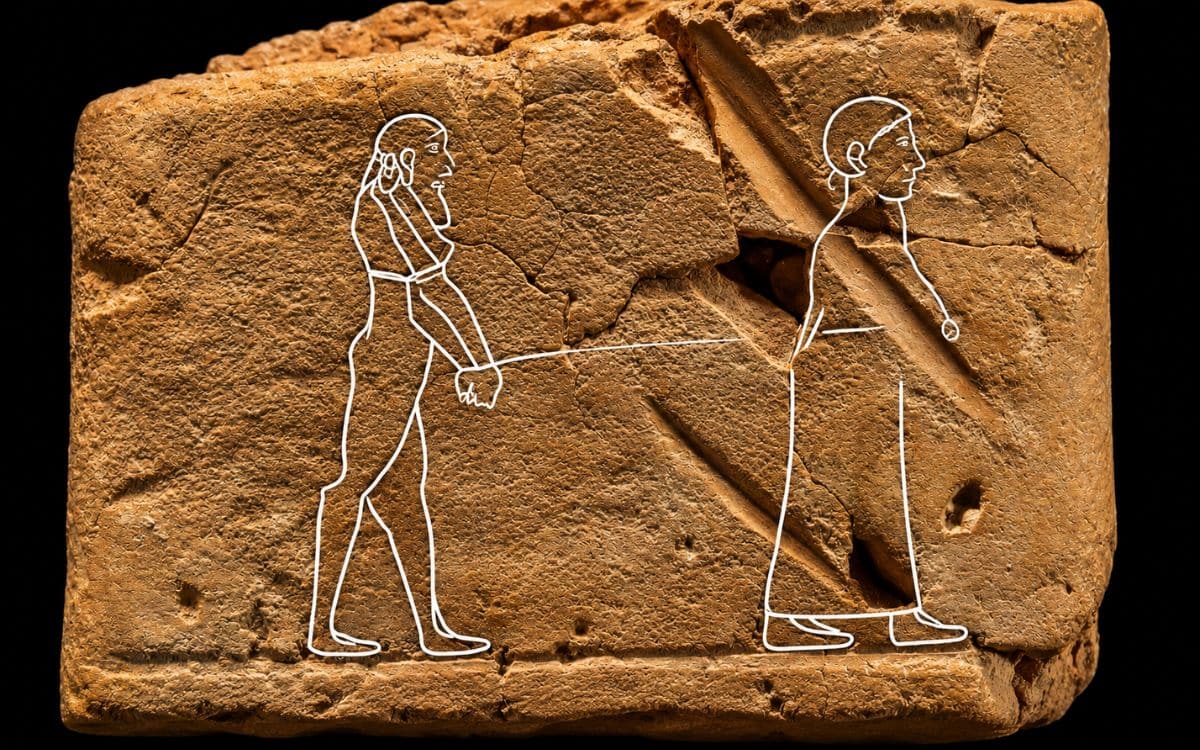
The first irrefutable mention of ghosts in the annals of history is circa 3,000 BCE, around five thousand years ago. It appears on an example of the oldest comprehensible writing in the world, the Mesopotamian cuneiform (wedge-shaped) script written on clay tablets in what is now Iraq.
At precisely what point in time between prehistoric cave paintings and this first documented mention of ghosts such a spiritual concept developed is, of course, impossible to ascertain now. Ancient Mesopotamian ghosts were known as gidim and can be found in the most important literary work of the period, The Epic of Gilgamesh.

Ancient Egypt – 2,700 to 1,100 BCE
The ancient Egyptians were obsessed with the concept of an afterlife which shaped nearly every aspect of their civilization and is often referred to as a ‘Cult of the Dead’. They believed that there existed three immaterial or spiritual parts within the physical human body, the ka, ba and akh, which parallel the astral body, the mind and the immortal soul of the Western esoteric tradition. The last of these, the akh, was said to be able to return as a ghost after bodily death.
The assorted collection of texts known as The Book of the Dead, written by many priests over a long period of time during the first and second millennia BCE contains a number of spells intended to help a dead person with their journey through the underworld, or Duat, and on to an afterlife.
The final judgement of their sins involved a ‘Weighing of the Heart’ ritual using a magical set of scales, which determined whether the deceased proceeded to their afterlife or was unpleasantly eaten by Ammit, the ‘Devourer of the Damned’.
Ancient Greece – 1,200 to 323 BCE
The ancient Greeks also had a fascination with the dead, the afterlife and ghosts, whom they broadly termed phasma. While some of their literature and mythology expressed ambiguous concepts about the nature of ghosts, references to them are both numerous and widespread.
The ancient Greek concept of ghosts was complex, with many sub-categories and names, often depending on the nature or timing of bodily death. A famous work which features ghosts is Homer’s Odyssey, written in 800 BCE, in which the Greek hero Odysseus encounters many ghosts and spirits.
Ancient Rome – 625 BCE to 43 AD
Ancient Roman beliefs concerning life after death were very varied. No single concept was particularly overarching, as the underlying polytheism (worshipping of multiple gods and goddesses) was supplemented by philosophical speculation and by individual sects such as Stoicism, Mithraism, Judaism, and eventually Christianity.
Ancient Roman folklore stories often used similar terms for demons, spirits, ghosts, apparitions, and even entities encountered in dreams. These beings could be either friendly or malicious and there are also many accounts of haunted houses, often noted as being difficult to sell on.
An important work of the period is Ovid’s Fasti (Book V), published in 8 AD. It not only discusses the festival of Lemuria, during which rites were performed to exorcise malevolent and restless ghosts, but also presents the myth of the ghost of Remus, brother of Romulus, the legendary founder and first King of Rome.
British oral tradition
Before the written collections which started to appear in the 12th century, Britain’s ghost lore existed purely in oral traditions and was linked to pre-Christian, Celtic or Roman sites. In pre-Christian and Celtic Britain, the concept of a “ghost” was rather different from the modern idea of spectres occupying haunted houses.
To the ancient Celts, the line between the living world and the Otherworld was fluid. Spirits were not trapped, fragmented echoes of the dead, but instead, they were active, sometimes terrifying components of the landscape, heavily tied to nature, ancestry, and the changing of seasons.
Following the advent of Christianity, these native entities were adapted, demonized, or recast as fairies and folklore cryptids. True pre-Christian and Celtic “ghosts” and death-spirits in Britain can be categorised by four key archetypes.
1. Portents of death
In Celtic belief, spirits did not typically haunt a location because of personal earthly unfinished business, but existed to oversee the boundary between life and death.
An example of this type of spirit is the Banshee (Bean Sí). Whilst predominant within the folklore of Ireland, variations exist across Britain’s Celtic regions. Originally derived from pre-Christian territorial and war goddesses, she transformed into an ancestral spirit with her blood-curdling wail signalling an imminent death.
Another similar entity is the Dullahan, a terrifying, headless shadow spirit who acts as a collector of souls. He rides a black horse through the night, and when he stops and calls a mortal’s name, that person instantly dies.

2. The restless dead
In Gaelic lore, the Sluagh (Sloo-ah) are troubled spirits of the dead. They are said to fly from the west in massive, dark packs resembling flocks of birds, actively hunting for the souls of the dying. To this day, old folklore dictates keeping west-facing windows strictly shut when someone is sick or dying to prevent the Sluagh from snatching their spirit away.
3. Pagan gods transformed
Many ancient deities transformed during Christianisation into local ghosts or legendary monsters, such as Herne the Hunter, manifesting across the woodlands of southern Britain. He is believed to be a localised folkloric version of Cernunnos, the ancient Celtic antlered god of the wild. He leads a phantom, spectral hunt across the night skies, forcing the souls of those he catches to join his eternal, ghostly procession.
More of an elemental nature spirit, the Cailleach is an ancient, blue-faced divine hag of winter in Scottish and Irish myth. She is said to haunt the mountain peaks (like Ben Nevis) and shape the winter landscape with her staff.
4. Fairies as the “pagan dead”
In Cornwall, Scotland, and Wales, the Fae were deeply associated with the dead. Folklore across the Celtic regions suggested that fairies were the lingering souls of people who died before the arrival of Christianity. Because they were not baptised, they could not enter the Christian heaven but belonged instead to the Celtic Otherworld (Annwn in Wales, Tír na nÓg in Ireland).
These spirits commonly manifested as Dobbies (from the Celtic dovach, meaning the black or sorrowful ones) who were said to be lonely, regional land spirits connected with ancient burial mounds, bogs, and stone circles.
Roman ghosts in Britain
The legend of Lucius
Lucius is said to have been a Roman soldier and sentry stationed at Milecastle 42 (Cawfields) of Hadrian’s Wall, which was built in the AD 120s by the Legio II Augusta. According to folklore, he fell in love with a local woman who manipulated him into leaking military intelligence.
Her brother used this information to undertake smuggling activities across the border. When the smuggling ring was uncovered, the brother exposed Lucius. Realising he had been used, Lucius reportedly threw himself down the steep northern escarpment of Cawfields Crags.
Witnesses have claimed that his spectral form appears hovering about 16 feet (5 to 6 metres) above the ground, approximately at the height the full stone wall would have stood during the Roman era. He is said to wander the ruins at dusk or be seen patrolling the perimeter during the day.
Historians and folklorists generally view the story as a modern or Victorian-era regional myth rather than a verified historical event.
The Roman legionary of Din Lligwy
Local folklore about the site of the ancient ironworks on the Isle of Anglesey, Wales, provides stories of it being haunted by the spectral figure of a Roman legionary. The apparition is described as pacing or stalking silently through the moss-covered limestone ruins and old forge areas of the Din Lligwy settlement. Roman occupation of the region was recorded in the 3rd and 4th centuries AD.
York
Even though reports of Roman soldiers seen in York were recorded in the 1930s and the 1950s, the most famous Roman ghost sighting in the city took place in 1953. In the cellar of the Treasurer’s House an 18-year-old plumber’s apprentice named Harry Martindale witnessed a procession of Roman soldiers marching through the walls.
He watched a column of about 20 Roman soldiers, as well as a mounted officer on a cart horse, emerge from a brick wall and pass through the basement. Interestingly, the soldiers appeared to be cut off at the knees, walking as if they were stepping on a lower surface.
Later excavations revealed that an original Roman road (via Decumana) ran roughly 15 inches to 2 feet beneath the modern cellar floor, matching the approximate level at which the soldiers appeared to be walking. Martindale described green tunics, plumed helmets, round shields, and knee-laced sandals.
These details were initially doubted by critics but later confirmed by historical research on 4th century Roman auxiliary troops.

M6 motorway
Drivers have reported seeing files of silent Roman soldiers with glinting spears and expressionless faces either walking along the hard shoulder or across the lanes. Witnesses near the M6 Toll crossing around Lichfield and Staffordshire have described seeing around 20 Roman soldiers whose lower legs were invisible, appearing to wade through the asphalt as if it were water.
The modern M6 frequently runs directly over or parallel to ancient Roman routes, including King Street and Watling Street. Archaeologists have uncovered Roman marching camps, pottery, coins, and metals along these roads.
Icknield Street, Birmingham, Metchley Fort
Witnesses have reported seeing groups of 20 to 30 Roman soldiers, including figures on horseback, marching or crossing country lanes and ancient road sections at night near Icknield Street and Metchley Fort. Observers have described the figures as appearing solid yet illuminated from behind, before vanishing into fields or barriers with no visible entry point.
Similar ghostly Roman soldier marches are also famously reported on the preserved section of Icknield Street in Sutton Park. The fort was established around 48 AD along the strategic Roman military and salt road known as Icknield Street (or Ryknild Street), and served as a key outpost during and after the Roman conquest of the West Midlands.
Badbury Rings, Dorset
In the 1970s, a group of archaeological students reportedly fled their camp near the Iron Age hillfort after being disturbed by the distinct sounds of clashing metal, foreign shouting, and marching Roman soldiers. Visitors and local folklore frequently report seeing ghostly Roman soldiers, a warrior on horseback, and even a phantom Irish wolfhound roaming near the site and the adjacent historic tracks.
Observers often note the visible agger (raised embankment) and side ditches of the ancient Roman road network that converged near Badbury, sometimes referred to as the “Roman spaghetti junction” of Dorset. The region was captured by Roman legions under Vespasian around 43 AD, when Badbury Rings became a major strategic junction connecting routes to Dorchester (Durnovaria), Old Sarum (Salisbury), Bath, and the coast.
Earliest British written accounts
The earliest written and recorded ghost stories in Britain date back to the 12th and early 15th centuries, emerging from medieval chronicles and monastic manuscripts.
Orderic Vitalis’s phantom army (c. 1130 AD)
The Anglo-Norman historian Orderic Vitalis recorded what is considered the oldest surviving written ghost account set in Britain. He described a local priest who allegedly encountered a terrifying nighttime phantom army of dead warriors, monks, and commoners roaming the English countryside.
William of Newburgh’s chronicles (12th century)
The historian William of Newburgh recorded early English accounts of walking corpses and restless spirits, including a famous 12th century tale of a former master of Alnwick Castle in Northumberland rising from his tomb at night to terrorise the town.
William of Malmesbury’s demon woman (11th to 12th century)
Chronicled accounts from this period include the story of a woman practicing dark arts whose grave was raided by fiends on a fierce black horse.
Moyse’s Hall Museum (1328 AD)
Town records in Suffolk note an early civilian report where a witness claimed to see a “horrible devil” haunting the cellar of the building.
The Byland Abbey ghost stories (c. 1400 AD)
Written by an anonymous monk at Byland Abbey in North Yorkshire, this Latin manuscript contains 12 local supernatural tales. It is recognized as the oldest known collection of English ghost stories. These medieval tales feature local villagers encountering spirits of everyday people, such as an excommunicated rector or a thief, who return from purgatory asking the living to perform penance, say prayers, or settle unpaid debts so their souls can find eternal rest.
Conclusion
Even though the earliest documented reports of ghosts and hauntings in the British Isles did not appear until the 12th Century, the pre-Christian and Celtic oral tradition and folklore which fed into these tales began to emerge at a similar time as those in other parts of the world.
The urban and political decline in Western Europe that followed the end of Roman occupation meant that little or nothing was recorded until educated clergymen began writing down these spooky stories in the late Middle Ages, by which time they were already old.
Nonetheless, British folklore and mythology still continues to make reference to these tales to the present day.
Books by Robert Radakovic
Robert Radakovic is the author of two paranormal novels. Find out more about Shuffle Off This Mortal Coil, a ghost’s story of grief and redemption, and The Fanciful Nonsense of Dr Oliver Yewtree, a paranormal crime novel, in our Spooky Books directory.