
Frankenstein Conquers the World (1965) brings Mary Shelley’s monster into Toho’s kaiju universe in one of the studio’s strangest hybrids, writes TERRY SHERWOOD
Review of Frankenstein Conquers the World (1965)
Just a short step, depending on your stride on a miniature set, from Universal’s monster gatherings of the mid-1940s was the idea of fusing Frankenstein’s Monster with a giant monster.
The result was one of Toho’s strangest productions: Frankenstein Conquers the World, released in Japan in 1965 as Frankenstein vs Baragon, adding yet another subterranean monster to its increasingly crowded universe of fantastic creatures.
From King Kong to Frankenstein vs Godzilla
In 1962, Toho purchased an American script titled King Kong vs Prometheus from independent producer John Beck. The concept originated with stop-motion pioneer Willis H. O’Brien, creator of the original King Kong effects. O’Brien had imagined King Kong fighting a gigantic creature created by Dr Frankenstein.
Beck took the idea to Toho without O’Brien’s approval. Screenwriter George Worthing Yates developed the story further, but Toho had another idea. Rather than Kong fighting Frankenstein’s creation, the Japanese studio wanted Kong to fight its own superstar: Godzilla.
After negotiations involving Beck and RKO, the copyright holder of King Kong, the Frankenstein concept was transformed into King Kong vs Godzilla. The film became a major success, although O’Brien was deeply unhappy with what had happened. He attempted legal action against Beck but lacked the money to pursue it. King Kong’s original director, Merian C. Cooper, also attempted to sue Beck and died before the matter was resolved.
Yet Frankenstein had not disappeared. Toho still wanted its own monster to fight Frankenstein.
Frankenstein meets Godzilla, then Baragon
In 1964, American producer Henry Saperstein approached Toho about producing Frankenstein vs Godzilla with United Productions of America. The proposed story, written by Takeshi Kimura with Jerry Sohl and producer Reuben Bercovitch contributing to the story and synopsis, was considerably darker.
Frankenstein’s heart had survived the Second World War and had been irradiated during the atomic bombing of Hiroshima. A feral boy possessing the heart would eventually grow into a gigantic Frankenstein creature.

The monster would become increasingly animalistic, eating people and livestock. Godzilla would awaken from the ocean depths to confront him. The climax would have been apocalyptic: natural disasters would destroy the combatants, with Godzilla swept away by a raging river and Frankenstein swallowed by volcanic magma.
Toho rejected the story.
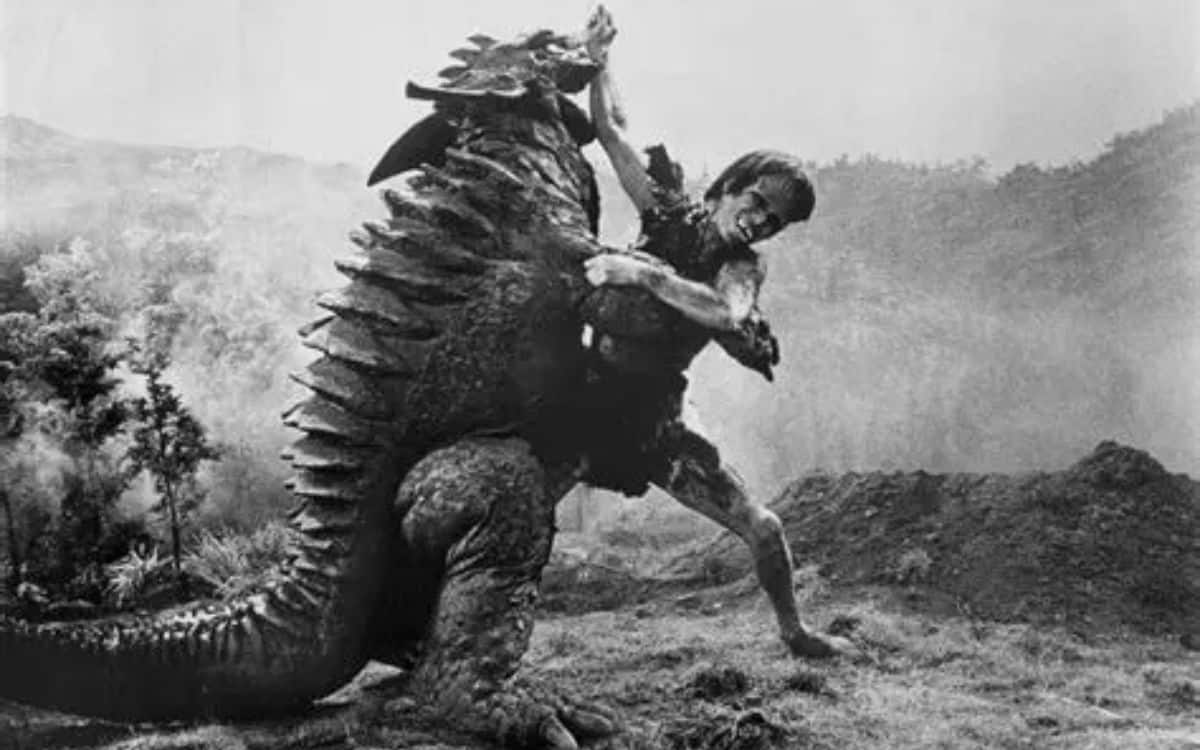
The basic concept returned in 1965, but Godzilla was replaced by Baragon, the subterranean reptilian monster. Much of the earlier story survived: the mysterious heart, Frankenstein’s hunger, the destruction of livestock and villages, the scientists attempting to save rather than simply destroy him, and a natural disaster providing the final solution.
Koji Furuhata played Frankenstein. He wore green contact lenses, a flattened forehead and heavy brow designed to evoke Jack Pierce’s classic Karloff makeup. His oversized clothing and loincloth gave him the appearance of a primitive, displaced version of the original Monster.
The strange film that emerged
Director Ishiro Honda originally wanted to concentrate more heavily on the film’s science-gone-wrong themes, but producers pushed the picture towards a more spectacular monster climax. Nick Adams was brought in as the American star, much as Raymond Burr had been used in the American version of Godzilla. Adams delivered his dialogue in English.
The opening places Frankenstein’s heart in wartime Europe before bringing the Monster’s legacy to Japan. Dr Bowen encounters a strange boy whose extraordinary growth is connected to his consumption of protein.
The boy is captured, chained and studied, while Sueko, a sympathetic assistant, begins caring for him. The scientists eventually realise that the boy may have grown from Frankenstein’s surviving heart.
The ethical question becomes whether the creature should be destroyed or saved. Kawaji considers cutting off a limb because Frankenstein supposedly cannot be killed, while Bowen and Sueko object.
After a television crew provokes the creature with bright lights, Frankenstein escapes. He begins roaming the countryside in search of food, destroying farms, roads and villages. The authorities believe he is responsible for the destruction, while Bowen and his colleagues discover that another creature, Baragon, is responsible for much of it.
The monsters finally meet, leading to a fiery confrontation and the film’s bizarre conclusion.
Saperstein also requested an alternate international ending in which Frankenstein fought a giant octopus. The scene was filmed but discarded, although stills appeared in Famous Monsters of Filmland, even making the cover of issue #39 and confusing readers for years.
Released in Japan on 8 August 1965, Frankenstein Conquers the World arrived only days after the 20th anniversary of Hiroshima. American International Pictures released it theatrically in North America in 1966.
The result is an odd fusion of Universal horror, Japanese science fiction and the emerging kaiju tradition. Beneath the monster spectacle is a surprisingly persistent question: who is responsible for a monster that science itself has created?