

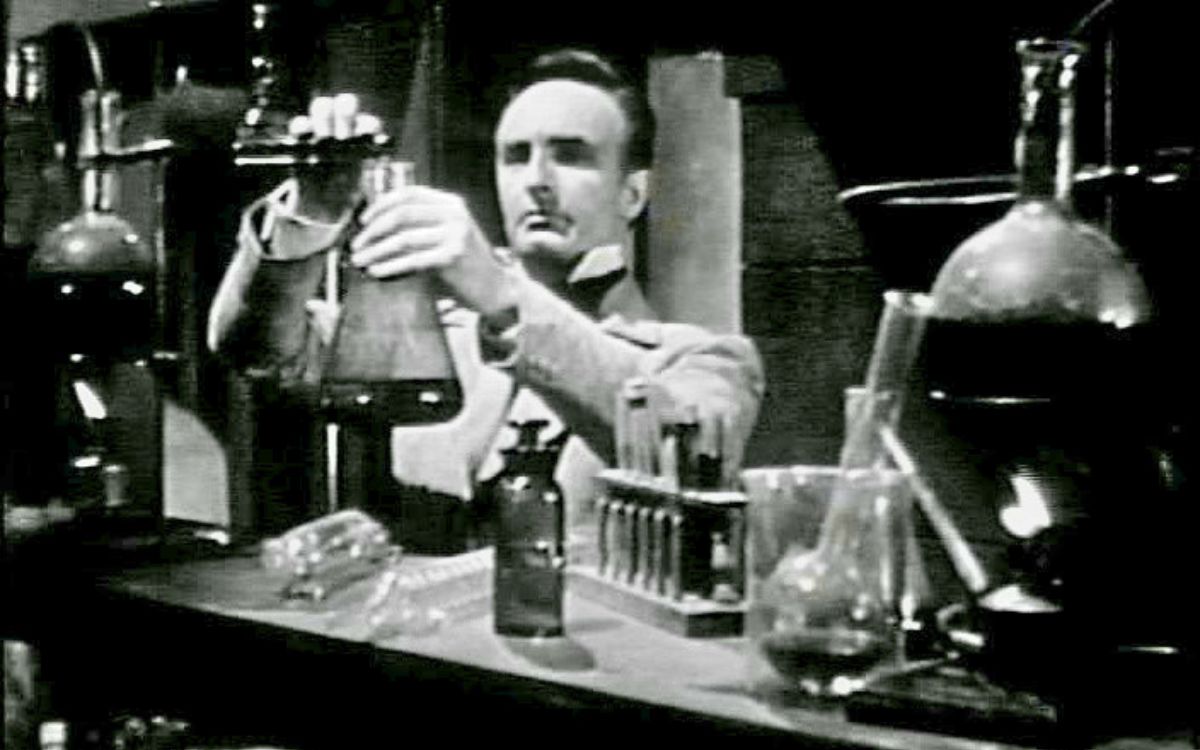
Hammer’s first foray into television with this unsold pilot for a series about the exploits of Baron Frankenstein and his experiments, produced with financier Columbia Pictures.
Twenty-six episodes were planned, with each studio (Hammer and Columbia) producing thirteen segments each, while Hammer was set to produce each episode in Bray Studios. The series was intended for the US audience.
The pilot episode, The Face in the Tombstone Mirror, was co-written and directed by horror legend Curt Siodmak. Starring Anton Diffring, who played Baron Frankenstein, whose creation (Don Megowan) is brought to life with a brain of a murderer, who tries to kill him, but is accidentally electrocuted.
Like The Curse of Frankenstein 1957, the Baron needs a new brain from someone with civilised behaviour.
A couple, Christine and Paul Halpert (Helen Westcott and Richard Bull), arrive in a nearby village, desperate to meet the Baron because Paul has an incurable illness. When the Baron rejects their plea, the couple lodge in a local inn and seek help from another doctor (Richard Greenleaf). That night, Paul dies.
After Paul’s funeral, the Baron bribes the cemetery groundskeeper (Peter Brocco) to leave the grave unsealed so that he can steal his corpse.
Christine later learns that her husband’s grave has been stolen and coerces the groundskeeper for information that leads her back to the Baron’s secluded castle.
She arrives there and learns that the Baron has already transformed her husband’s brain into the creature. Like Frankenstein Must Be Destroyed (1969), Paul is disgusted by his new appearance and tries to kill the Baron before meeting his fatal end once again.
The Baron is arrested for body snatching and sorcery, leaving this episode open for another chapter.
Although no more episodes were produced, there is another segment, Jack the Ripper, which was thought to be lost. This time depicting the serial killer as a scientist engaged in experiments to unlock the mysteries of immortality. This segment was recently discovered and can be accessed on YouTube.
Tony Hinds did commission many scripts, including an episode in which Frankenstein created a beautiful woman with no soul, like Frankenstein Created Woman, and another scripted by Peter Bryan (The Plague of the Zombies) when Frankenstein uses the services of a mystic to hypnotise his creation, similar to The Evil of Frankenstein. Another screenplay planned was titled Frankenstein Meets Dr Varno.
Michael Carreras also hired Jimmy Sangster to pen an unused pilot called The Single-Minded Blackmailer, while more scripts were provided to feature Frankenstein in the Hammer style.
Curt Siodmak did dispute the series’ direction, when both studios wanted this to be entirely based on Frankenstein: “You cannot carry a whole show with nothing but Frankenstein stories.”
Anton Diffring is good as the Baron and would have been a good Frankenstein had Peter Cushing turned down the role. Surprisingly, Peter Cushing wasn’t considered for the role, especially a year after his breakout role.
The creature played by Don Megowan also played another iconic creature, known as the Gill-man in The Creature Walks Among Us. His portrayal, including the make-up, is similar to Boris Karloff’s Frankenstein creature.
As Hammer couldn’t use Universal’s visual look of the creature to avoid a lawsuit for The Curse of Frankenstein, Columbia got away with it because they owned the TV rights to the Universal Monsters franchise.
Overall, this episode is a condensed 27-minute Hammer film.
Hammer’s next television attempt was more successful with Journey Into the Unknown, ten years later, which was an anthology series, followed by the hugely successful Hammer House of Horror in 1980, and finally Hammer House of Mystery of Suspense. All anthology shows with a contemporary setting.
As Hammer Films has new ownership under the name of John Gore, it would also mark a perfect opportunity to produce an anthology show.