
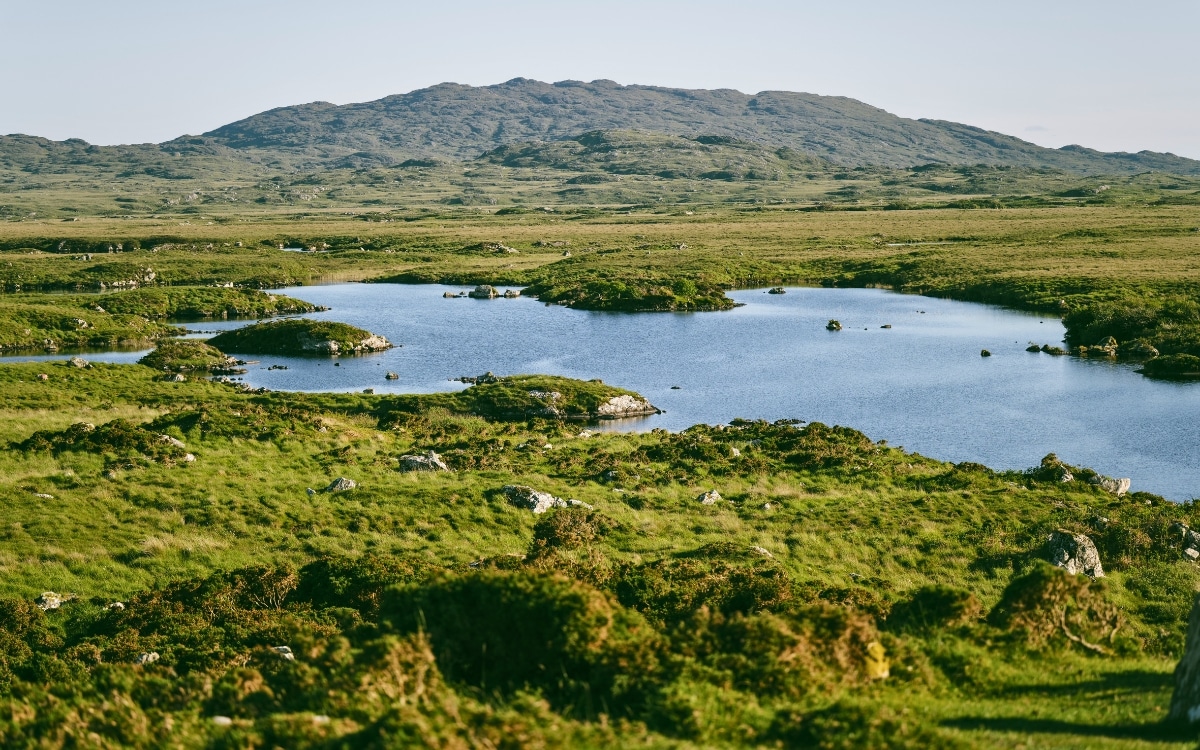
Ireland’s boglands are ancient, eerie places. While landscapes of silence and stillness, beneath the soft ground lie stories as rich as the peat itself. Ritual killings, lost villages, famine dead and bodies preserved for millennia.
Folklore tells us that bogs aren’t just burial places, but spiritual snares where time stops and the dead never quite seem to leave.
These five haunted peatlands still echo with the past and more…
Old Croghan Man, Croghan Hill, County Offaly
For more than 2,000 years, the bog held its secret. Old Croghan Man was discovered in County Offaly in 2003, his remarkably preserved remains revealing evidence of an exceptionally violent death.
His arms had been pierced and bound, signs of extreme ritual violence and torture. Believed to be only in his 20s, the high-status young man was decapitated and dismembered, and there was evidence of defensive wounds.
Archaeologists have connected his fate with the symbolic rejection or ritual killing of kings.
In ancient Ireland, the king was intimately bound to the fertility and wellbeing of the land. One interpretation is that Old Croghan Man may have been a failed ruler – sacrificed to appease forces greater than himself.
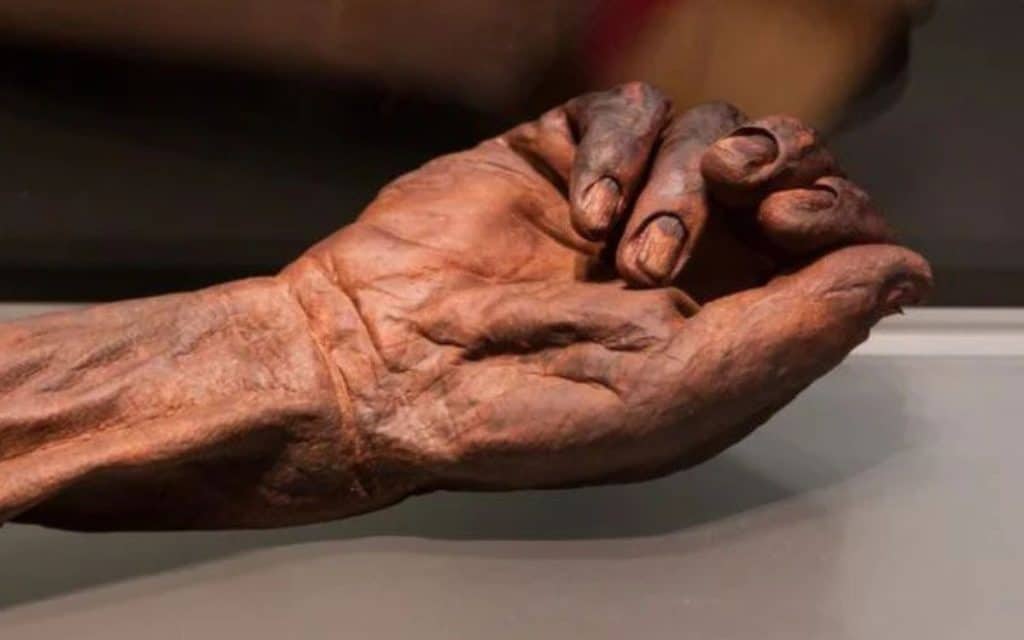
While his time-ravaged remains are displayed in Dublin at the National Museum of Ireland – Archaeology, dark folklore has gathered around the bog itself.
It is not hard to imagine the murdered king never truly leaving the bog, his spirit absorbed into the very landscape in which he died.
On misty evenings, when the peat seems to breathe beneath a low sky, it is easy to understand why generations believed that some souls placed in the bog were never meant to escape.
Clonycavan Man, Ballivor, County Meath
Clonycavan Man emerged from an Irish bog in County Meath, his face still startlingly recognisable – despite having lain hidden for more than 2,000 years.
His death was brutal, with blunt force trauma to the head and chest ending his life before his body was consigned to the peat.
Like Old Croghan Man, his remains have been interpreted in the context of Iron Age ritual killing and kingship, adding another unsettling layer to an already extraordinary discovery.
Around bog burials such as this, it is easy to imagine tales arising of unease, unexplained voices and elusive lights appearing across the darkness – becoming entwined with the ancient mystery of the landscape itself.
Perhaps there is something uniquely disturbing about standing close to a place where a human being vanished into the earth thousands of years ago.
The bog preserved his face, his unique mohawk and the violence of his final moments.
Ferocious ritual violence took place in a location imbued with the layers of violent history and dark worship, spanning more than 2,000 years.
It could be that tortured remains were not the only unnatural thing preserved in the rotting black peat.
The Phantom Lights of Littleton Bog, Lurgoe, County Tipperary
When darkness settles over Derrynaflan Monastic Site and Littleton Bog, heed the warning not to follow ethereal lights that have no earthly business being there.
Strange flickering glows are said to appear above the bog, hovering in the distance before slipping away whenever a traveller attempts to approach them.
Like the will-o’-the-wisp found throughout Irish and European tradition, these phantom lights are believed to lure the curious from safe ground and deeper into treacherous peat.
There, one wrong step can become a fatal mistake.
Some say they are wandering spirits; others blame the Faeryfolk, mischievously drawing mortals away from familiar paths.
Whatever their origin, the warning remains the same – if a lonely light appears across the bog after nightfall, do not follow it.
What looks like a lantern showing the way home may be leading somewhere from which no road returns.
At its heart is Derrynaflan Monastic Site, its medieval ruins and grave slabs claimed by black moss, the stones broken and twisted.
Are the lights actually the spectres of old treasure hunters, searching for gold and silver hidden in the peat by the monks?
The only one who would truly know is the legendary architect Gobán Saor, as he watches on silently from beneath his reputed tomb.
Cloone Bog and The Great Hunger, Cloone, County Leitrim
Cloone Bog lies within Bóthar na Naomh (Road of the Saints), a local walking trail that becomes a spooky Halloween walk for visitors during Samhain.
Beneath the fun and frivolity of trick or treating lies a darker story of victims of the Great Hunger.
A story of countless tragic souls, whose deaths were never properly recorded and whose stories disappeared into the black, dense peat as cruelly as they did.
The road through the bog itself was named for a pilgrimage route between monastic sites – a stark contrast to imagining the dark, swallowing peat holding the silent dead of the Great Hunger.
For any who may have found their final resting place within, the bog becomes a quiet, freezing grave, wrapping the forgotten dead in wet moss – never rotting, never resting.
Like the Hungry Grass, it is not hard to imagine skeletal hands clawing from beneath the black moss, from a landscape weighed down by the grief of ancestral loss and forgotten corpses.
Roundstone Bog and The Bog Road, Connemara, County Galway
Stretching between Roundstone and Clifden in County Galway lies the wild expanse of Roundstone Bog, a landscape of dark peat, scattered lakes and lonely tracks beneath the Twelve Bens mountains.
It is one of those places where the desolate landscape of Connemara seems to swallow sound.
The Bog Road cuts directly through the ancient landscape, once forming part of a major travel route through the area.
Today it is breathtakingly beautiful, but after dusk it has acquired a rather different reputation.
For generations, stories have been shared of strange figures beside the road, unexplained shadows and apparitions that seem to appear ahead of travellers before vanishing again into the bog.
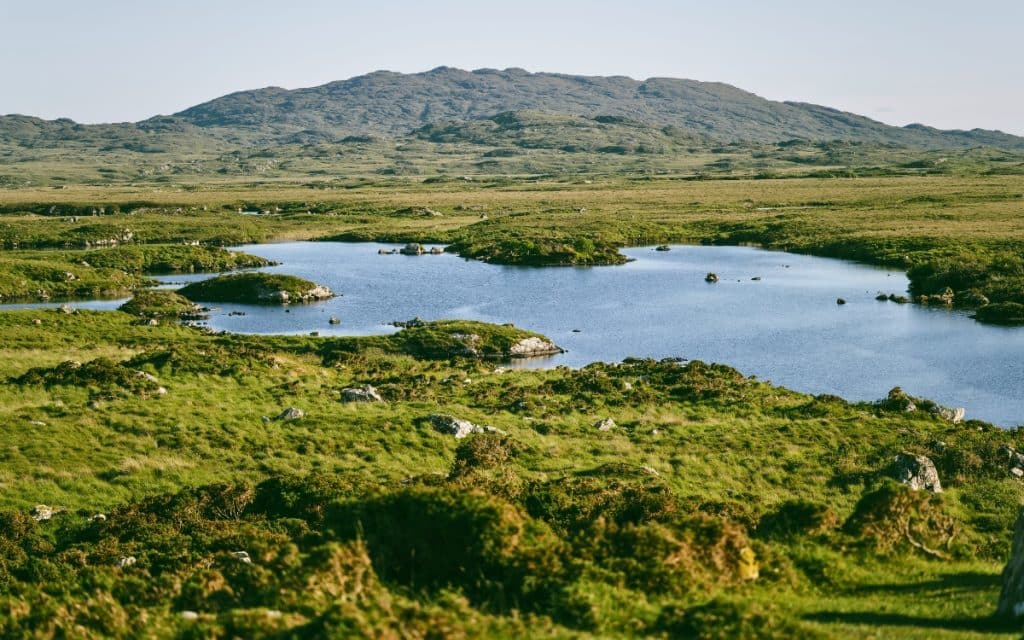
It is said that some locals would rather take the long way around than travel the Bog Road alone at night.
At the heart of its darker folklore is the story of an old inn from the 18th century, believed to have been kept by a brother and sister who offered shelter to lone travellers crossing the bog.
Their hospitality, however, appeared to come at a terrible price.
Tales tell of travellers showing signs of wealth being murdered as they slept, their possessions stolen and their bodies disposed of in the surrounding bogs and lakes.
The lonely pools and stretches of road around the old inn consequently became associated with its alleged victims.
There are accounts of dark forms emerging near the water, figures standing silently at the roadside and shapes suddenly appearing in front of passing cars.
They disappear when the driver looks again.
Perhaps that is what makes the Bog Road so wonderfully unsettling.
By daylight, Roundstone Bog is rich in rare vegetation and wildlife. However, at night, those same stretches of dark, empty peat become something altogether less welcoming.
There is a deserted village here too, an abandoned reminder that people once lived and worked in a barren, otherworldly landscape that now feels eerie.
When the Atlantic mist comes down and the Twelve Bens disappear from sight, perhaps it is worth remembering the stories – just in case your headlights catch a pale, wild-eyed victim in the darkness…
The boglands of Ireland are more than natural wonders – they are landscapes of liminality, places where the veil between worlds is especially thin.
Whether cursed by ancient kings, echoing with the cries of famine ghosts or haunted by the victims of robbery, these peat-filled plains continue to feed the darkest corners of Irish folklore.
You can read more with The Horrific Truth Of Ireland’s Bog Bodies.