
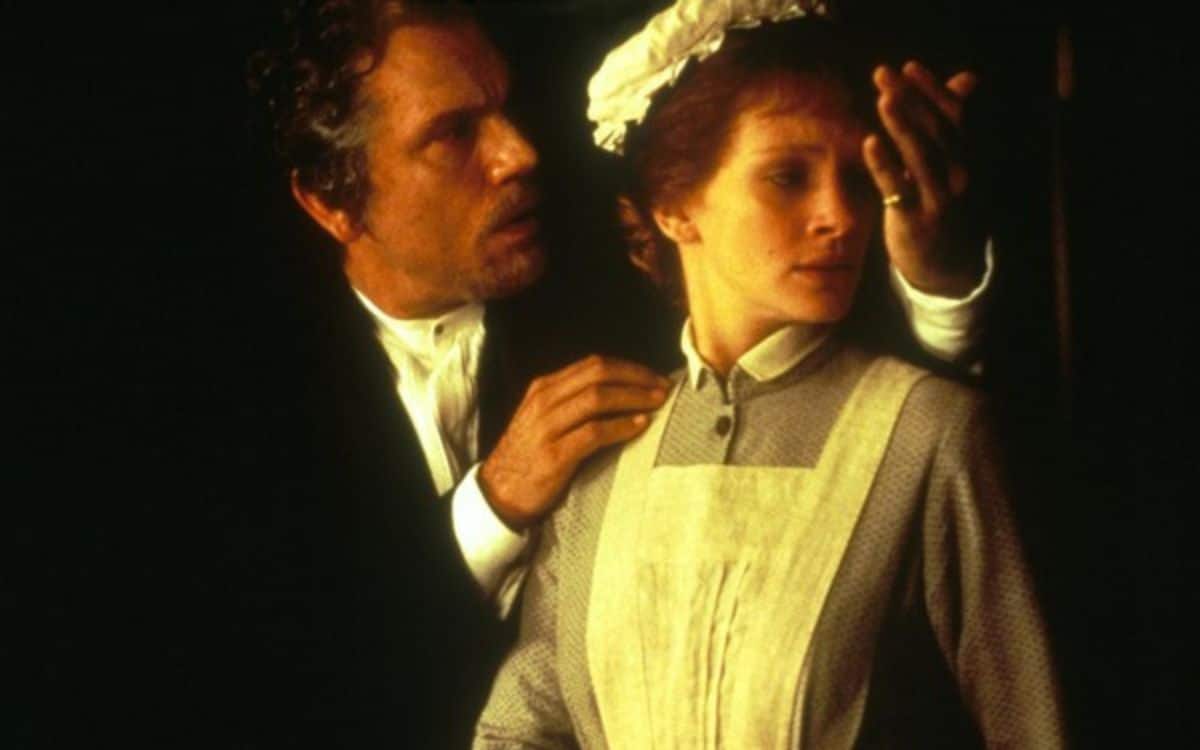
Mary Reilly (1996) is a gloomy retelling of Dr Jekyll and Mr Hyde, starring Julia Roberts and John Malkovich, writes ANN MASSEY McELROY
Review of Mary Reilly (1996)
There are certain things the Irish have learned to endure on screen. Fields populated entirely by donkeys, villages containing seventeen pubs and apparently no other businesses, and unexplained fiddle music. And of course the accents, oh dear Lord, the accents.
Into this distinguished hall of shame strides Julia Roberts in Mary Reilly, a lavish 1996 Gothic drama in which one of Hollywood’s biggest stars plays an Irish servant in Victorian Britain.
Unfortunately, this sets the scene for a lacklustre retelling of a classic horror tale, despite its all-star cast.
Based on Valerie Martin’s 1990 novel, this film is a retelling of Robert Louis Stevenson’s Strange Case of Dr Jekyll and Mr Hyde from the perspective of a servant working in Dr Henry Jekyll’s household.
Mary Reilly (Julia Roberts) is a quiet Irish maid carrying the physical and emotional scars of a brutal childhood.
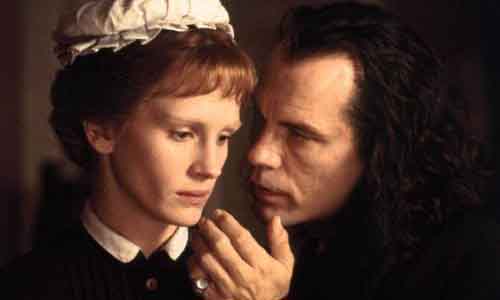
Her alcoholic father, played with suitably unpleasant menace by Irish actor Michael Gambon, abused her and locked her in a cupboard where the rats could get to her.
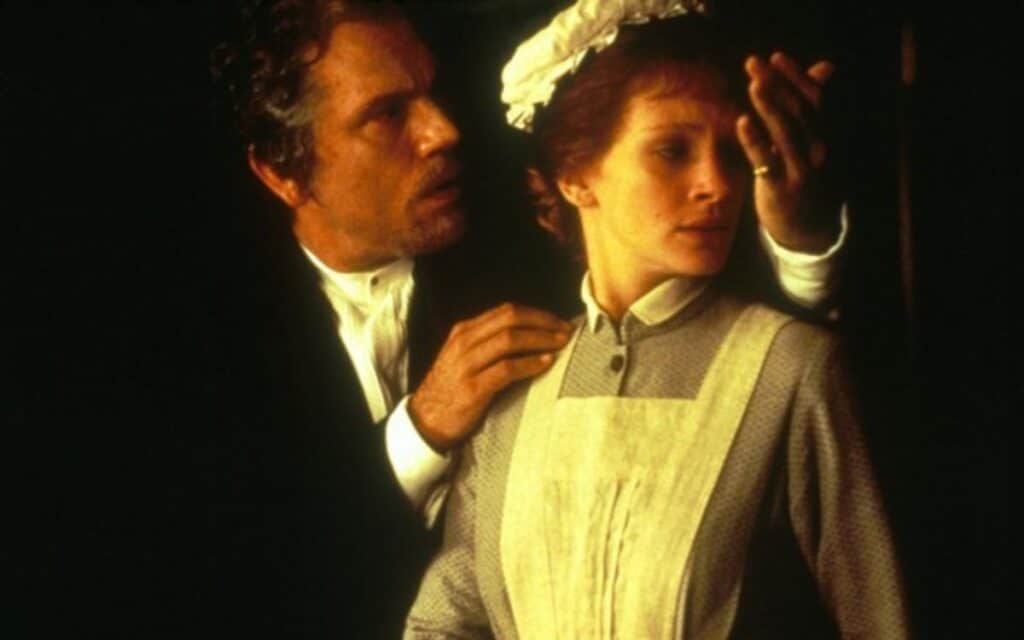
Mary now works in the home of the respectable Dr Henry Jekyll (John Malkovich), who takes an unusual interest in his withdrawn young servant.
While conducting secret experiments concerning the dual nature of man, Jekyll informs his household that his new assistant, Mr Edward Hyde, will be coming and going as he pleases.
Hyde is also played by John Malkovich, just without Jekyll’s facial hair – nobody manages to put two and two together.
Mary becomes increasingly fascinated by both men, sensing vulnerability in Jekyll and something altogether more dangerous in Hyde.
She encounters Hyde repeatedly and finds herself simultaneously frightened by and attracted to him.
Meanwhile, as Jekyll becomes more ill and erratic, Hyde becomes increasingly violent. Bodies start to pile up and Mary gradually realises that her employer and his mysterious assistant are rather more closely connected than anyone imagined.
Those familiar with Stevenson’s story will be considerably ahead of her, quite possibly by several postcodes.
A brilliant idea looking for a better film
The basic premise of Mary Reilly is genuinely clever. Instead of the traditional route of following Jekyll, we experience the familiar story through the eyes of someone else.
A humble servant who lives below stairs, cleans the blood away and sees only fragments of the horrors occurring above her station.
Mary is virtually invisible in Victorian society. She enters rooms without being noticed, hears conversations not intended for her and occupies the peculiar position of a place of servitude – knowing everything about her master, yet possessing virtually no influence herself.
There is a very good Gothic film buried in here, but sadly, somebody appears to have buried it quite deeply.
After almost two hours, the film moves at the stately pace of a Victorian funeral procession whose horses have stopped for lunch.
For a film involving murder, sexual obsession, abuse, severed body parts and a scientist physically transforming into his murderous alter ego, Mary Reilly is astonishingly reluctant to become exciting.
The irritating thing about the film is that visually it is often beautiful. Everything is wet, grey, filthy and miserable, instilling perfect Gothic ambience.
Jekyll’s enormous house feels cold and oppressive. Servants disappear through dimly lit corridors and stairways, while the doctor conducts increasingly sinister experiments behind closed doors.
The production design is excellent and the costumes are wonderfully severe. The cinematography wraps everything in fog, shadow and grime, and you can practically smell the damp.
Yet despite this, the film just lacks atmosphere.
Julia Roberts and that accent
Now we must address the elephant in the scullery – Julia Roberts’ Irish accent.
To her credit, Roberts commits herself completely to Mary. Gone is the megawatt Pretty Woman smile. She is pale, withdrawn, frightened and deliberately plain.
There are scenes where Roberts’ vulnerability works extremely well, particularly when Mary’s abusive childhood begins to explain her strange attraction to dangerous men.
All these are non-verbal, which is a huge testament to her acting ability – but then she speaks.
A sentence may begin somewhere around Dublin, take an unexpected detour through Galway and arrive at its destination having apparently spent the weekend in County Kerry.
As a result, it completely detracts from Roberts’ performance like a minor character trying to steal the scene from the star.
John Malkovich – subtle transformation
Then we have John Malkovich as both Dr Jekyll and Mr Hyde.
Traditionally, cinema has gone to considerable lengths to distinguish the two with prosthetics, hair, teeth and make-up. The two characters would be distinguished by physical transformation or different actors in the roles.
Mary Reilly, however, gives Jekyll a moustache.
This leads to the slightly unfortunate situation where Mary spends considerable time wondering about the mysterious connection between two men who both look remarkably like John Malkovich.
The brilliance of Victorian detective work was apparently still in its infancy.
Malkovich certainly gives Hyde a more predatory physical presence, and there is something deeply unpleasant about his fascination with Mary.
But he is never quite as frightening as the film desperately wants him to be.
Perhaps the strangest thing about Mary Reilly is the amount of talent lurking around its edges.
Michael Gambon is memorably horrible as Mary’s abusive father. Glenn Close turns up as Mrs Farraday, the formidable keeper of a brothel used by Hyde, and George Cole plays Jekyll’s butler, Mr Poole.
Among the additional supporting cast are Michael Sheen and Ireland’s own Ciarán Hinds.
This is not a film lacking actors, money, craftsmanship or literary pedigree – what it lacks is a pulse.
The verdict
There is much about Mary Reilly that should work. The idea of viewing Jekyll and Hyde through the eyes of a powerless female servant is fascinating.
Julia Roberts deserves credit for abandoning her glamorous Hollywood image to play someone damaged, frightened and socially invisible.
In addition, John Malkovich is always interesting to watch, but the finished film is relentlessly sombre, desperately slow and strangely lifeless.
Gothic doesn’t simply mean turning the lights down and making everybody miserable. There needs to be danger, passion, tension and, of course, terror.
Sadly, this is a dragging production where the scariest Gothic horror within it was a poorly coached accent.
Watch Mary Reilly 1996 Trailer
10 Things You Didn’t Know About Mary Reilly (1996)
- Tim Burton, who was known for his quirky and dark style, was originally attached to direct the film. However, after receiving the script for Ed Wood, he decided to direct that instead. Ed Wood went on to become a critical success and won two Oscars.
- The distinction between the rings worn by Dr Jekyll and Mr Hyde symbolises the difference between the two characters. Dr Jekyll, who represents the good side, wears a gold ring, which is associated with wealth and purity. Meanwhile, Mr Hyde, who represents the evil side, wears a silver ring, which is associated with coldness and sterility.
- To achieve a more authentic Victorian feel, the filmmakers borrowed many props from museums and galleries. This includes everything from furniture to medical equipment. This attention to detail helped to create a more immersive experience for the viewers.
- The film initially had an ending that closely followed the book, where Dr Jekyll dies and Mary lies beside him. However, the ending went through multiple rewrites, and the producers called back the stars to shoot three alternative endings several months after production had wrapped. Glenn Close, who had already left London, was flown back for one day of work to shoot one of the new endings.
- To further add to the authenticity of the film, some of the indoor sets were sections of real houses preserved from the Victorian era. This helped to create a more realistic environment and allowed the actors to fully immerse themselves in their roles.
- Julia Roberts, who was one of the biggest movie stars at the time, had a jet on standby around the clock during filming in London. This added luxury cost over $120,000, which was considered excessive by some.
- Dangerous Liaisons was a critically acclaimed film that brought together many of the cast and crew of Mary Reilly. This includes director Stephen Frears, screenwriter Christopher Hampton, actors John Malkovich and Glenn Close, producer Norma Heyman, composer George Fenton, cinematographer Philippe Rousselot, production designer Stuart Craig, and casting director Juliet Taylor.
- John Malkovich, who naturally has blue eyes, wore coloured contact lenses to make his eyes appear brown for his role as Dr Jekyll. This was done to give the character a softer look in comparison to the wild dark-eyed look of Edward Hyde.
- In the film, Mrs Farraday comments to a patron that Mary isn’t even 18 years old, implying that the character is underage. However, in reality, Julia Roberts was almost 30 at the time she took on the role of Mary Reilly.
- Despite their on-screen chemistry, Julia Roberts and John Malkovich reportedly did not get along during filming. This tension was reportedly due to Malkovich’s method acting style, which caused him to stay in character even off-camera.