

In October 1642, two armies faced each other in the Vale of the Red Horse, Warwickshire.
The Battle of Edgehill would go down as the first major engagement of the English Civil War, and as darkness brought an end to the fighting, neither side had achieved the decisive victory that they had hoped for.
The war would drag on.
A phantom battle above Edgehill
As Christmas approached, the people living around the site of the battle must have begun to feel relatively untouched by the war. After the battle, both of the armies had left the area, making for London, and soldiers hadn’t been seen in those parts for some time.
Besides, December wasn’t a good time for campaigning. It was with some surprise, then, that while travelling across the former battlefield sometime between midnight and 1am, some local shepherds and “other countrymen and travellers” began hearing some unusual noises.
As they listened carefully, they could make out the beating of drums and what sounded like the groans of injured men. The noises seemed to get nearer and nearer to the startled men.
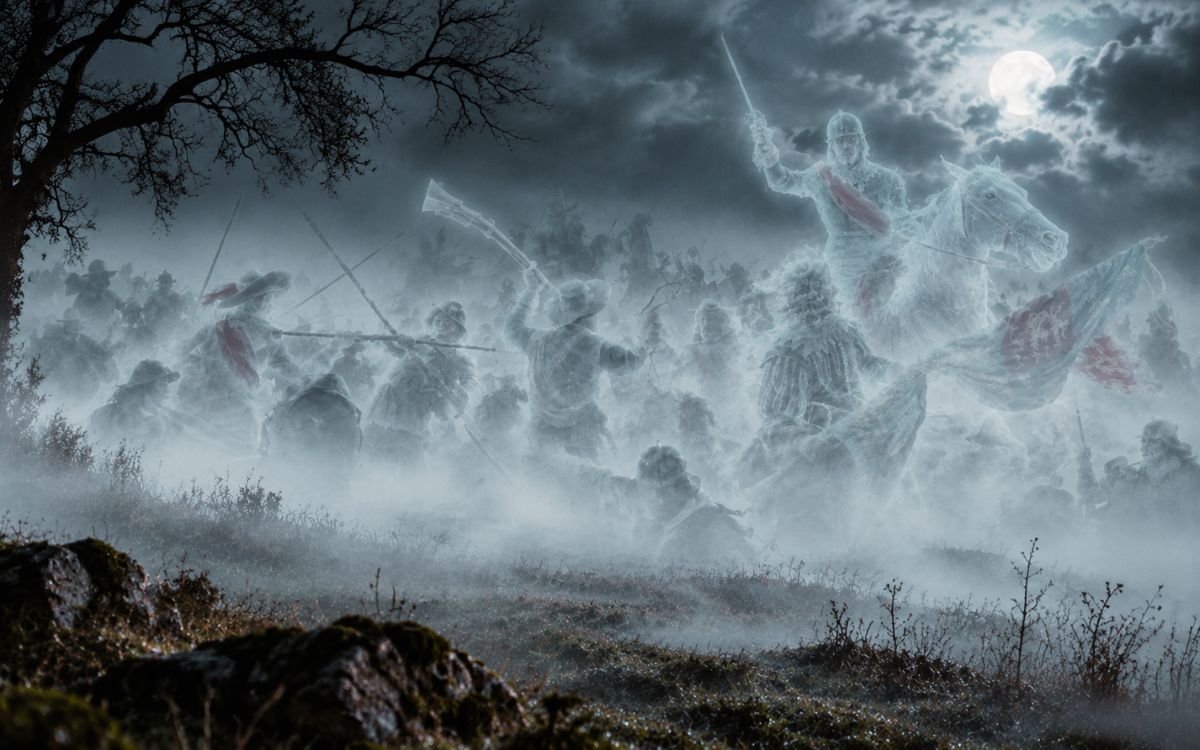
As they sought to flee the scene, soldiers appeared in the sky “with ensigns displayed, drums beating, muskets going off, cannons discharged and horses neighing”. Terrified by the sights and sounds of this spectral battle, the men stayed rooted to the spot.
A contemporary pamphlet said: “run away, they dare not – for fear of being made a prey to these infernal soldiers”.
Witnesses return to the battlefield
Amazingly, this encounter lasted for around three hours. Finally, one of the spectral armies appeared to withdraw and the ghosts vanished.
The shaken witnesses went immediately to the nearby village of Kineton, where they roused Mr William Wood, the local Justice of the Peace. He, in turn, called on his neighbour, a church minister called Samuel Marshall, and together the two men received a full account of the events.
Wood and Marshall both knew some of the witnesses and believed them to be men of integrity, so they held off judgement until they had investigated the events for themselves.
The following night, Wood and Marshall, along with a group of other people from the neighbouring parishes, made their way to the battlefield. Events unfolded as they had before, and the spectators left in fear of what they had seen.
After that, the haunting seemed to stop, as the spirits were not seen for several nights. This was only a pause, however, as the ghostly battle was fought again the following week, with the spectral soldiers once more engaged for around four hours.
The local area was soon in a state of terror, with many people choosing to hide themselves away after dark.
King Charles I sends investigators
Unsurprisingly, news of these apparitions began to travel, and it wasn’t long before word reached King Charles I at his wartime capital of Oxford of what had been happening in rural Warwickshire. Disturbed by the accounts he heard, the king decided to send a group of people to investigate the alleged ghostly activity.
Out of the group he sent, three of them – Colonel Kirke, Captain Dudley and Captain Wainman – had fought at the Battle of Edgehill. On arrival in the area, they interviewed a number of people who had witnessed the ghostly battle, including Samuel Marshall.
There is no mention of them speaking to William Wood, with some suggestion that he had been so disturbed by what he had witnessed that he had left the area.
Before they made their report to the king, the investigators sought to witness the battle for themselves. They were not disappointed and were able to watch the phantom troops re-fighting the battle.
As they looked at the spectral soldiers, they recognised a number of their friends and comrades who had been killed in the battle. Amongst them, they recognised Sir Edmund Verney, the king’s standard bearer, who chose to face death rather than surrender the standard that had been entrusted to him.
In an attempt to take the standard, Parliamentarian soldiers had cut off Sir Edmund’s hand. It was said that when the standard was reclaimed, Sir Edmund’s severed hand was still holding on.
Why did the ghostly battle appear?
There was much discussion about what exactly these terrible apparitions meant and what, if anything, could be done to prevent them appearing again. Some claimed that the haunting was a sign from God, unhappy at the spilling of blood.
Others claimed that the manifestations were caused by unburied dead from the battle. Searches of the battlefield were undertaken and a number of bodies were found and subsequently given a proper burial.
Eventually, the ghost battle faded out and ceased to be seen, much to the relief of the local population.
Later ghosts at Edgehill
However, the story of the ghosts of Edgehill does not end there. Even though visions of the ghostly battle appear to have ceased, a number of other spirits are still said to roam the battlefield, especially around the time of the battle’s anniversary, when it is said that the sounds of battle may still be heard.
One of the people who fought on that fateful day was Henry Kingsmill, who, it is said, rode into battle on a white horse. Maybe he is one of the spectres still said to roam the field of battle.
There have been multiple reports of a man on a white horse being seen charging down the slope of Edgehill, waving his sabre above his head. Visitors to the battlefield have also reported hearing disembodied hoofbeats.
The weeping women of Warwickshire
The Warwickshire villages of Lighthorne and Leek Wootton, although away from the battlefield itself, are said to be haunted as a result of the events that played out on that October day in 1642. In both of these places, ghosts are said to have been seen weeping and wailing.
In Lighthorne, the ghost of a woman has been seen around Church Lane. She appears to be young, pale and with a tear-stained face.
Sometimes she stands in silence, while at others she appears to be weeping. It has been said that the apparitions at both Lighthorne and Leek Wootton are widows of those killed in battle.
What do the historical records tell us?
It is often claimed that Edgehill is Britain’s only “officially” haunted battlefield, due to the fact that it was the subject of a royal investigation. Claims that the haunting is somehow officially recognised by the National Archives, however, seem not to be true.
Despite the best efforts of historians, no official report from the king’s investigators has ever been found in the archives. In fact, the earliest source we have for the spectral battle and the subsequent investigation is a pamphlet entitled “A Great Wonder in Heaven”, published in January 1643.
Some people have questioned whether, in an era that saw unusual events as a kind of divine signal, the pamphlet embellished or even made up the story as a propaganda exercise.
Whatever the truth of what happened over the few months from October 1642 to January 1643, strange things are said to happen on the site of the battle even up to the modern day. Even with much of the battlefield inaccessible, people still travel there, especially around the time of the anniversary of the battle, hoping to encounter something paranormal.
Maybe at the archives in London, or in the quiet Warwickshire countryside, there is still another chapter in the story of the phantom battle of Edgehill waiting to be told.
Discover other Ghosts of the Civil War on Spooky Isles.
GEORGE HEINZ was born in Wolverhampton and has a long-standing interest in the paranormal, particularly hauntings and cryptozoology. He is a Methodist minister based in Shropshire, where he lives with his family. In his spare time, he enjoys playing the trumpet, painting, and watching classic horror and science fiction films.