

Imagine renovating an old house and discovering a doorway that hasn’t been opened for centuries.
Behind it lies a forgotten room. Dust covers the furniture, cobwebs hang from the ceiling, and in the corner sits a chair.
And on that chair is a skeleton.
It sounds like something from a Gothic horror novel, but stories of such discoveries have circulated throughout Britain for centuries.
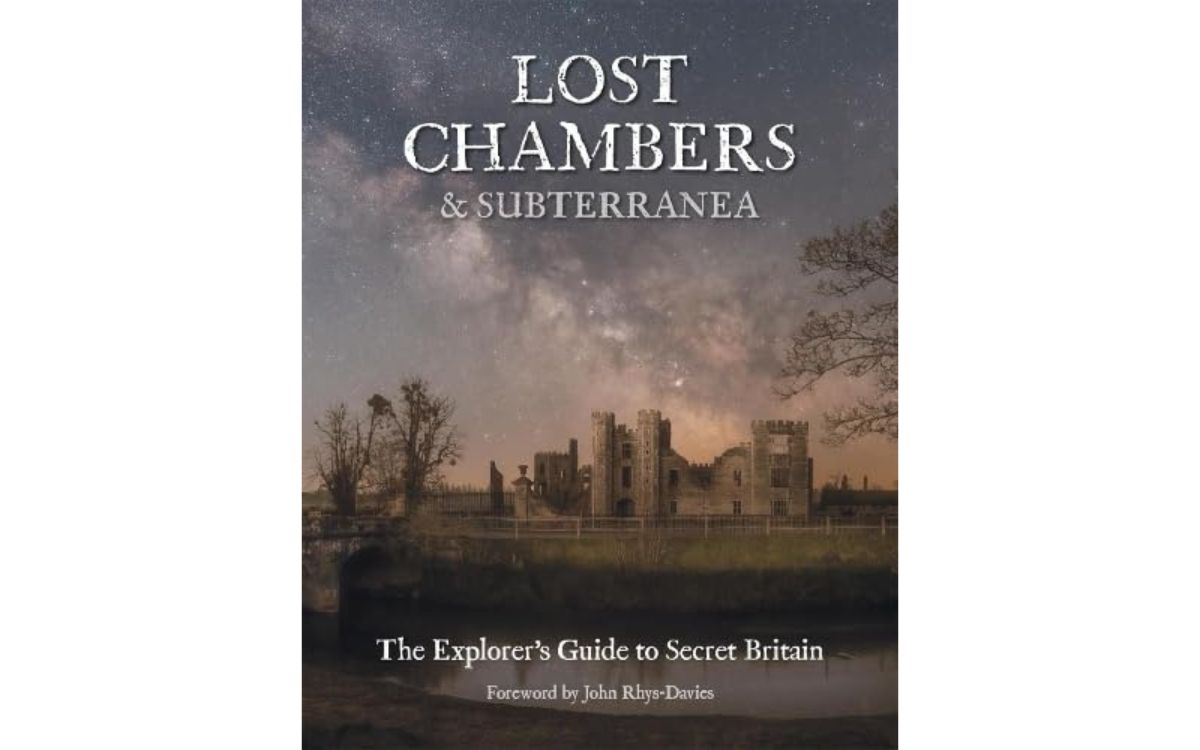
While researching our book, Lost Chambers & Subterranea, we encountered numerous accounts of hidden chambers, secret passages and unfortunate souls who apparently entered them but never came out.
Some discoveries are documented. Others belong to folklore.
And a few have become so entangled with ghost stories that separating fact from fiction is almost impossible.
Here are ten of Britain’s strangest tales of skeletons behind walls, forgotten rooms and restless spirits.
Minster Lovell Hall, Oxfordshire
The picturesque ruins of Minster Lovell Hall are the setting for one of England’s most extraordinary stories of a hidden skeleton.
According to an account published by antiquarian Francis Peck in 1740, workmen installing a chimney in 1708 discovered a secret underground vault.
Inside was the skeleton of a man sitting at a table.
Before him lay a book, pen and paper. Nearby were the decaying remains of a cap, while barrels and jars suggested the mysterious occupant had been supplied with food.
But who was he?
One theory identified the remains as those of Francis Lovell, a close supporter of Richard III who disappeared after the Battle of Stoke Field in 1487.
According to legend, Lovell had taken refuge in the chamber but became trapped when the person responsible for bringing him food failed to return.
Unable to escape, he slowly starved to death.
Adding to the mystery, ghostly sounds are said to emanate from underground, supposedly originating in the vault where the unfortunate fugitive met his end.
Whether the discovery happened exactly as described remains uncertain, but the image of a forgotten man sitting at his table for centuries is difficult to shake.
Littledean Hall, Gloucestershire
Grey, gloomy and home to protected bats, Littledean Hall in Gloucestershire certainly looks the part of a haunted house.
The seventeenth-century property boasts an ancient cellar and the remains of a Roman temple in its grounds. Its supernatural traditions include a ghostly monk, phantom Civil War soldiers and the sound of heavy footsteps crossing bare wooden floors where soft carpets now lie.
There are even reports of indelible bloodstains.
Adding to the intrigue is a concealed staircase behind a hinged fireplace overmantel, together with stories of secret passages beneath the cellars and skeletons dressed in armour discovered behind bricked-up walls.
But perhaps the most disturbing legend concerns the haunted Blue Room.
According to tradition, a woman who had conducted an illicit affair gave birth to a child whose existence threatened to expose her secret. The infant was supposedly hidden behind a panel in the room.
A mysterious woman dressed in blue is said to appear at an upper window, gazing forlornly from the house.
Bruntsfield House, Edinburgh
Bruntsfield House has an unsettling legend involving a hidden apartment.
According to one version, an architect examining the building noticed something peculiar.
There were more windows visible from outside than there were rooms inside.
Suspecting that part of the house had been concealed, he began investigating.
An elderly housekeeper was questioned, and eventually a narrow doorway was discovered behind a tapestry.
When the door was forced open, it revealed one or more forgotten rooms.
Inside were reportedly silver candlesticks, an old dressing gown, ashes in a fireplace and a bed that appeared to have been left in a hurry.
Even more disturbingly, some accounts mentioned bloodstains and a skeleton.
The chamber became known as the ghost room, and its mysterious history has sometimes been linked to tales of a Green Lady haunting the grounds.
Bruntsfield House later became part of James Gillespie’s High School, but the legend of its hidden apartment survives.
St Andrews Cathedral, Fife
The ruined cathedral at St Andrews was once Scotland’s largest and most important church.
Within its ancient precinct wall stands a square tower containing a long-forgotten burial chamber.

In 1868, stonemasons repairing the wall reportedly discovered a sealed mausoleum.
Inside were coffins containing human remains.
But one coffin attracted particular attention.
According to accounts of the discovery, it contained the skeleton of a woman dressed in satin and wearing white gloves.
As the story spread, increasingly sensational details emerged. Some claimed the woman had long dark hair, while others insisted her body was perfectly preserved.
In 1888, local antiquarian William T. Linskill arranged for the chamber to be opened again.
By then, the mysterious woman had disappeared.
Instead, investigators found broken coffins, scattered bones and debris.
The mystery soon acquired a supernatural dimension. A ghostly lady was reportedly seen wandering the cathedral graveyard and occasionally appearing on the old battlements.
Was she the mysterious woman from the sealed mausoleum? Nobody knows.
Thornton Abbey, Lincolnshire
The atmospheric ruins of Thornton Abbey are associated with a dark tale.
According to the Lincolnshire antiquarian Abraham de la Pryme, demolition work around 1600 revealed a mysterious chamber near the chapter house.
Inside sat what appeared to be a monk, still wearing his clothing.
Before him stood a small table holding a parchment book, pen, ink and paper.
The scene had apparently remained undisturbed for generations.
But when the objects were touched, they reportedly turned to dust.
Later versions claimed the unfortunate monk had been deliberately walled up alive.
One tradition identifies him as Thomas de Gretham, a former abbot supposedly punished for practising the dark arts and indulging in forbidden pleasures.
His ghost is said to haunt the abbey ruins, sometimes appearing near the gatehouse.
Although the tale remains unverified, Thornton Abbey has yielded genuine human remains. Archaeologists uncovered a medieval plague burial containing 48 skeletons, including 27 children.
Menabilly, Cornwall
The Cornish mansion of Menabilly, once home to novelist Daphne du Maurier, has a story of a forgotten skeleton.
During the 1960s, du Maurier described an alleged discovery made during building work around 1820.
According to the tale, a secret chamber was uncovered near the kitchens.
Inside was a skeleton dressed in the clothing of a seventeenth-century Cavalier.
When fresh air entered the room, the ancient garments supposedly crumbled into dust.
The remains were believed to belong to a young member of the Grenville family who had taken refuge during the Civil War, only to become trapped and die.
Menabilly also possessed a haunted reputation. Du Maurier recalled tales of a mysterious Blue Lady appearing at a side window, although no known account directly connects her to the unfortunate Cavalier.
The skeleton story inspired du Maurier’s historical novel The King’s General, while Menabilly itself became the model for Manderley in Rebecca.
Monkton Priory Farmhouse, Pembrokeshire
Near Pembroke Castle, the medieval settlement of Monkton grew around a Benedictine priory. Its surviving buildings are associated with intriguing stories of skeletons concealed behind walls.
At Priory Farmhouse, a former occupant, George Jenkins, reportedly noticed that the building’s internal and external dimensions did not correspond.
Breaking through a wall, he allegedly discovered a hidden passage containing a human skeleton surrounded by oyster shells.
The remains were believed to belong to a monk known locally as ‘Oyster John’.
The farmhouse subsequently acquired a haunted reputation, with reports of a ghostly monk, unexplained disturbances and an exorcism during the 1920s.
Nearby Monkton Priory Church has its own mystery. During nineteenth-century restoration work, another monk’s skeleton was reportedly discovered walled up above the porch.
And the ghost stories do not end there.
At Monkton Old Hall, the Reverend Tudor Evans reportedly heard mysterious knocking at his bedroom door, while his daughter saw the head and shoulders of a hooded figure at a window. The family dog also refused to enter one particular room.
Visitors can still stay at the medieval hall, whose vaulted chambers and spiral staircases provide an atmospheric setting for its ghostly traditions.
Greystoke Castle, Cumbria
At Greystoke Castle, an old bedroom in the medieval pele tower is associated with a ghostly legend.
A secret passage supposedly connected the chamber with a chapel in the grounds.
According to tradition, when the passage was sealed, a monk was trapped within and left to die.
Ever since, knocking has allegedly been heard coming from the blocked entrance.
The bedroom acquired an especially sinister reputation after a guest was said to have disappeared without explanation, leaving all his belongings behind.
Such stories might easily be dismissed as Gothic invention were it not for the castle’s genuine architectural mysteries.
An archaeological account published in 1924 described dungeons beneath the pele tower and a surviving trapdoor from a room above.
It also referred to a chamber called the Priest’s Hole, with a secret passage and staircase said to connect with an underground route leading towards the old moat.
The possible existence of these features does not establish the truth of the ghost story, but it makes the legend of the knocking monk considerably more atmospheric.
Burton Agnes Hall, East Yorkshire
Hidden within the walls of an Elizabethan manor house in East Yorkshire is a skull said to unleash terrifying disturbances whenever it is removed.
Burton Agnes Hall, built by Sir Henry Griffith in the early seventeenth century, is home to one of Britain’s strangest ghost stories.

According to legend, his daughter Anne was attacked by robbers and died from her injuries. Her skull, known as ‘Owd Nance’, supposedly screams and causes mysterious disturbances whenever it is taken from the house.
But there is a curious twist.
No historical record of Anne Griffith has been found, and Sir Henry’s memorial names only two daughters, Frances and Margaret.
The skull is said to remain concealed behind panelling or within a secret wall niche, its whereabouts closely guarded.
Yet ghost hunter Peter Underwood claimed to have examined it, adding another intriguing dimension to this enduring mystery.
Lyme Park, Cheshire
At Lyme Park in Cheshire, ancestral home of the Leigh family for six centuries, an imposing portrait of the Black Prince conceals a secret doorway. The painting swings out on hinges, revealing an entrance to the Drawing Room, and is thought to have inspired Sir Walter Scott’s novel Woodstock (1826).
But an altogether more sinister mystery surrounds the Knight’s Bedroom, opening off the Long Gallery on the top floor. Said to have accommodated Mary Queen of Scots, the room was reputedly connected by a secret passage to the Lyme Cage, a building in the grounds.
According to tradition, the skeleton of a forgotten priest was discovered beneath the floorboards, and the room became known as the ghost room, where the sound of tinkling bells was heard at night.
Intriguingly, two genuine secret hiding places survive beneath removable floorboards in a closet beside the fireplace. One extends behind the chimney, while the other lies directly beneath the bedroom floor, lending a tantalising element of truth to the legend.
What other secrets are hidden behind Britain’s walls?
There is something uniquely disturbing about discovering a bricked-up room that has remained sealed for centuries.
Someone wanted the space concealed.
And perhaps they wanted whatever was inside to remain hidden forever.
During the eighteenth and 19th centuries, Britain’s fascination with Gothic literature helped transform these discoveries into increasingly elaborate tales.
Skeletons sat at forgotten tables, ancient relics crumbled into dust, and sealed rooms became the resting places of the dead.
The boundary between genuine discoveries and supernatural storytelling became increasingly blurred.
Yet the real history of Britain’s secret chambers is often frightening enough.
Priests genuinely hid from persecution in cramped spaces. Families concealed valuables and weapons during political upheavals.
Ancient buildings contained secret passages, blocked doorways and rooms whose original purposes had long been lost.
And occasionally, human remains really were discovered where nobody expected them.
Perhaps that is why these stories continue to fascinate us.
Because somewhere in Britain, behind the plaster of an ancient manor house or beneath the stones of a ruined abbey, there may still be a room that nobody remembers.
And who knows what might be waiting inside.
ALVIN NICHOLAS is co-author of Lost Chambers & Subterranea: The Explorer’s Guide to Secret Britain, which explores the hidden secrets of Britain’s castles, manor houses, crypts and caves, together with the legends, ghostly encounters and dark histories associated with them. The book is available from Bookshop.org, Central Books, Amazon and other booksellers.