

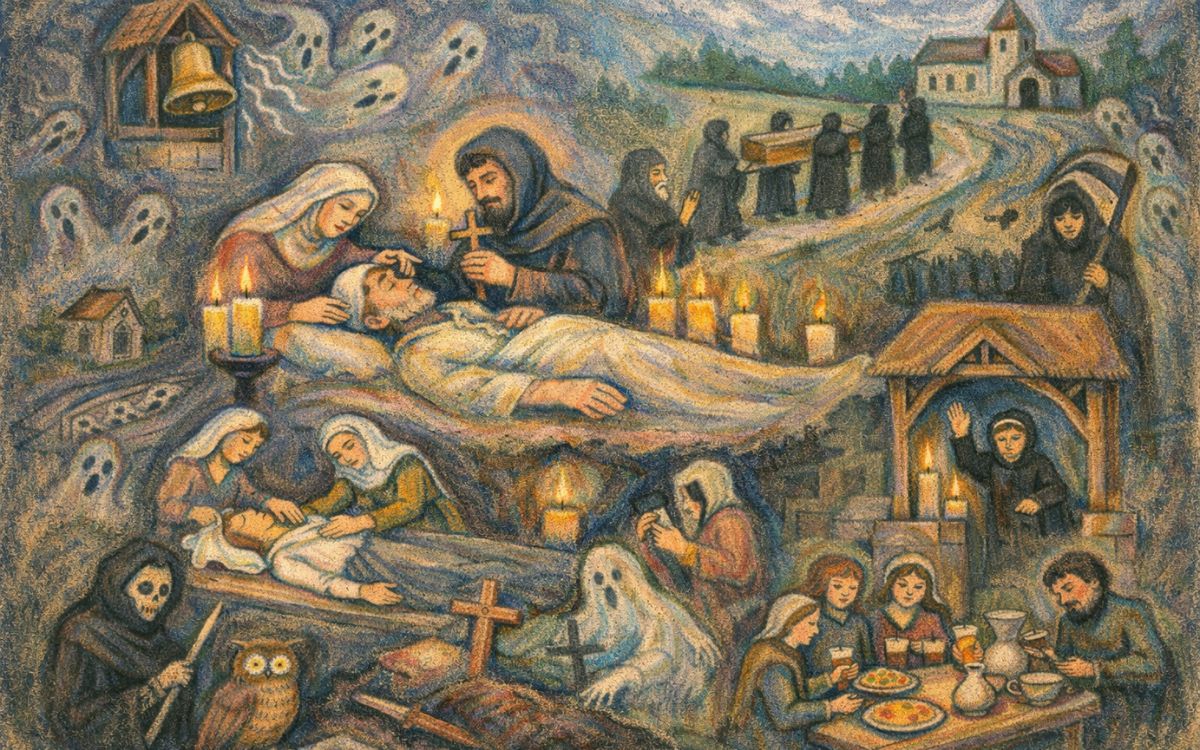
In a world where life was often short and sudden death a constant threat, medieval people surrounded dying and burial with carefully observed customs.
These rites offered comfort, religious assurance and protection – both spiritual and, at times, physical.
Here are 10 striking practices that shaped how death was understood and honoured in medieval England.
1. The “Good Death” and Last Rites
A “good death” was the ultimate goal for any devout medieval Christian.
Dying with one’s sins confessed and the Church’s last rites administered – including confession, communion (viaticum) and anointing (extreme unction) – was seen as essential for the soul’s safe passage to God.
It was believed that evil spirits gathered at the deathbed, so priests would be summoned by the toll of the passing bell.
Candles were lit, crosses or rosaries placed in the dying person’s hands, and prayers spoken to guard against demonic interference.
Dying unprepared was deeply feared – without final absolution, the fate of the soul was uncertain.
2. Washing and Shrouding the Body
After death, women of the community – usually family or neighbours – would wash the body in a ritual act known as “laying out”.
This was both a hygienic and symbolic purification.
The deceased was dressed in a simple shroud, the jaw bound and eyes closed – often with coins to keep them shut.
Beyond practicality, this was also spiritual: open eyes were said to encourage the spirit to linger, or even claim another life.
3. The Wake and Night Vigil
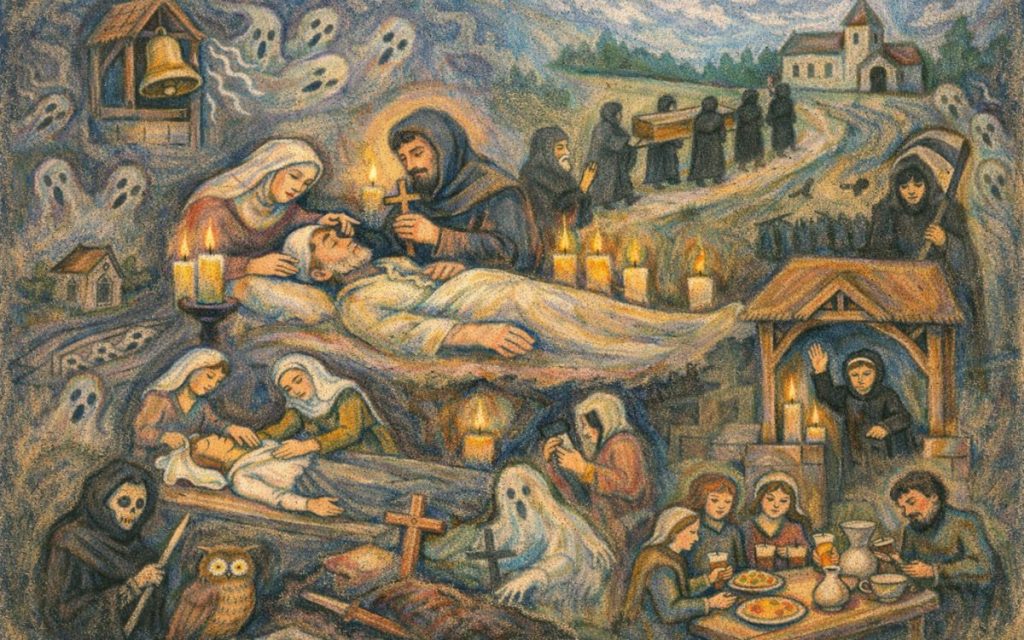
The medieval wake, or lyke-wake, was a night vigil held before burial.
Friends and relatives gathered to pray, keep watch and protect the corpse – from both animals and supernatural threats.
Folklore warned of cats jumping over coffins bringing ill luck, or even raising the dead.
Such beliefs made the vigil not just a time of mourning but a sacred duty.
The term “wake” itself reflects the act of staying awake with the dead, often accompanied by candles, psalms and shared food or drink.
4. The Tolling of Bells
Church bells were believed to have spiritual power.
As death approached, the passing bell was rung to summon prayers and ward off evil spirits.
After death, a death knell announced the loss, sometimes in patterns that indicated the sex or age of the deceased.
During the funeral, a lych bell (or corpse bell) might be rung to accompany the body to the grave – literally ringing the soul home.
Bells were often blessed and considered to drive demons away by sound alone.
5. Corpse Roads and Funeral Processions
Funeral processions were solemn, often travelling long distances to reach the parish church.
This gave rise to corpse roads or lych ways – dedicated paths for carrying the dead.
These routes were kept straight, as folklore believed ghosts could only travel in straight lines.
Coffins were carried feet-first to prevent the spirit looking back at its former home.
Bridges or fords were often chosen deliberately, as spirits were thought unable to cross running water.
6. Lychgates and Coffin-Stones
At the entrance to churchyards stood lychgates – roofed gateways where the coffin would pause.
Here, priests welcomed the dead and said initial prayers.
A coffin-stone or bench might provide rest for pallbearers.
Symbolically, the lychgate marked the crossing from the world of the living to consecrated ground.
Some traditions even included circling the gate or a cross with the coffin, enacting a ritual farewell.
Many ancient lychgates still stand in English churchyards today.
7. Burial and the Unquiet Dead
Most people were buried in hallowed ground, feet facing east towards the rising sun, awaiting Resurrection.
The wealthy might lie within the church; the poor in the yard.
Burial without grave goods reflected Christian beliefs: one’s soul, not possessions, made the journey beyond.
However, those who died by suicide or criminal execution were often denied church burial.
Such corpses might be buried at crossroads, sometimes with stakes through the heart, in hopes of confusing or trapping the spirit.
Fear of revenants – the reanimated dead – was real and widely believed.
8. Funeral Feasts and Mourning Dress
Funeral gatherings, or arvel suppers, followed burial.
Mourners shared ale, bread and special cakes, sometimes sealed with black wax as tokens of remembrance.
These meals reinforced family ties, honoured the dead and in some cases marked the legal passing of inheritance.
Mourners dressed in dark or plain clothing – with black becoming the standard for the upper classes by the 14th century.
Widows might wear mourning garb for years.
Alms (known as doles) were often given to the poor as both charity and a way to encourage prayers for the departed soul.
9. Prayers, Purgatory and Chantries
The medieval Church taught that most souls entered Purgatory after death – a state of cleansing before heaven.
Prayers, Masses and almsgiving could shorten this time.
Wealthier families often paid for Requiem Masses, sometimes founding chantry chapels where priests would pray for the dead daily.
Charity was seen as spiritually valuable – even torch-bearers at funerals were sometimes paid to pray.
This belief in aiding the dead created a strong bond between the living and the departed, shaping medieval religious life.
10. Omens and Signs of Death
Medieval people watched for omens of death.
The cry of a screech owl – nicknamed the lych owl – was feared.
So were corpse candles: flickering lights seen in graveyards or moorland, said to mark the path a funeral would take.
Dreams, unexplained knocks or howling dogs were also interpreted as warnings.
Folklore blended with faith.
While the Church cautioned against superstition, many believed death made itself known through mysterious signs.
Protective customs arose in response – stopping clocks, covering mirrors or placing rosemary on the dead.