

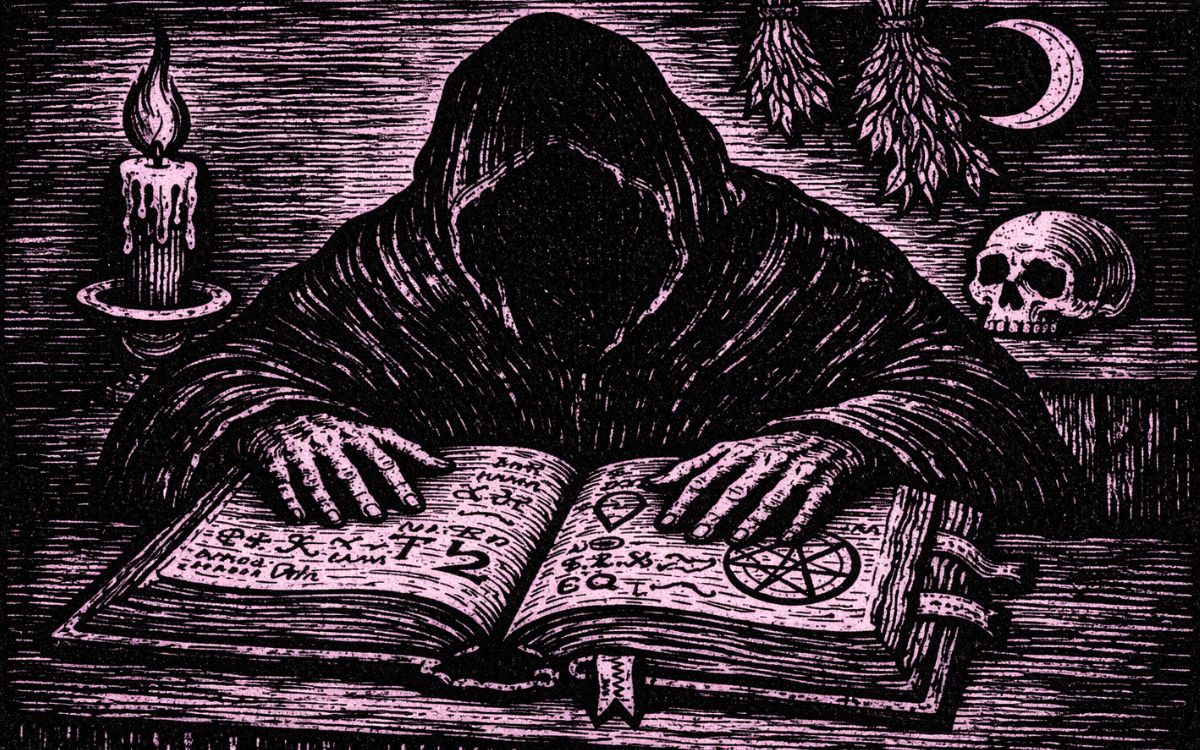
What is a Grimoire?
Across Britain and Ireland, stories of witches, wise women, and occultists often revolve around secret books of power. These are grimoires — books of magic filled with rituals, charms, and forbidden knowledge.
Some were copied in cramped handwriting by village cunning folk. Others were bound in leather and whispered about in hushed tones.
The idea of a dangerous spell book has seeped into our culture. Horror fans know the infamous Necronomicon from H. P. Lovecraft’s tales and the Evil Dead films, where it unleashes monstrous spirits.
Hammer Horror loved to show dusty grimoires in candlelit libraries, while Roman Polanski’s The Ninth Gate centred on the search for a legendary volume said to summon the Devil.
These fictional creations owe their power to real books — the Key of Solomon, the Goetia, and the Grand Grimoire — which terrified readers centuries before they inspired cinema.
Whether promising angels or demons, grimoires sit at the crossroads of folklore, religion, and the supernatural.
They remain one of the most chilling aspects of Europe’s occult heritage, and Britain has played a central part in their story.
Here are 13 things you need to know about these most mysterious of books.
Grimoires are more than spell books — they are manuals of the supernatural
Grimoires are not just spell collections but practical guides to unlocking the unseen.
They include instructions for drawing protective circles, summoning spirits, and invoking divine or demonic power.
In horror films, they often serve as the trigger for a haunting — much like the cursed book in Evil Dead that turns an ordinary cabin into hell on earth.
The word “grimoire” hides in plain sight
The word comes from the French grammaire, meaning grammar or a book of learning.
Over time, it came to mean secret or arcane knowledge.
This shift is echoed in films like Doctor Strange, where books of spells are stored like university texts — dangerous, but essential to mastering hidden wisdom.
Britain’s cunning folk kept their own “black books”
Ordinary people encountered grimoires through cunning folk — village healers who wrote their own “black books” filled with charms and cures.
In folklore, these books had the same aura as the dangerous tomes seen in films like The Conjuring, where occult notebooks become keys to paranormal forces.
The Key of Solomon shaped Europe’s magical imagination
The Clavicula Salomonis was one of the most influential grimoires, filled with diagrams and rituals to summon and control spirits.
Its elaborate magical circles inspired the kind of imagery used in countless horror films — from chalk-drawn pentagrams in The Devil Rides Out to protective wards in modern supernatural thrillers.
The Goetia catalogues 72 demons with terrifying precision
The Goetia lists spirits by name, symbol, and appearance.
This grim detail has inspired fiction from Hellraiser to Supernatural, where demons are catalogued and summoned by ritual.
The very idea of a demon directory still chills readers and film audiences alike.
The Book of Abramelin promised visions of the divine
While not always sinister, even “angelic” grimoires carried an unsettling reputation.
The Book of Abramelin demanded months of ritual to contact one’s Holy Guardian Angel.
Its legacy fed directly into the occult experiments of Aleister Crowley — a figure who himself inspired horror cinema, from Hammer’s The Devil Rides Out to Chemical Wedding.
The Grand Grimoire claimed to summon the Devil himself
The Grand Grimoire is often described as the most dangerous of all, with instructions to strike a pact with Lucifer.
Its legend mirrors the grimoires seen in The Ninth Gate or Rosemary’s Baby, where forbidden texts drive mortals into the Devil’s grasp.
The idea that a single book can damn a soul has kept this myth alive for centuries.
Christianity and sorcery were tangled together
Grimoires blur the line between church and sorcery, filled with psalms and invocations of saints alongside spells.
This paradox is reflected in films like The Exorcist, where Catholic ritual and demonic manifestation are inseparable.
To villagers, grimoires were equally holy and profane — a contradiction that gave them their fearful power.
The Sworn Book of Honorius was too dangerous to ignore
This medieval text promised divine visions and prophecy, making it one of the most ambitious grimoires.
In tone, it resembles the cursed volumes seen in The Omen or Constantine, where sacred knowledge twists into dangerous obsession.
Its rarity and reputation still make it one of the most whispered-about occult manuscripts.
Victorian occultists revived grimoire traditions in Britain
London’s Golden Dawn mined grimoires for their rituals, fusing them with Egyptian magic and Kabbalah.
Their ceremonial robes, incense, and ritual circles look almost cinematic today — which is why Hammer Horror films borrowed their imagery so heavily.
The connection between real Victorian magic and movie occultism is direct and deliberate.
Folklore warned some grimoires could never be destroyed
British folklore is full of tales of grimoires that resisted burning or burial, leaping back onto shelves like cursed props from a ghost story.
This trope has appeared again and again in films — from cursed videotapes in The Ring to haunted books that return in The Evil Dead.
The idea of an indestructible grimoire taps into our deepest fears about the permanence of evil.
Horror fiction thrives on the grimoire’s dark reputation
Fictional grimoires — from Lovecraft’s Necronomicon to Hammer’s dusty occult volumes — all echo the legends of real texts.
In The Conjuring series, grimoires appear as backstory for demons. In The Ninth Gate, they are the plot itself.
Cinema has ensured that the word “grimoire” still makes audiences shiver.
The grimoire’s legacy lives on in Britain’s folklore today
Modern witches keep “books of shadows” that directly echo older grimoires, while horror fans still thrill at cursed books in films and TV.
From folklore to cinema, the grimoire endures as the ultimate symbol of forbidden knowledge — one that Britain’s haunted imagination will never let die.
Famous Grimoires and Books of Magic
- The Key of Solomon (Clavicula Salomonis) — Surviving manuscripts in the British Library
- The Lesser Key of Solomon (Lemegeton, including the Goetia) — Copies in London and Cambridge collections
- The Book of Abramelin — Translated into English in the 19th century, widely read in occult circles
- The Sworn Book of Honorius (Liber Juratus) — Survives in a handful of medieval manuscripts, including at the British Library
- The Grand Grimoire — Said to be hidden in the Vatican archives, though later versions circulate in print
- Heptameron — A day-by-day ritual manual, with copies in European libraries
- Munich Manual of Demonic Magic — Preserved in Munich’s Bavarian State Library
- John Dee’s Spirit Diaries — Elizabethan manuscripts kept in the British Library, often treated as a grimoire in their own right
If you want to see real grimoires today, the British Library in London holds several important examples.
Universities such as Oxford and Cambridge preserve rare copies in their archives.
Some facsimiles and translations can also be found in print or online archives, though many are heavily sanitised.
Grimoires: Frequently Asked Questions
Were grimoires really used in Britain and Ireland?
Yes — cunning folk often kept their own notebooks, while imported grimoires circulated among occultists in cities like London, Dublin, and Edinburgh.
Were grimoires always satanic?
Not at all. Many are Christian in tone, using psalms, angels, and saints. Others veer into darker territory with demon summoning or pacts.
Could grimoires really summon spirits?
Believers swore they could, and folklore records terrifying encounters. Sceptics see imagination and suggestion at work, but the fear they inspired was real.
Why do grimoires keep appearing in horror films?
Because they symbolise forbidden knowledge. From The Evil Dead to The Ninth Gate, grimoires are always the trigger for horror, echoing centuries of folklore.
Do people still use grimoires today?
Yes — modern witches, ceremonial magicians, and Wiccans still write their own books of shadows, continuing the age-old tradition of recording spells and rituals.
Have you ever come across a grimoire in fiction or folklore? Share your favourite examples in the comments below!