
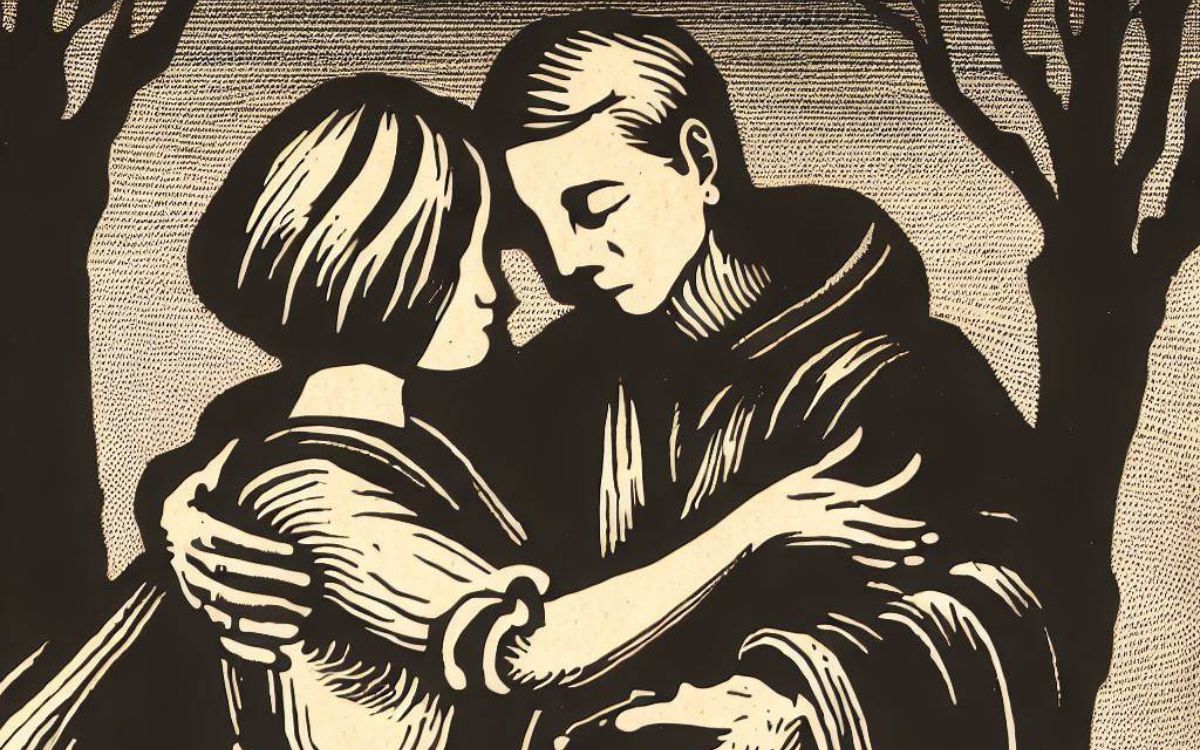
The Suffolk Miracle is one of British folk music’s strangest supernatural ballads, telling how a dead lover returns from the grave for one final ride
British folk songs are full of murdered lovers, unfortunate maidens and young men who die before their time, but The Suffolk Miracle does something rather different with the familiar ingredients.
Nobody is murdered, despite the song sometimes sitting comfortably alongside the great murder ballads.
Instead, a young man dies of grief after being separated from the woman he loves, then returns from the grave to take her home.
Considering how these old songs normally finish, that almost counts as a happy ending.
The Suffolk Miracle can be traced back at least to the late 17th century, when it appeared as a printed broadside under the wonderfully long title The Suffolk Miracle: Or, A Relation of a Young Man, Who a Month after his Death Appeared to his Sweet-heart, and Carryed her on Horseback behind him for Forty Miles in Two Hours, and was never seen after but in his Grave.
You certainly knew what you were buying.
The broadside was printed in London and the story subsequently survived in oral tradition, becoming Child Ballad No. 272 in Francis James Child’s The English and Scottish Popular Ballads.
It is also catalogued as Roud Folk Song Index No. 246, with versions collected in Britain, Ireland and North America.
The story begins with a wealthy Suffolk farmer whose daughter falls in love with a young man considered beneath her social position. Her furious father sends her away to prevent the couple meeting, leaving her lover devastated by their separation.
After some time, the young man appears unexpectedly at the house where she is staying and asks her to return home with him.
She agrees, climbs onto his horse and rides behind him through the night.
Something, however, isn’t quite right.
The young woman complains that he feels extremely cold, while her lover explains that the night itself is chilly. During the journey, her handkerchief blows away, but he refuses to stop and retrieve it.
Eventually he delivers her safely to her father’s home before disappearing.
Her father is understandably astonished when she explains who brought her back, because the young man has been dead for some time.
The family goes to his grave and opens it.
There lies the young man’s corpse, exactly where it should be, except for one rather disturbing detail. The woman’s missing handkerchief is found inside the grave with him.
It is a cracking supernatural twist and provides the physical evidence that separates the story from a dream or imagined encounter.
The dead man really did come for her.
Unlike many traditional supernatural ballads, there is no revenge and no terrible punishment waiting at the end. The ghost apparently returns because his love for the young woman remains strong enough to bring him out of his grave.
The ballad remained in oral tradition long after the original broadside disappeared from everyday life, with versions collected from traditional singers during the 19th and 20th centuries.
Peter Bellamy recorded a particularly memorable version of The Suffolk Miracle on his 1969 album Fair England’s Shore, helping introduce the old ghost story to modern folk listeners. Other traditional and revival singers have also performed it under titles including The Suffolk Miracle and The Holland Handkerchief.
The latter title gives away the song’s best piece of evidence.
The Suffolk Miracle has everything required for a good fireside ghost story: forbidden love, a lonely night journey, a mysterious horseman, an opened grave and an object brought back from beyond the grave.
Best of all, the ghost isn’t interested in frightening anybody.
He simply gets out of his grave, rides forty miles to collect his sweetheart and makes sure she gets safely home.
For a traditional British ballad, that’s practically romantic.
Tell us your thoughts about The Suffolk Miracle in the comments section below!