

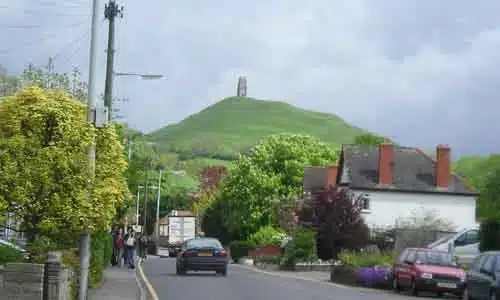
About 20 years ago, I climbed Glastonbury Tor. It was a long trek – longer than it needed to be, since I started miles away instead of parking closer. But it was worth it.
From the top, the Somerset Levels stretched out beneath me like a vast, ancient land, shrouded in mist and mystery. The wind howled around the remains of St Michael’s Tower, the only remnant of a chapel that once stood proud on this legendary hill.
At the time, I knew little of the Tor’s deeper secrets. But in the decades since, I’ve come to understand just how much history, folklore, and supernatural intrigue swirl around this sacred site.
Glastonbury is often linked to the legendary Isle of Avalon, the mystical resting place of King Arthur. In ancient times, the surrounding marshlands would flood, turning the Tor into an island. To the Celts and early Britons, this was a liminal place – a bridge between the mortal world and something far older, far stranger.
Some believe that beneath the hill lies a hidden entrance to Avalon itself, where Arthur’s body was taken after his final battle. In the 12th century, monks at Glastonbury Abbey claimed to have found the king’s grave, but was it truth or a clever ploy to attract pilgrims?
The legend persists, whispering through the winds that coil around the Tor’s peak.
Many myths suggest that Glastonbury Tor is not just a hill – it is a gateway. The ancient Britons spoke of Annwn, the Otherworld, a land of eternal youth and mystery ruled by the enigmatic Gwyn ap Nudd.
Gwyn, the king of the fairies and the lord of the Wild Hunt, is said to dwell within the Tor. On stormy nights, some claim to hear his spectral hounds—red-eared and ghostly – howling through the darkness, hunting lost souls. Those who stray too close to the hill at twilight may find themselves drawn into the fairy realm, never to return.
The ruins of St Michael’s Tower, perched at the summit, are said to be haunted. The original chapel was destroyed by an earthquake in 1275, and its replacement fell into ruin over the centuries. Some visitors report shadowy figures moving within its stone remains, while others hear strange whispers carried on the wind.
The most famous tale speaks of a lone monk who still roams the site, his spectral form glimpsed in the twilight hours. Some say he guards the secrets of the Tor; others believe he is trapped, bound to the land by an ancient curse.
Glastonbury Tor is also entwined with myths of sacred geometry. Some believe it is a powerful energy point, where ley lines – the so-called “dragon paths” of the Earth’s energy – converge. The most famous is the St Michael Ley Line, which runs from Cornwall to Norfolk, linking many ancient sites, including St Michael’s Tower itself.
There is even a legend that the Tor is shaped like a coiled serpent, representing the slumbering power of the Earth. Druids and mystics still visit, seeking to unlock its hidden energy.
Standing at the peak of Glastonbury Tor, one cannot help but feel its ancient presence. It is a place where history, myth, and the supernatural blur together. Whether as Avalon, the gateway to the Otherworld, or a beacon of mystical energy, the Tor remains one of Britain’s most enigmatic landmarks.
I should return one day – to walk its slopes again, to listen to the wind, and to see if, just maybe, the spirits of the past still linger.
Have you ever visited Glastonbury Tor? Did you feel its magic? Share your experiences in the comments below!