


The Lake District is famous for its mountains, lakes and poets.
It is rather less famous for its ghosts.
Yet hidden among the tales is one of England’s least-known ghost stories: the legend of the Claife Crier.
Unlike many famous British hauntings, this Cumbrian tale survives in only a handful of historical references, which captured my imagination.
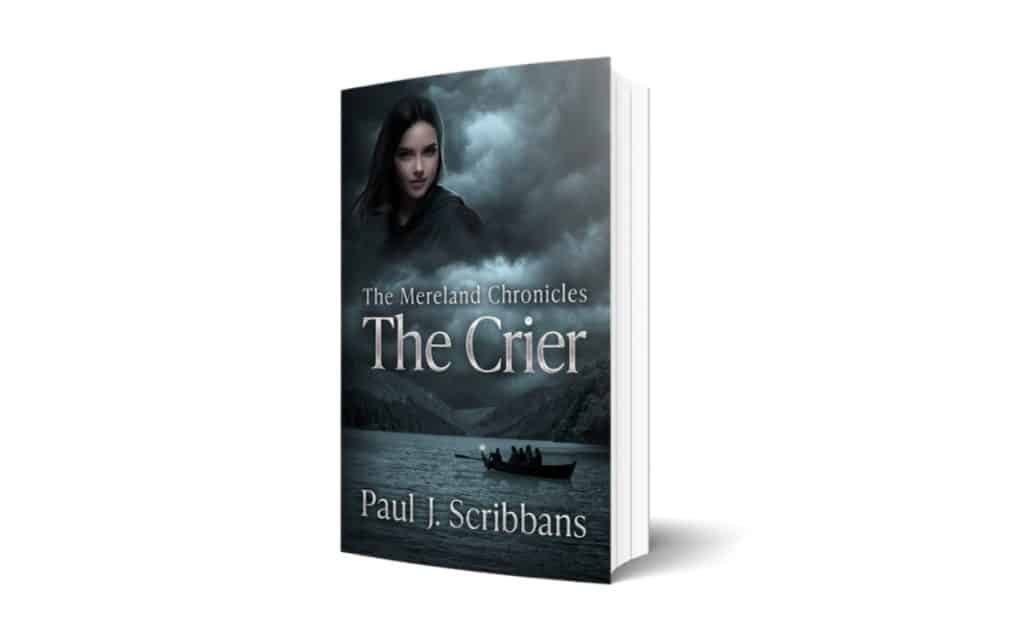
I first stumbled across the tale while conducting research for my debut novel, The Mereland Chronicles: The Crier. I discovered a brief nineteenth-century account of a heartbroken monk whose cries were said to echo across Claife Heights long after his death.
Reading this changed everything. What survived in the folklore felt like the end of a tragedy rather than the whole story. I found myself wondering what had happened before the ghost, before the cries across the water, before the legend became folklore. That was the story I wanted to tell. It became the first instalment of The Mereland Chronicles.
Two nineteenth-century references to the Claife Crier caught my eye: an 1852 article in the Kendal Mercury and an account published in The Complete Guide to the English Lakes in 1855. Together, they preserve slightly different versions of the same strange tale. Like many pieces of folklore, the story has shifted over time, with different tellers preserving different details while the heart of the legend remained recognisably the same. Without nineteenth-century writers recording these local traditions, the Claife Crier might easily have faded from memory altogether.
Both tell of a monk from Furness Abbey who fell hopelessly in love with a young woman.
She rejected him.
Broken by grief, he wandered Claife Heights calling for her until he died of torment, exposure and starvation.
Following his death, so the legend tells, the cries never stopped. Later versions of the story added another unsettling detail. Ferrymen crossing Windermere were said never to answer mysterious cries from the western shore after dark, following the supposed disappearance of one unfortunate boatman who tried to help the unseen caller.
It’s a fantastic haunting premise. But it also raised a series of questions.
Who was the monk?
Who was the mysterious woman?
Why did she reject him?
Why did her rejection drive him to a slow and miserable death?
Walking Where the Legend Lives
One of the pleasures of researching Lake District fiction is that the work rarely stays indoors. I spent countless hours in my hiking boots, exploring the places connected with the legend.
Claife Heights has an atmosphere that changes completely with the weather. On a bright summer afternoon, it feels peaceful, yet, away from the tourist areas, there’s an eerie undertone. Return during fading light and the unsettling feeling reaches another level entirely.
The woods seem to absorb sound. Paths disappear into shadow, and it isn’t difficult to imagine why stories like this took root. The more I explored those woods, the less the legend felt like something attached to the landscape and more like something that had grown out of it.
Furness Abbey, with its own spooky tales, became equally important.
Standing among the vast sandstone ruins, it’s easy to forget this was once one of medieval England’s wealthiest monasteries. I explored the ruins for hours, speaking with experts and studying monastic life, imagining the people who lived there over 500 years ago.
The Ghost on the Map
One discovery fascinated me more than any other and sparked an idea that would become a recurring thread throughout the series.
If you open Ordnance Survey Explorer Map OL7 (The English Lakes – South-Eastern Area), among the woodland on Windermere’s western shore appear the words “Crier of Claife”, marking the place where local tradition says the spirit finally came to rest.
What fascinated me was that, to the best of my knowledge, the Crier of Claife is the only known ghost or haunting ever to be named on any Ordnance Survey map. That in itself is thought-provoking, at least for me.
Naturally, I had to visit it.
Standing in the exact location shown on the map was surreal. An isolated, steep wooded hillside falls away into the remains of an abandoned slate quarry, reclaimed by nature over centuries of abandonment. The silence is difficult to describe until you’ve experienced it yourself. Standing there, it was easy to understand why generations of local people believed something haunted this place.
Those visits stayed with me long after I left and eventually inspired one of the novel’s key scenes.
History Hiding in Plain Sight
Research often led me to places that raised more questions than answers.
One example is the building now known as the Abbey Mill Café beside Furness Abbey, nestled beside Mill Beck.
Today it appears to be a modest nineteenth-century, two-storey building. Yet a local theory suggests the building was once a three-storey watermill. Whether this is true is open to speculation. However, beneath the café floor is evidence of a lower level.
Was this a watermill?
Standing there and looking at the building’s stunted appearance certainly makes you wonder. As an author with a vivid imagination, I couldn’t resist the idea, so the Abbey watermill became part of The Mereland Chronicles canon.
To see what I mean, visit the blog post I wrote on the subject.
When History Leaves Gaps
That process of asking “what if?” became central to writing the novel. Rather than inventing history, I found myself exploring the gaps where many things are fictionally possible.
One of the things I enjoy most about folklore is that it often survives only as fragments. Unlike recorded history, legends rarely explain everything. They leave spaces, and those spaces invite questions.
As I researched the Claife Crier through various sources, including websites such as Spooky Isles, I became less interested in whether every detail of the story was historically accurate and more fascinated by the possibilities those fragments suggested.
The Claife Crier lingered with me long after I’d finished reading those original Victorian accounts, eventually changing how The Mereland Chronicles began. I had already completed a substantial draft of what was intended to become the opening novel in the series. Instead of continuing, I renamed it Book Two, put it on ice, and started again, telling the story of the events that led to the haunting.
Looking at the Landscape Differently
Since researching and writing the novel, I have never looked at the western shore of Windermere in quite the same way.
One unexpected pleasure since publication has been hearing from readers who have gone on to visit Claife Heights, Furness Abbey and other locations featured in the novel. Knowing that my novel, inspired by a forgotten piece of local folklore, is encouraging people to explore these remarkable places has been immensely rewarding.
If you ever visit Windermere’s western shore, pause for a moment, because some stories are still waiting to be discovered.
And if you happen to hear a distant cry drifting through the trees…
I’ll leave you to decide whether it was simply the wind. Or whether, somewhere beyond the trees, something is still calling for the ferry.
PAUL J SCRIBBANS is a Cumbrian author whose debut novel, The Mereland Chronicles: The Crier, reimagines the events that led to the legend of the Claife Crier. Alongside writing fiction, he spends his free time trail running, hiking and photographing the landscapes that inspire his stories. His website, https://pjscribbans.co.uk, also includes short stories, articles on writing, and behind-the-scenes features on The Mereland Chronicles.