

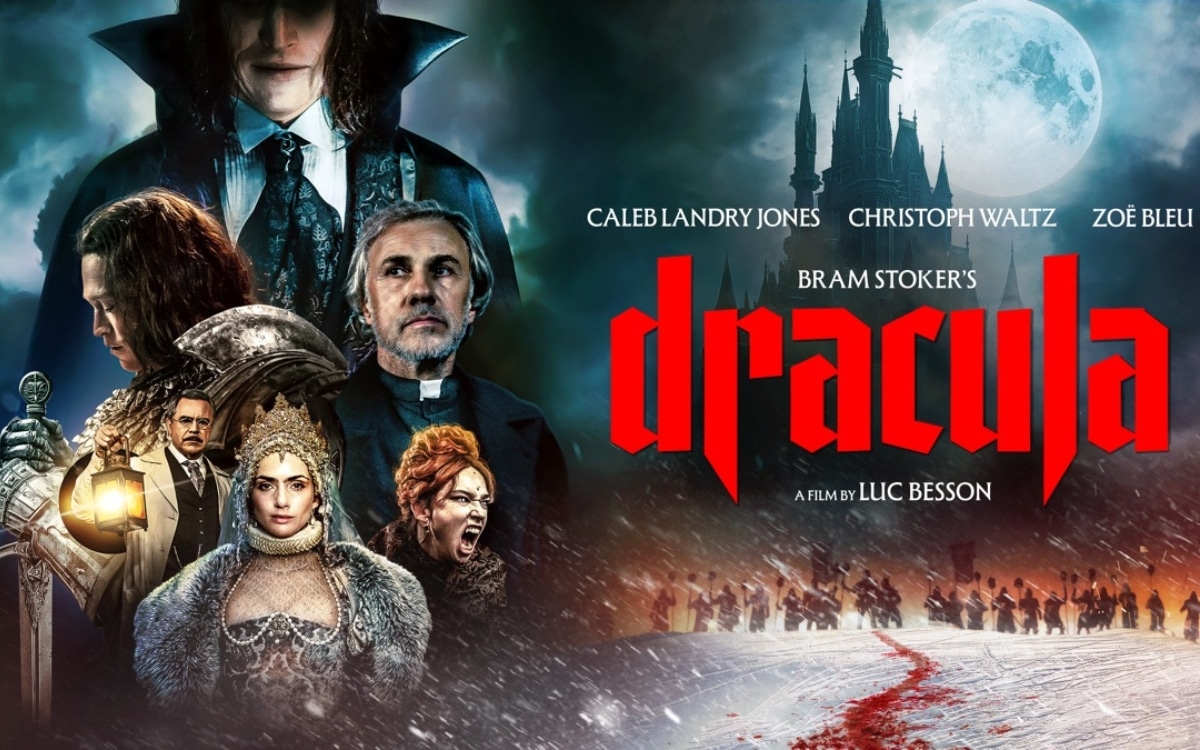

Luc Besson’s Dracula: A Love Tale abandons Bram Stoker’s novel for a romantic fantasy that amounts to a poor imitation of Francis Ford Coppola’s 1992 film, writes CHRIS NEWTON
Review of Dracula: A Love Tale 2025
Luc Besson, the director of 2025’s Dracula: A Love Tale, has admitted that he is not a fan of horror films, nor of Dracula. Unfortunately, it shows.
His recent ‘adaptation’ of Bram Stoker’s 1897 novel, starring Caleb Landry Jones as Dracula and Zoë Bleu as Elisabeta / Mina Murray, eschews the horror of the original and replaces it with fantasy romance.
Gone are the brides of Dracula, gone is the vampiric transformation and brutal staking of Lucy Westenra, gone is the very essence of the Dracula story, replaced with a story about the reincarnation of a long-lost love.
The film opens in the 14th century, with Prince Vlad of Wallachia waging holy war against the Ottoman Empire. Following the death of his wife, Elisabeta, Vlad renounces God and becomes a vampire.
If this is sounding familiar, that’s because this prologue – which does not feature in Stoker’s novel – is taken wholesale from Francis Ford Coppola’s 1992 masterpiece, Bram Stoker’s Dracula, even down to the name of Dracula’s long-lost love. (In Coppola’s film, Winona Ryder starred in dual roles as Mina and Elisabeta.)
In an interview with Deadline, Besson explained that ‘there’s a romantic side in Bram Stoker’s book that hasn’t been explored that much. It’s a love story about a man who waits for 400 years for the reincarnation of his wife. That’s the true heart of the story, waiting an eternity for the return of love’.
Except … it isn’t.
The Dracula of Bram Stoker’s novel does not wait 400 years for a reincarnation of anyone, let alone Mina Harker, whom he refers to as his ‘bountiful wine-press’.
One cannot help but conclude that Luc Besson hasn’t actually read Dracula and has confused Coppola’s film for a Victorian novel.
Yet, he persists, stating during an interview on French television that ‘the original novel [is] a big love story. So I wanted to go back to this man who loses his wife and who sadly is eternal because God stops him from dying, and he looks for his wife for 400 years’.
Again, I really can’t emphasise this enough, the novel is not a love story, and it does not feature Dracula looking for a wife. There’s nothing in the book which specifically mentions Dracula having a wife.
Even the three iconic ‘Brides of Dracula’, as they came to be known, are only ever referred to in the book as ‘weird sisters’ (and there is as much to suggest that they are Dracula’s daughters as there is that they are his wives, but I digress…).
Caleb Landry Jones’ Dracula, tired of checking to see whether or not every single woman in the world is the reincarnation of his lost love, does what any right-thinking lover would do and – let me check my notes here – concocts an enchanted perfume which makes him irresistible to women in the hope that one of them will be Elisabeta.
(Exactly how and why he is certain that she will eventually be reincarnated is unclear.)
Though the original book is not a love story, I agree with Besson that there is a ‘romantic side’ to the novel. Stoker’s Dracula is at times wistful and tragic, lamenting that his heart ‘through weary years of mourning over the dead, is not attuned to mirth.’
I’m all for a romantic Count Dracula. In fact, I prefer a romantic Dracula – from Frank Langella’s Count seducing Kate Nelligan (with lasers!) in John Badham’s 1979 adaptation which, I cannot resist mentioning, had the tagline ‘A Love Story’, to Klaus Kinski’s ‘absence of love’ being the most ‘abject pain’, to Gary Oldman crossing ‘oceans of time’.
My issue with this film isn’t so much its butchery of the source material (I’m a fan of Dracula A.D. 1972, for God’s sake!), but its blatant and shameless plagiarism.
James V. Hart, the screenwriter of Bram Stoker’s Dracula, was not the first writer to give Dracula a reincarnated bride. The trope actually goes back to the 1972 Blaxploitation movie Blacula, in which Prince Mamuwalde’s murdered wife, Luva, is reincarnated in the 20th century as Tina (both played by Vonetta McGee).
The concept was used again in Love at First Bite (1979), with Mina Harker as the reincarnation of Dracula’s true love, and crops up again and again, from Fright Night (1985) to ‘Bram Stoker’s Dracula’.
Yet, every part of this 2025 re-hash feels like an AI recreation of Coppola’s film, from the 15th-century battles in the prologue, to Jonathan Harker (Ewens Abid) visiting an ‘old age’ Dracula who looks like Caleb Landry Jones in fancy dress as Gary Oldman, down to the long white wig.
Bram Stoker’s novel is in the public domain, James V. Hart’s screenplay is not, and the wholesale theft of Elisabeta leaves a bad odour that not even the scent of Dracula’s magic perfume can mask.
