
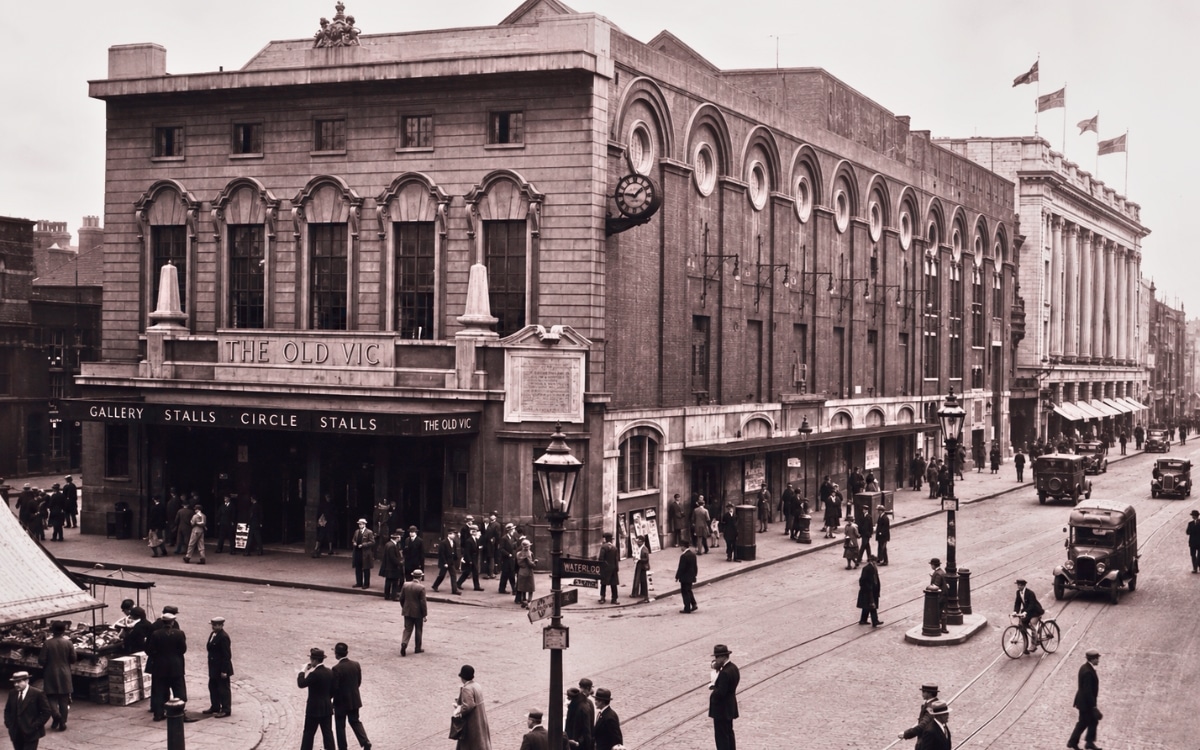
The Old Vic in London’s Waterloo first opened in May 1818. It was originally named the Royal Coburg Theatre, after its patrons, Prince Leopold of Saxe-Coburg and Princess Charlotte. The notion of a major theatre on the south side of the Thames had only become viable due to the newly constructed Waterloo Bridge.
Shortly after opening, a legendary “looking-glass curtain” was installed, made from layers of mirrors that reflected the audience back at themselves. It was a short-lived attraction which had to be dismantled for fear that its immense weight would collapse the ceiling.
Gothic Melodramas and Frankenstein
The Royal Coburg gained early fame for its staging of gothic melodramas. Trial by Battle; or, Heaven Defend the Right, written by William Barrymore, the Coburg’s first theatrical manager, was performed on its opening night and featured a dark castle and an evil baron.
On the other side of Waterloo Bridge, the theatre now known as the Lyceum staged Presumption; or, the Fate of Frankenstein in June 1823, the first theatrical production of Mary Shelley’s novel. The Royal Coburg was quick to follow with Frankenstein; or, The Demon of Switzerland a couple of months later.
Written by H. M. Milner, the plot leaned into the theatre’s predominantly working-class audience by making the monster less of a tragic science experiment and more like a diabolical entity haunting the bleak crags of the Swiss Alps.
Milner revised his play three years later as Frankenstein; or, The Man and the Monster. Again staged at the Royal Coburg, this version was responsible for establishing a number of key tropes that would prevail a century later when Frankenstein hit the big screen.
He was responsible for creating the laboratory scene, with the chemical apparatus, and the dramatic animating spark of life. Detailed stage directions were set down for O. Smith, the actor who played the monster, setting a performance template for Karloff and others whose interpretations followed in the 20th century.
Another Coburg favourite of the period was Three Vampires; or, The Invisible Spectre. Also known as The Three Vampires; or, Maids Beware of Moonshine, it was an unauthorised English adaptation of a hit French parody called Les Trois Vampires. With a script written by one of the Coburg’s house writers, it was credited in the pay bill as “written under the Lunar influence, but not by a Lunatic.” It caused such a sensation at the time that one review described it as “melodramatic, terrific, monstrous, and Frankensteinish.”
The Coburg also beat its rivals at the Lyceum and the Theatre Royal by being the first to stage an adaptation of the German gothic sensation Der Freischütz. The Fatal Marksman; or, The Demon of the Black Forest featured phantasmagoria-style lanterns projecting images of ghosts onto swirling smoke, and trap doors bursting open accompanied by chemical flash powders heralding the entrance of the demon.
Meanwhile, The Phantom Lover; or, The Innkeeper’s Daughter featured a wrongfully accused hero, a corrupt villain, and a restless phantom returning from the grave to point a ghostly finger at the true murderer.
Ghosts of the Old Vic
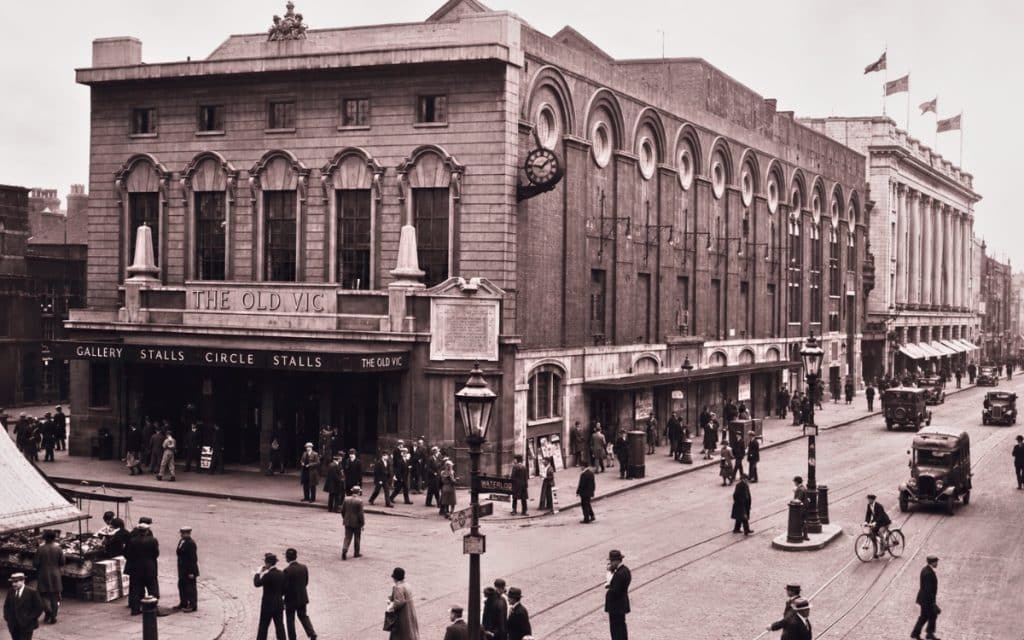
The Coburg became the Royal Victoria in 1833, shortly before Victoria ascended to the throne. As the century moved on, the theatre began to be the subject of its own ghost legends. The most famous of these was the spectre of the lady with blood dripping from her hands, said to be an actress who died before she was due to play Lady Macbeth, and whose hands were covered in theatrical blood.
In the late Victorian and early Edwardian eras, reformer Emma Cons and her niece Lillian Baylis had taken over the running of what was by then more commonly known as the Old Vic. Baylis Road, which runs from the Old Vic towards Lambeth North, is named after Lillian Baylis.
She left her mark in more ways than one. Staff have reported catching glimpses of her roaming the upper circles of the theatre or sitting in her old private box. There have also been late-night reports of the spectral sound of her playing the violin from the darkness.
The Spanish flu pandemic of 1918 produced two other ghostly legends. One was of an actor who died of the flu before he was due to appear in a play, followed by the audience reporting a mysterious shadowy figure taking the stage with the rest of the cast.
The second instance concerns an adaptation of Shakespeare’s A Winter’s Tale, in which the cast member playing the role of Hermione was soldiering on despite being seriously ill with the flu. During the performance, multiple cast members and backstage crew saw two identical figures in the wings dressed as Hermione. One was the actress, ill and shivering in the dark, and the other was an eerie double standing right next to her.
This gave rise to the theatrical superstition of the “Old Vic Double”, the notion that an actor’s spiritual doppelgänger will step in to help them finish a performance during a crisis.
The Old Vic underwent renovations in the 1980s, during which the original stage door was walled up. Following this, there were several sightings of a phantom ballerina running along the corridor and vanishing into the solid brick wall where the door used to be.
Horror Returns to the Stage
In recent years, the theatre has embraced its horror-inspired roots. In 2016 it staged Jekyll and Hyde, an entirely silent dance thriller devised and choreographed by Olivier Award winner Drew McOnie. Inspired by Robert Louis Stevenson’s The Strange Case of Dr Jekyll and Mr Hyde, it featured two different dancers taking the roles of Dr Jekyll and his monstrous alter ego, Mr Hyde.
A year later, an acclaimed production of Jack Thorne’s adaptation of Dickens’ A Christmas Carol received rave reviews. Since then, the ghost of Jacob Marley has rattled his chains annually on the Old Vic stage in what has become the theatre’s Christmas tradition.
Actors who have taken on the role of the haunted Ebenezer Scrooge include Rhys Ifans, Christopher Eccleston, and John Simm. When the theatre was closed during lockdown in 2020, The Walking Dead star Andrew Lincoln took on the role in a livestream version.
This year’s Scrooge will be Paul Hilton, star of the 2021 body horror film Earwig.