

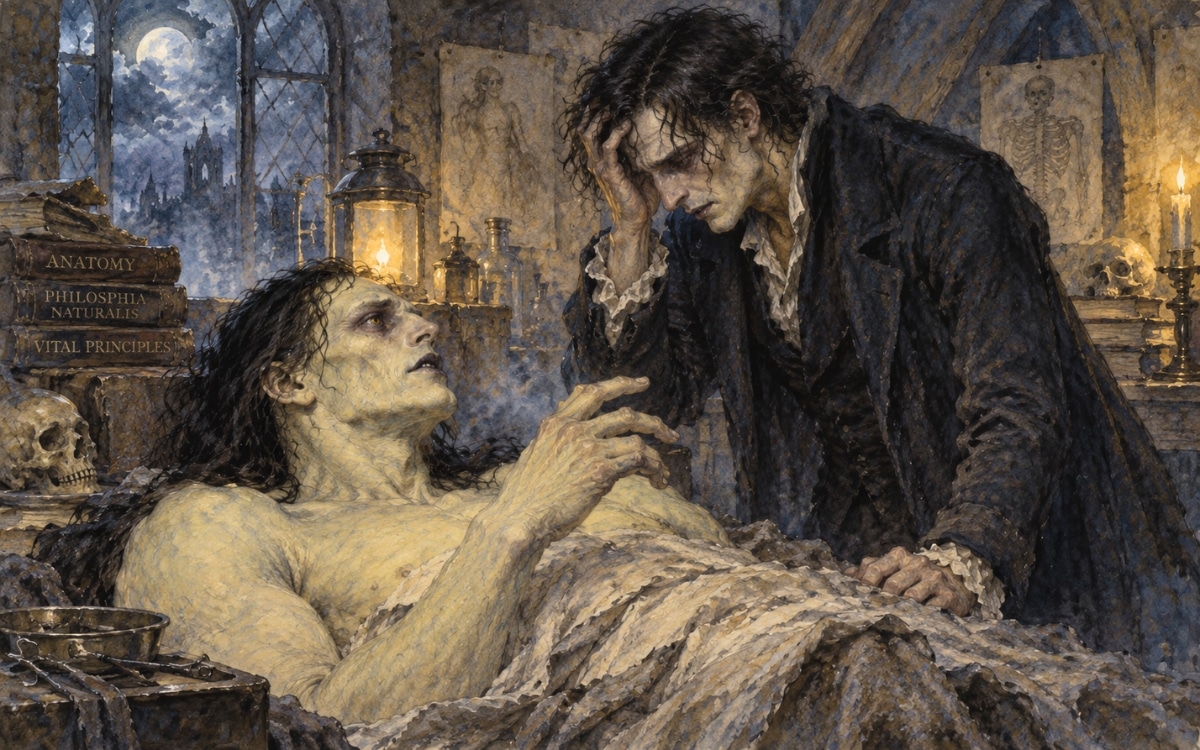
In Guillermo del Toro’s Frankenstein 2025, the Creature makes a terrible discovery about himself.
“I found what I am. What I’m made from. I am the child of a charnel house. A wreckage, assembled from refuse and discarded dead. A monster.”
There is great sadness in those words.
Can a monster cherish something as fragile as humanity? Here the Creature tells the story of his birth not as a weapon, but almost as a plea.
Humanity is the very thing he longs for.
The story comes from a tongue itself brought back from decay and death. With terrible conviction, the Creature understands what he was made from and the horror of the process that created him.
Yet there is sadness, regret and longing within that admission. That is what gives it such power.
Victor Frankenstein’s broken heart
Alchemy, science, decay and the mysterious “spark of being” all lead Victor towards his goal. But death provides the path.
In del Toro’s interpretation, the death of Victor’s mother becomes central to his obsession with conquering mortality. A broken heart changes him and turns grief into something darker.
Pain can drive us towards extraordinary things. It can also cause us to lose ourselves completely.
Victor becomes so obsessed with defeating death that he fails to recognise what his obsession is doing to him.
In that sense, the Creature almost exists inside Victor before it ever receives a physical body. It grows from grief, ambition and rage against death.
When Victor finally succeeds, a new soul is born from that broken heart. The sight of it is more than he can bear.
Victor rejects his creation almost immediately.
What can a creator give his creation when he has already surrendered so much of his own humanity?
Victor gives the Creature life, but little else. His first gift is abandonment.
The horrors of Victor’s secret work
Mary Shelley surrounds the creation of the Creature with some of the darkest imagery in Frankenstein.
Victor recalls: “Who shall conceive the horrors of my secret toil, as I dabbled among the unhallowed damps of the grave…”
That single image tells us much about what Victor has become.
He gathers bones from charnel houses and disturbs the secrets of the human body. The dissecting room and slaughterhouse provide materials for his terrible work.
These are places of discarded death.
Charnel houses held human remains when burial space was exhausted. Dissecting rooms dealt with bodies reduced to anatomical material.
The slaughterhouse represents another place in which living flesh becomes dead matter.
Victor takes material associated with all these places and attempts to reverse its natural course. Life has become something that can be dismantled, examined and reconstructed.
You can read the relevant passages in the 1818 edition of Frankenstein at Project Gutenberg.
Is Victor Frankenstein practising necromancy?
To call Victor literally a necromancer would go further than Mary Shelley does. Yet in Gothic terms, his work certainly begins to resemble necromancy.
He enters the world of graves and dead bodies. He takes lifeless material and discovers a way to animate it.
Through force of will, study and obsession, he attempts to manipulate the boundary between life and death itself.
The scientist begins to resemble something much darker.
Victor wants to control one of the great mysteries of existence. Instead, he becomes its servant.
Once the Creature opens its eye and draws breath, Victor Frankenstein’s fate is sealed.
The spark of being
Popular culture has given us lightning, electrical machinery and bolts in the Creature’s neck. Mary Shelley gives us something much more mysterious.
Victor gathers his “instruments of life” around him and prepares to infuse a “spark of being” into the lifeless thing at his feet.
Exactly how that spark works is never properly explained. That mystery is essential.
Somewhere between flesh and the grave lies Victor’s secret.
Mary Shelley allows it to remain there. Perhaps that knowledge is simply waiting in silence to be discovered again, ready to fill another dark night with horrors that refuse to leave the imagination.
Why the mystery matters
Mystery is one of the most powerful things we possess.
There are places human beings seem compelled to explore even when something inside us warns that we should stay away.
Our curiosity tells us to seek, strive, find and discover. Our imagination demands to know what might be waiting beyond the boundary.
Yet if every mystery were explained, something important would disappear.
That struggle between wanting to know and fearing what we might discover is part of the power of storytelling. It is also part of the enduring power of Frankenstein.
More than 200 years later, readers are still trying to understand exactly what crossed that boundary on the dreary November night when the Creature opened its yellow eye.
For more on the novel itself, see Mary Shelley’s Frankenstein: 19 Things You Didn’t Know.
I hope we never receive a complete answer.
Mary Shelley remains one of my favourite figures in Gothic literature, and I will always cherish the mystery at the soul of Frankenstein.